Tesla Has $45 Billion in Cash. Why Did It Line Up $30 Billion of Bank Credit?
Tesla replaced a $5 billion credit line with $30 billion of undrawn bank commitments while capital spending more than doubled. The term loan’s shrinking availability shows when that money is designed to be used.
 Wealth / The Compound journal
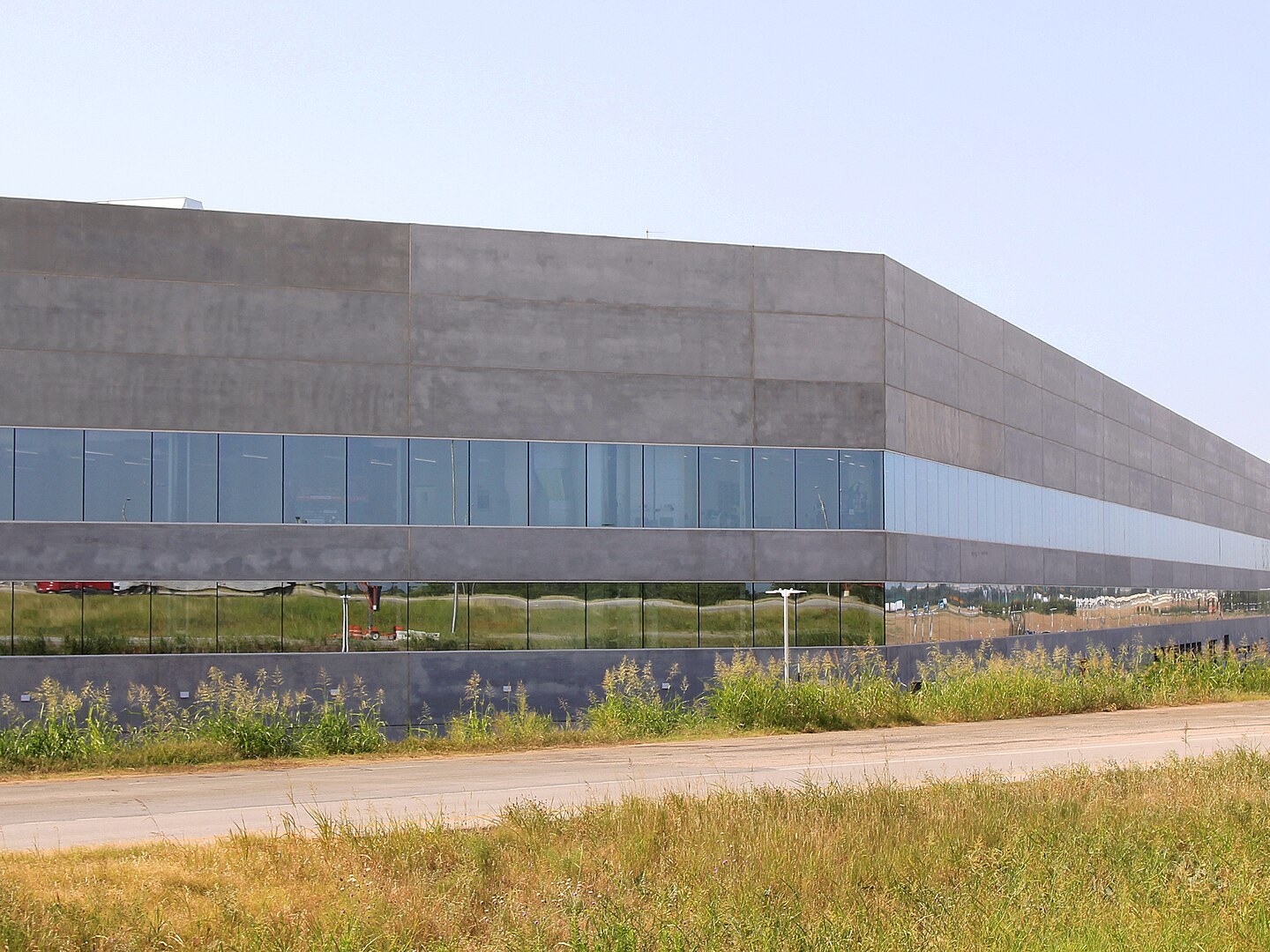
Photo: Larry D. Moore via Wikimedia Commons, CC BY 4.0. Archival photograph taken on 17 June 2022; resized and cropped. · Illustrative image.
Tesla ended September with $45.4 billion of cash, cash equivalents and short-term investments, and almost no debt with a claim on the company as a whole. Yet on 29 September it signed three bank agreements giving it access to another $30 billion. A company that does not expect to need money rarely pays to keep that much on standby.
The facilities have not been used. Tesla said it did not plan to draw on them in 2026. But the way the largest one is built tells investors something useful about timing: it is designed to be drawn within 18 months or lost.
What Tesla signed
According to Tesla’s 8-K filed on 29 September and Note 8 of its third-quarter Form 10-Q, the package has three parts.
| Facility | Commitment | Matures | Key terms |
|---|---|---|---|
| Delayed-draw term loan | $20.0bn | September 2029 | Up to ten draws; repaid amounts cannot be reborrowed |
| Five-year revolving facility | $8.0bn | September 2031 | US dollars, euros or sterling; two optional one-year extensions |
| 364-day revolving facility | $2.0bn | September 2027 | One-year term-out option |
| Total | $30.0bn | Unsecured; at least $5bn of liquidity must be maintained |
The two revolving lines replaced a $5 billion revolving facility from January 2023, which had never been drawn. Tesla can ask to increase the revolving lines by up to $4 billion more. Interest on any borrowing would float over SOFR (or SONIA or EURIBOR for sterling and euro loans), with a margin set by Tesla’s credit rating.
The term loan shrinks on a timetable
The $20 billion term loan carries a built-in deadline. Undrawn commitments automatically fall to $10 billion twelve months after closing, to $5 billion at fifteen months and to zero at eighteen months. With closing on 29 September 2026, Compound’s reading of those dates is:
- until late September 2027: up to $20 billion available;
- from late September 2027: no more than $10 billion undrawn;
- from late December 2027: no more than $5 billion;
- from late March 2028: nothing left to draw.
Combined with Tesla’s statement that it does not plan to draw in 2026, the practical window for most of that money is 2027. That is an inference from the contract terms, not a stated plan. Tesla may never use the loan at all, and keeping it unused costs relatively little: the 10-Q gives current undrawn fees of 0.10% a year on the term loan and five-year line, and 0.08% on the 364-day line. On full commitments, Compound calculates roughly $30 million a year, a small sum next to Tesla’s cash pile.
Spending has more than doubled
The reason to arrange the money is in the cash flow statement. Capital expenditure was $13.01 billion in the nine months to 30 September 2026, against $6.13 billion a year earlier, an increase of about 112%.
| Nine months to 30 September, US$bn | 2026 | 2025 |
|---|---|---|
| Net cash from operating activities | 14.90 | 10.93 |
| Capital expenditure | (13.01) | (6.13) |
| Purchase of SpaceX shares | (2.00) | — |
| Operating cash less capex and SpaceX stake (Compound calculation) | (0.12) | 4.80 |
Operating cash flow still covered capital spending. Once the $2.00 billion investment in SpaceX shares is included, the nine-month total was slightly negative. Quarterly free cash flow is covered in our third-quarter earnings analysis; the point here is the funding gap, not the quarter.
Two details in the 10-Q suggest the operating figure flatters the underlying position. Rising accounts payable, accrued and other liabilities added $7.33 billion to operating cash flow over nine months. And $3.67 billion of property and equipment purchases had been recorded in liabilities rather than paid, compared with $1.63 billion a year earlier. Bills that are owed but not yet paid will eventually need cash.
The outlook wording changed
Tesla’s second-quarter 10-Q said it expected 2026 capital expenditure “in excess of $25 billion”. The third-quarter filing says “in excess of $20 billion”. Both are floors, not forecasts of a precise total, so the change does not prove spending is being cut. It does lower the stated minimum.
Even the lower floor implies a busy final quarter. Compound calculates that reaching $20 billion requires at least $6.99 billion of capex in the fourth quarter, compared with $4.73 billion in the third quarter. Tesla attributes the spending to what it now calls “SI” initiatives, including compute infrastructure and data centres, production lines and a fleet of company-operated vehicles. Its 10-Q also says heightened spending “will necessitate additional funding beyond our operating cash flow” and cites the credit agreements as the example.
Balance sheet strength, read carefully
None of this suggests a liquidity problem. Tesla’s total debt principal was $9.28 billion at 30 September, and almost all of it was non-recourse: $5.97 billion under a China working-capital facility and $3.32 billion of asset-backed notes, which lenders can only recover from specific assets. Recourse debt was about $2 million. Cash and short-term investments less total debt principal comes to about $36.2 billion on Compound’s arithmetic, before finance leases.
The question for shareholders is different. Tesla has signalled that its investment programme may outrun its own cash generation, and it has arranged most of the extra funding on a timetable centred on 2027. If the term loan is drawn, interest costs will begin to appear in results, and the returns on that spending, from autonomy and robotics to the Texas polysilicon plant, will be measured against borrowed money rather than surplus cash.
What to watch
The fourth-quarter 10-K should show whether capex cleared $20 billion, whether any facility was drawn, and whether payables and accrued capex begin to unwind. A draw in 2027 would not be alarming in itself. What matters is whether operating cash flow grows fast enough to carry the spending without it.
See the Tesla stock profile for the wider investment case, our autonomy analysis for what the spending is meant to buy, and our piece on a possible Tesla and SpaceX combination for the related-party questions behind the SpaceX stake.
Analysis by Compound Research, checked 26 November 2026. Figures are from Tesla’s SEC filings and are unaudited interim results; calculations are Compound’s own. Facility dates are derived from the contractual step-down schedule and are approximate. Not personalised investment advice.
Archival photograph: Larry D. Moore, 17 June 2022, via Wikimedia Commons, CC BY 4.0. Resized and cropped; not a photograph of current activity.