Will Tesla and SpaceX Merge in 2027? The Financial Case, Risks and Shareholder Impact
Could Tesla and SpaceX merge in 2027? An evidence-first analysis with SEC-sourced revenue, profit and segment charts, governance risks and a hypothetical shareholder ownership model.
 Wealth / The Compound journal
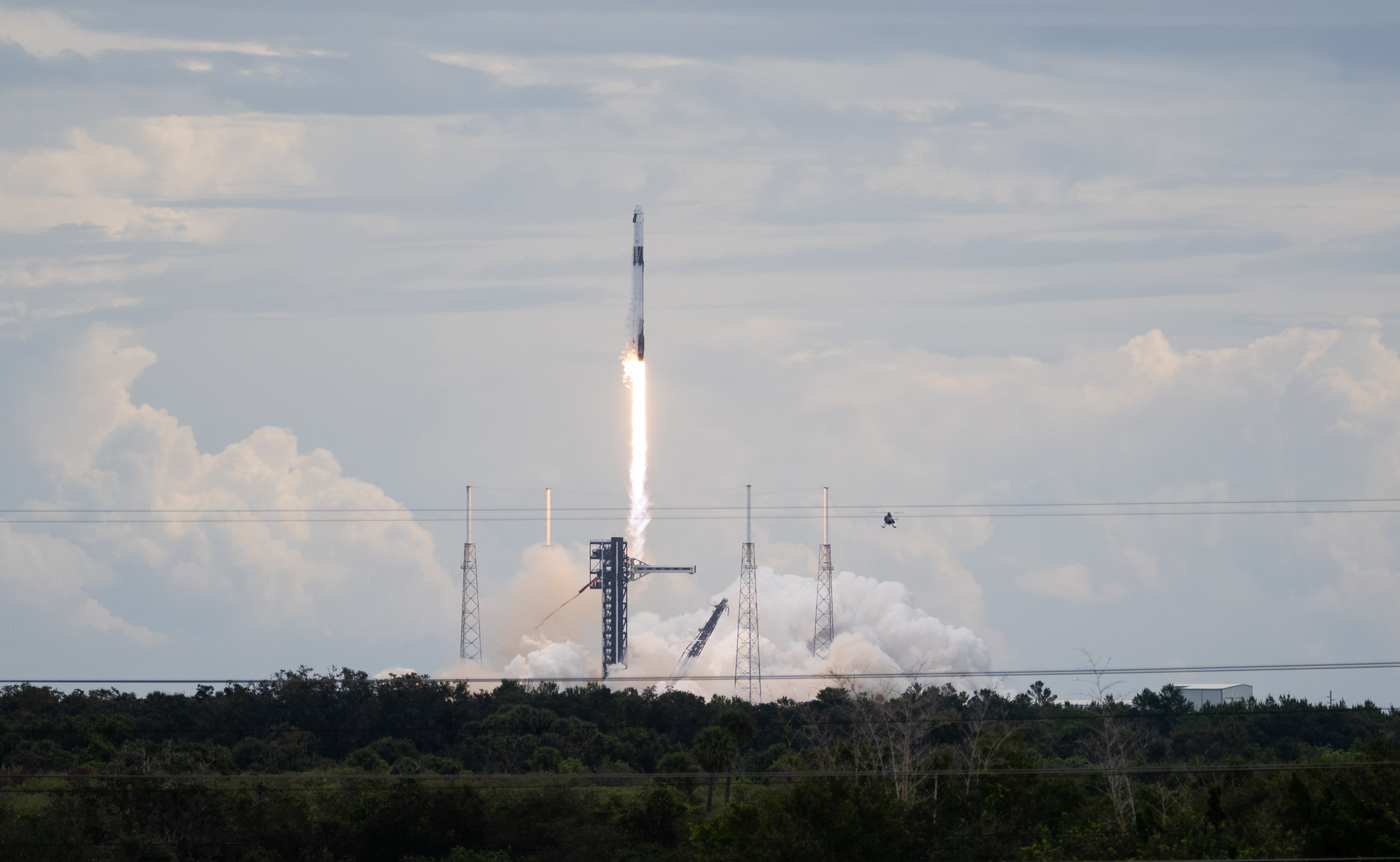
Photo: NASA / Joel Kowsky (public domain) · Illustrative image.
COMPOUND / STOCKS RESEARCH / 10 OCTOBER 2026
Two companies. One founder. A 2027 question.
What the filings establish, what the numbers reveal and what shareholders would need to know before any combination.
Could Elon Musk merge Tesla and SpaceX in 2027? The short answer is that it is conceivable, but there is no confirmed merger agreement, exchange ratio or timetable in the public statements and filings reviewed for this analysis as of 10 October 2026. A Tesla executive has discussed the growing commercial overlap between the companies. That is not an announcement of a deal.
This question has changed since SpaceX’s June 2026 flotation: SpaceX shares now trade as SPCX, rather than being an inaccessible private holding. Both businesses have distinct public shareholders, filings and valuations. Any proposed combination would therefore raise serious questions about fair value, board independence, conflicts of interest and shareholder ownership, not simply whether the companies share technology.
Read alongside our permanent Tesla stock research hub and SpaceX stock research hub.
The evidence-led conclusion
Operating collaboration is already real. A full corporate merger remains hypothetical. The 2027 question is not whether Musk can imagine one company, but whether independent boards can demonstrate that combining them delivers more value than commercial contracts, joint projects and minority investments.
Is a Tesla–SpaceX merger actually being discussed?
During Tesla’s 22 July 2026 earnings call, Musk pointed to increasing overlap, particularly the Terafab semiconductor project. He declined to discuss a corporate combination in the format of an earnings call and said any such matter would require the appropriate process. Tesla general counsel Brandon Ehrhart emphasised the existing investment and collaboration agreements. Neither statement is a merger announcement. Read the exchange.
That caution matters. Three things are easily confused in merger headlines:
- A commercial relationship: Tesla sells products or shares capabilities with SpaceX. This already exists.
- A financial investment or joint venture: one company takes a stake or participates in a shared project. This already exists in limited forms.
- A corporate merger: shareholders receive a legally defined economic interest in a combined business, subject to governance, valuation and regulatory conditions. This has not been announced.
SpaceX’s prospectus describes Terafab as a general framework, with actual projects subject to further negotiation and approval. The prospectus expressly cautions that specific projects, costs and timelines were not yet determined. Recent October commentary about who operates the facility does not change that into a binding merger arrangement.
Chart 1 — Revenue: Tesla is much larger; SpaceX is growing faster
SEC FILINGS / FULL YEAR / USD BILLIONS
Two very different growth trajectories
Same year, same dollar units, but not comparable operating models. Bar lengths use a $100bn scale.
Source: Tesla FY2025 10-K; SpaceX IPO prospectus. Rounded to the nearest $0.01bn. 2025 revenue growth: Tesla −2.93%; SpaceX +33.24%.
Accessible chart data
| Company | FY2024 ($bn) | FY2025 ($bn) | Growth |
|---|---|---|---|
| Tesla | 97.690 | 94.827 | −2.9% |
| SpaceX | 14.015 | 18.674 | +33.2% |
In 2025, Tesla generated roughly 5.1 times SpaceX’s revenue. Yet the direction of travel was different: Tesla’s total sales contracted slightly, while SpaceX’s consolidated revenue rose approximately one-third. SpaceX is also expanding beyond launches and satellites into AI products and infrastructure. Those changes complicate direct comparisons with an automaker and energy-storage business.
A simple sum of the 2025 filings gives $113.50 billion in sales. That is useful only as a scale illustration. It is not a credible forecast for combined-company sales: related-party transactions, consolidation eliminations, future growth, accounting policies and potential disposals would all matter.
Chart 2 — What would the combined business actually contain?
FY2025 REVENUE MIX / SHARE OF EACH COMPANY
Different businesses, different exposures
Each band totals 100% of that company's revenue. The bands are proportions, not equal absolute dollar amounts.
Tesla
Automotive remains the majority; energy is expanding.
SpaceX
Starlink-linked connectivity dominates the revenue mix.
Sources: 2025 company filings. Tesla reports automotive, energy generation and storage, and services and other revenue categories. SpaceX reports Space, Connectivity and AI. Sector names and accounting are not perfectly interchangeable.
The strategic attraction: a combination could give investors exposure to a single group spanning autos, energy storage, satellites, communications, space launch and AI. Shared AI chips, power systems, software, manufacturing and capital allocation might produce savings or growth.
The counterargument: those are radically different cash-flow profiles, capital needs, regulatory exposures and valuation methods. Forcing them into one company could increase complexity rather than reduce it. In particular, investors who chose Tesla because of electric vehicles would suddenly own direct exposure to launch programmes and large-scale AI infrastructure investment, whether they wanted that or not.
Chart 3 — Revenue is not earnings
GAAP OPERATING RESULT / FY2025 / USD
$4.36bn profit versus $2.59bn loss
Operating income, not adjusted EBITDA and not stock-market valuation.
For visual scale only, each bar length is the absolute result relative to $5bn; the colour and sign distinguish profit from loss. Source: Tesla 2025 10-K ($4.355bn income from operations); SpaceX 2025 filing ($2.589bn loss from operations). These are consolidated operating results, before any hypothetical transaction adjustments.
The contrast is not that one business is necessarily ‘good’ and the other ‘bad’. SpaceX spent heavily on areas including research, satellite infrastructure and AI. Investment today may create value later, but a merger could shift the combined group’s near-term earnings, cash needs and investor risk. Tesla’s own operating margin and capital needs must also be considered.
Chart 4 — SpaceX’s latest reported quarter shows why markets are paying attention
SPACEX Q2 REVENUE / USD BILLIONS
From $4.07bn to $7.81bn
Second quarter to second quarter; revenue rose approximately 92%.
Source: SpaceX Q2 2026 10-Q, revenue $4.071bn for Q2 2025 and $7.814bn for Q2 2026. Bar scale $8bn. SpaceX reported a Q2 2026 net loss of approximately $541m despite the revenue rise. Growth is not proof of a merger or of a sustainable margin.
The latest quarter demonstrates a growing SpaceX revenue base, especially in Connectivity and AI. It does not establish how investors should value the business. A shareholder deciding whether a merger is fair would need forward cash-flow assumptions, capital expenditures, debt, voting rights and a separately assessed exchange ratio—not a chart of sales alone.
The deal that already exists: Tesla and SpaceX are doing business
The strongest argument that a merger is at least conceivable is not a rumour. It is the transactions in Tesla’s own SEC filings.
Tesla’s Q2 2026 Form 10-Q disclosed a $2.0bn investment in SpaceX common stock in March 2026, representing an interest of less than 1%. The same filing disclosed Tesla revenue from SpaceX Megapack sales of $87m in Q1 and $318m in Q2—a $405m first-half total. These are reported related-party sales, not consolidated profits.
TESLA REPORTED RELATED-PARTY SALES / 2026
Commercial collaboration is measurable
Tesla revenue recognised on Megapack sales to SpaceX; $405m total for the first half of 2026.
Source: Tesla Q2 2026 10-Q, Note 13. Scale uses Q2 as 100%. Related-party revenue recognised by Tesla is not equivalent to SpaceX profit or proof of a merger plan.
These relationships could deepen without a merger. Tesla and SpaceX may agree further contracts, share infrastructure costs or operate a joint project. The fact that a product is purchased from an affiliated business is not, on its own, evidence that shareholders benefit from a complete corporate combination.
Why 2027—and what would have to happen?
The year 2027 is an analytical time horizon, not a confirmed target date.
For a deal to emerge, at least four separate hurdles would have to be cleared:
Independent directors, conflicts review, potential special committees, and documented alternatives to a merger.
Standalone valuations, whether consideration is stock or cash, the precise exchange ratio and any premium.
Voting arrangements, dilution, capital structure and treatment of different SpaceX share classes.
Applicable securities, competition, export-control and national-security reviews, depending on the actual transaction.
Large overlapping requirements in chips, data centres, vehicles, batteries, satellites and launch systems.
A signed agreement, regulatory filings and an explicit board-backed explanation of expected shareholder value.
Could Terafab be the catalyst?
Terafab creates a shared operational motivation: both groups want access to specialised AI computing. Yet a joint facility does not require common corporate ownership. SpaceX’s own prospectus stated that specific future projects under the framework would require separate negotiations and approval. In October, Musk clarified the intended operating roles of Tesla and SpaceX in the project; that is relevant to collaboration, not a formal combination.
Would regulators permit a deal?
The outcome would depend on the actual legal entities, transaction structure, market shares, contracts and national-security considerations. A combination involving launch services, defence and government contracts, telecom infrastructure, automotive systems and AI could face materially different questions from an ordinary industrial merger. No specific regulatory conclusion can be drawn in the absence of a transaction filing.
Interactive model — what would Tesla shareholders own?
A merger headline can sound like ‘Tesla buys SpaceX’ while concealing the single most important number for shareholders: how much of the combined company must be issued to the other side.
Below is an educational all-share exchange model, not a forecast and not a representation of either company’s market capitalisation. It assumes each group receives new combined-company equity in direct proportion to a hypothetical negotiated equity value. It ignores debt, cash, dual-class voting rights, fees, premiums, pre-existing cross-ownership and post-transaction synergies. Actual terms could be radically different.
INTERACTIVE / PURELY HYPOTHETICAL / USD EQUITY VALUE
Who gets what in a notional all-stock merger?
Change the assumed values and watch how the *economic ownership split* changes. This is not a share-price target, merger probability or recommendation.
Formula: Tesla holders' proportional economic ownership = negotiated Tesla equity value ÷ (Tesla value + SpaceX value). SpaceX holders receive the remainder. The model is deliberately stripped back to isolate the exchange-ratio effect.
Example: if the businesses were valued equally for an entirely share-funded merger, each set of shareholders would mathematically own 50% of the combined equity before any adjustments. If the negotiated SpaceX equity value were twice Tesla’s, existing Tesla shareholders would retain only one-third. That is not necessarily a loss: shareholders receive a stake in both sets of businesses. Whether the exchange is attractive depends on whether the values used are fair.
Tesla’s previously disclosed minority investment in SpaceX also matters. A real model must account for the existing cross-holding and remove double counting, something this deliberately simple demonstration does not attempt.
Three practical outcomes for 2027
| Outcome | What it would mean | What would actually confirm it |
|---|---|---|
| No merger | Tesla and SpaceX remain separate but continue commercial cooperation. | Continued normal filings and no signed transaction. |
| Deeper partnership | Terafab, Megapack, satellite connectivity or AI projects expand through contracts or joint ventures. | Disclosed agreements, spending commitments and related-party transaction notes. |
| Formal combination | Boards seek to combine economic ownership and legal structures. | Signed merger terms, transaction disclosures, approvals and any necessary shareholder vote. |
This is a scenario framework, not a probability table. Assigning numerical odds without reliable evidence would create false precision.
What are the biggest risks to TSLA and SPCX investors?
Valuation transfer. If one company is overvalued relative to the exchange ratio, shareholders of the other company could effectively subsidise it. Independent valuation work is essential.
Related-party governance. Both groups are strongly associated with Musk. Independent boards would need to identify and manage overlapping fiduciary duties, insider interests and voting influence.
Debt and financing. A combined entity could inherit obligations and capital commitments that investors did not originally choose. Cash flow matters more than headline combined revenue.
Execution risk. Terafab, AI compute infrastructure, Starship, robotaxis and humanoid robots are capital-intensive projects. A combined structure would not eliminate their technical or commercial uncertainty.
Regulatory concentration. SpaceX has substantial government, space and communications exposure. Tesla has vehicle-safety, consumer, energy and autonomy exposure. A merger could aggregate risk rather than diversify it away.
Different shareholder preferences. Some investors seek Tesla’s vehicles and energy-storage cash flows; others may seek Starlink connectivity, space technology or AI exposure. A merger removes the choice to hold one without the other.
What should investors watch between now and 2027?
Look for formal documents, not social-media excitement. The most decision-useful signals would be new related-party notes in Tesla’s quarterly filings, disclosures in SpaceX SEC filings, agreements covering Terafab financing and ownership, and any publicly filed transaction or board decision.
The next regular earnings updates may add clarity to cash generation, investment spending and commercial exposure even if no merger is contemplated. Monitoring those data points is more useful than interpreting every shared project as a sign of an imminent deal.
Frequently asked questions
Will Tesla and SpaceX merge in 2027?
There is no publicly confirmed agreement or schedule establishing a merger in 2027 as of 10 October 2026. The companies have acknowledged closer collaboration, but a merger would require a separate formal process.
Has SpaceX already gone public?
Yes. SpaceX began trading under SPCX in June 2026. Its official investor-relations release confirms trading began on 12 June 2026. See the SpaceX stock profile.
Does Tesla own SpaceX?
Not outright. Tesla disclosed a $2.0bn SpaceX equity investment representing less than 1% ownership in March 2026. Elon Musk’s individual interests and the corporate investment are not the same thing.
Would a merger automatically raise Tesla stock?
No. Shareholder outcomes depend on valuations, consideration, dilution, expected synergies, liabilities and the market’s assessment of the combined business. The all-share model above illustrates ownership mathematics, not an expected return.
Could they collaborate without merging?
Yes. The disclosed Terafab framework, Megapack sales and existing equity investment already demonstrate that extensive cooperation is possible with separate companies.
Is the merger likely?
Public information does not support a defensible numerical probability. The financial and industrial rationale is worth studying, but possibility is not confirmation.
The Compound verdict
A Tesla–SpaceX merger in 2027 is a legitimate question, but not an announced event. The companies have an increasingly measurable relationship and different economics. The decisive investor question is not whether a merger sounds ambitious; it is what price, ownership structure and governance protections would make one fair.
Until a formal agreement appears, separate financial reporting, the Terafab framework and related-party disclosures are the clearest evidence. For ongoing coverage see Tesla (TSLA), SpaceX (SPCX), the Stocks directory and our earnings reports.
Research method, 10 October 2026: chart inputs are transcribed from the company SEC filings linked in the sources section; percentages and simple sums are Compound calculations. Tesla and SpaceX financial periods, reporting segments and ownership interests are not consolidated here. Hypothetical ownership inputs are not current quotations or transaction projections. This article is informational, not personalised investment advice.