IES’ Data-Centre Backlog Doubled. Can It Fund a $691 Million Acquisition and Bigger Buyback?
IES has doubled backlog as data-centre work expands, then committed $691 million to DBM Global and authorised $350 million more buybacks. Cash conversion must now catch up with earnings.
 Wealth / The Compound journal
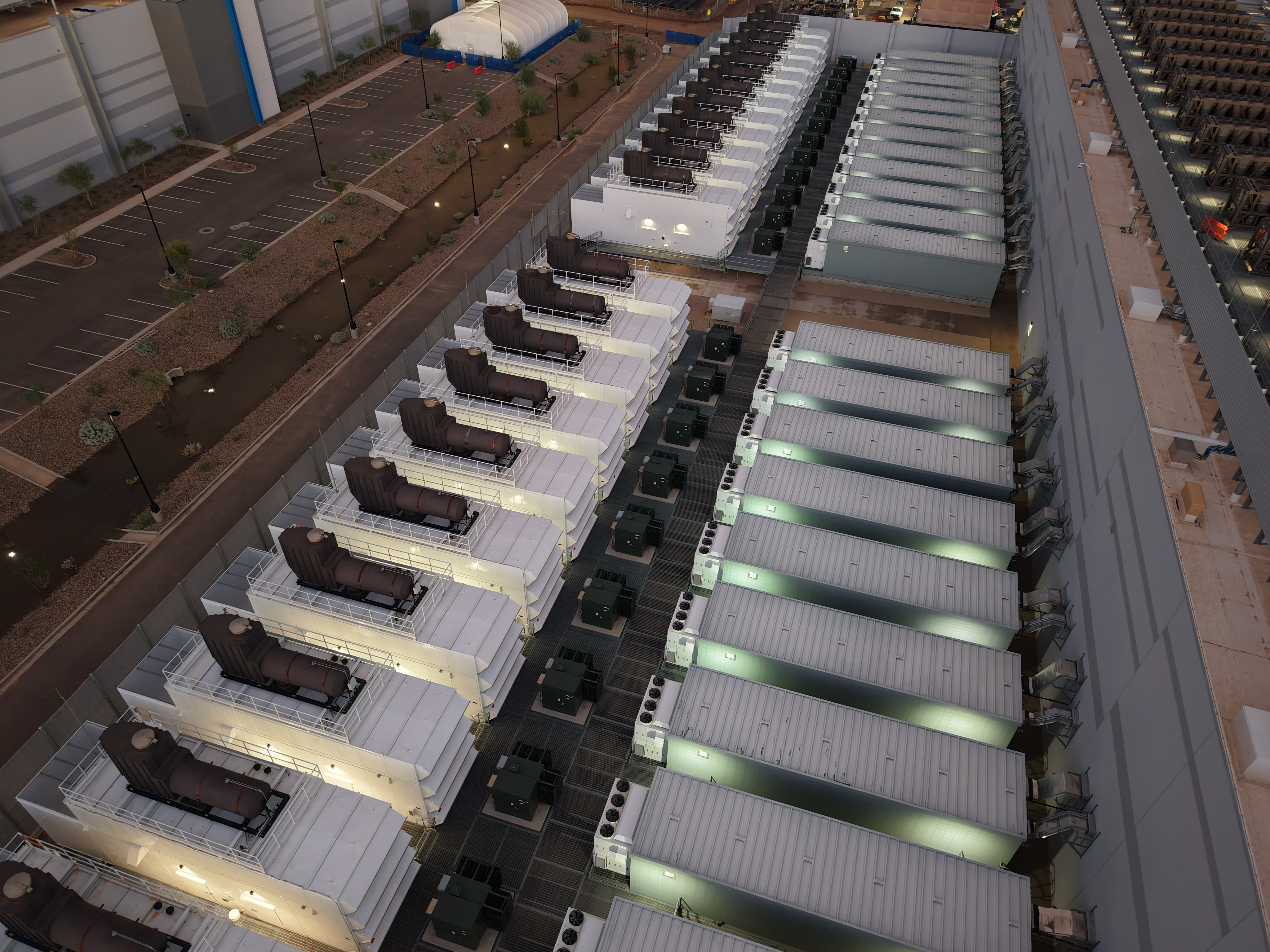
Photo: Rsparks3 / Wikimedia Commons, CC0 1.0. Representative archival photograph captured 23 November 2025; it is not identified as an IES project. · Illustrative image.
IES Holdings is benefiting from the physical build behind the digital economy. Its electrical and infrastructure businesses are wiring data centres, manufacturing equipment and adding capacity. The company has now made its largest acquisition and authorised a much larger buyback.
For the year ended 30 September 2026, revenue increased 33% to $4.48 billion and operating income rose 58% to $605.7 million. Total backlog reached $4.96 billion, more than twice the prior-year level.
The investment question is whether that demand can convert into enough cash to support the $691 million DBM Global acquisition, higher capital spending and an additional $350 million share-repurchase authorisation without overextending the balance sheet.
Compound does not currently maintain a dedicated IES stock profile, so this analysis concentrates on backlog quality and capital allocation rather than repeating annual results.
Data centres are changing the business mix
IES’s Communications segment designs and installs network infrastructure for data centres and other mission-critical facilities. Segment revenue rose 48% to approximately $1.69 billion, while gross margin improved to 25.2% from 23.2%.
Management attributed the improvement to volume, project execution and work suited to its skilled labour force. That is better than growth produced solely by passing through more expensive materials: the company earned a higher gross margin while scaling.
Infrastructure Solutions also grew rapidly, with revenue up 65.7% to $826.6 million. Its gross margin slipped to 33.1% from 34.4%, showing that not every part of the data-centre exposure is expanding with the same economics.
The opportunity is substantial, but customer capital budgets can move together. IES does not identify its large customers in the filing, describing them as global technology, social-networking and ecommerce companies. A broad pullback in data-centre spending could therefore affect multiple projects at once.
Backlog needs a quality check
Remaining performance obligations, a GAAP measure of contracted future revenue, increased to $3.48 billion from $1.69 billion. Company-defined backlog rose to $4.96 billion from $2.37 billion.
The difference matters. Backlog includes $1.47 billion of signed agreements and letters of intent that IES says are not yet legally enforceable before work begins. Those arrangements are excluded from remaining performance obligations.
Communications RPO nearly tripled to $2.00 billion from $692 million, offering real evidence of demand. Investors should still watch cancellations, project timing and margin at completion. Construction revenue can arrive with cash needs before customers pay.
Earnings are ahead of cash
Net income was $538.4 million, while operating cash flow was $364.5 million. Cash flow increased 27%, but much more slowly than earnings.
Accounts receivable used $418.3 million of cash, and costs and estimated earnings in excess of billings used another $83.8 million. These were partly offset by accounts payable and customer billings. That pattern is consistent with rapid project growth, but it places the burden on collection and contract discipline.
Capital expenditure rose to $163.1 million from $67.3 million as IES expanded manufacturing and communications capacity. Subtracting capex from operating cash produces about $201 million before acquisitions and other investments.
That is healthy cash generation, but materially below the scale of the next transaction.
DBM changes the capital-allocation test
Five days after year-end, IES acquired DBM Global for approximately $691 million, consisting of $545 million in cash and 430,974 IES shares valued at closing. DBM adds structural-steel engineering, fabrication and erection across data centres, stadiums and industrial projects.
IES expanded its borrowing capacity from $300 million to $700 million, comprising a $200 million term loan and a $500 million revolver. Capacity is not the same as debt drawn, but it shows that the acquisition materially changes the financing framework.
The strategic logic is understandable: IES can participate in more layers of a large construction project. The risk is that structural steel introduces different project, commodity and integration economics just as the existing businesses are growing quickly.
The board also authorised an additional $350 million for repurchases after year-end. Actual fiscal 2026 repurchases were only $25 million. An authorisation is not an obligation, but investors should question the order of operations: integrate DBM, protect liquidity and prove cash conversion before deploying a large amount into buybacks.
Capital governance also deserves attention. Tontine owned about 52% of IES shares, giving it control over most shareholder matters. That does not make capital allocation poor, but minority investors have limited influence if priorities differ.
What would confirm the thesis?
The constructive case requires GAAP RPO—not only broader backlog—to convert into revenue at stable margins, receivables to grow more slowly than sales, and operating cash flow to close the gap with earnings. DBM should add returns without persistent leverage or meaningful further dilution.
The case would weaken if customers delay data-centre projects, if working capital continues absorbing a large share of profit, or if buybacks compete with integration and debt reduction. A rising backlog is valuable only when contracts become cash at acceptable margins.
IES has demonstrated strong demand and execution. Its next challenge is capital discipline: converting the boom into cash while integrating a transaction larger than one year’s operating cash flow. A view on the shares also requires a current valuation and explicit assumptions; this analysis makes no price target.
Explore Compound’s earnings hub and our guide to investment diversification.
Reported figures are in US dollars and relate to fiscal 2026 ended 30 September 2026 unless stated. Backlog is a company-defined non-GAAP measure; remaining performance obligations are GAAP. Facts come from IES’s Form 10-K, results release and acquisition Form 8-K; interpretation and rounded calculations are Compound’s. General information, not personal investment advice.
Cover: Rsparks3, Wikimedia Commons, under CC0 1.0. Captured 23 November 2025 in Mesa, Arizona. Cropped and resized for publication; representative archival image not identified as an IES project.