Analog Devices Plans to More Than Double Capital Spending. Can Cash Returns Keep Pace?
Analog Devices returned almost all of its $5.45bn free cash flow to shareholders in fiscal 2026. Now it plans capital spending of $1.6bn to $1.9bn and has bought another chip company. We test what that leaves.
 Wealth / The Compound journal
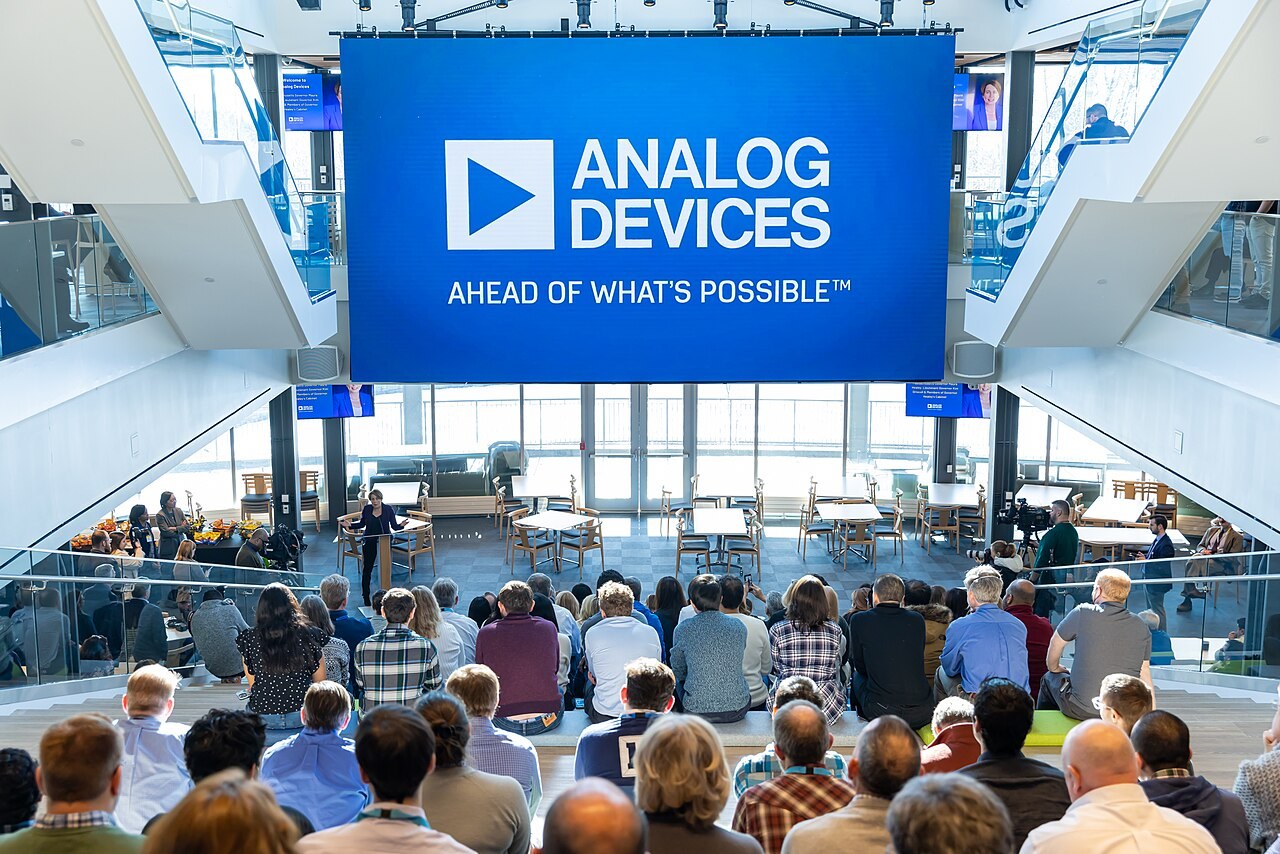
Photo: Office of Governor Maura Healey of Massachusetts / Wikimedia Commons, public domain (Commonwealth of Massachusetts public record). Analog Devices, Massachusetts, 24 January 2023; archival photograph, resized. · Illustrative image.
Analog Devices, the maker of chips that connect electronics to the physical world, had a record year. It also gave almost all of its free cash flow back to shareholders. For fiscal 2027 it plans to more than double its capital spending, and it has just paid $1.35 billion for another company. The question for investors is how much cash will be left for buybacks.
For fiscal 2026, which ended on 31 October, Analog Devices reported revenue of $15.18 billion, up 38%. Fourth-quarter revenue was $4.37 billion, up 42%. GAAP diluted earnings per share more than doubled to $10.21, and adjusted EPS rose 68% to $13.05.
For the maintained quarterly record, see Analog Devices’ stock profile. This article focuses on cash flow, investment and capital returns.
A strong year, almost all of it handed back
Operating cash flow was $6.19 billion and capital spending was $733 million, leaving free cash flow of $5.45 billion, or 36% of revenue. Over the same year Analog Devices paid $2.09 billion in dividends and spent $3.32 billion buying back shares, a total of $5.41 billion.
That is about 99% of free cash flow, Compound’s calculation. The company also paid about $1.5 billion for Empower Semiconductor, a maker of power-management chips, in July. Returns plus the acquisition came to more than the cash the business generated.
The gap showed up in the balance sheet. In September Analog Devices sold $3.0 billion of new senior notes, due between 2029 and 2036 with coupons of 5.1% to 5.75%. Total borrowings, including commercial paper and debt due within a year, rose from about $8.59 billion to $11.43 billion. After cash and short-term investments of $5.20 billion, net debt rose from about $4.94 billion to $6.23 billion. These totals are Compound’s calculations from the balance sheet.
Capital spending is about to step up
The 10-K says the company now expects fiscal 2027 capital expenditure of about $1.6 billion to $1.9 billion. That is 2.2 to 2.6 times the fiscal 2026 figure, Compound’s calculation.
The step-up has already started. Fourth-quarter capex was $340 million, against $109 million to $146 million in each of the three earlier quarters. Management says its momentum and customer pipeline have “increased our confidence in future growth” and are driving more investment in manufacturing capacity, to be funded from cash, operations and “existing and anticipated available short- and long-term financing”.
There is also another acquisition. On 3 November Analog Devices completed the purchase of Alif Semiconductor, which makes AI-enabled microcontrollers, for about $1.35 billion, with up to $200 million more possible later.
What the arithmetic leaves for buybacks
The company has not given a free cash flow forecast for fiscal 2027, so the following is an illustration, not a prediction.
If operating cash flow simply matched fiscal 2026 at $6.19 billion, capex of $1.6 billion to $1.9 billion would leave free cash flow of about $4.3 billion to $4.6 billion. The current dividend of $1.10 a quarter costs about $531 million each time, or about $2.12 billion a year. Add the Alif payment and those two items come to roughly $3.5 billion.
That would leave about $0.8 billion to $1.1 billion for buybacks without more borrowing, against $3.3 billion spent in fiscal 2026. These are Compound’s calculations. Faster growth in operating cash flow would close part of the gap; slower growth would widen it. The board still has $6.5 billion of buyback authorisation available.
The share count matters for per-share growth. Shares outstanding fell only 1.4% in fiscal 2026, to 482.7 million, despite the $3.3 billion of buybacks, because employee share plans add shares back.
Working capital is a second thing to watch
Fiscal 2026 cash flow had help from suppliers and accruals. Receivables rose 81% to $2.60 billion, and inventory rose 26% to $2.08 billion as the company built stock to support demand. Those used about $1.6 billion of cash. Most of that, $1.29 billion, came back from higher payables and accrued liabilities. If that support reverses, operating cash flow could lag profit.
How durable is the demand?
Growth was broad. In the fourth quarter, industrial revenue rose 55%, communications rose 81%, automotive rose 21% and consumer rose 7%. Chief executive Vincent Roche said more than two-thirds of fiscal 2026 growth came from “non-AI-centric” markets. That is a management claim; the release does not give an AI revenue figure.
The near-term outlook is flatter. First-quarter guidance is revenue of $4.4 billion, plus or minus $150 million, almost unchanged from the fourth quarter. The guided adjusted operating margin of 50.5% is below the fourth quarter’s 52.3%. The 10-K says the company is positioned for “sustained above-seasonal growth in fiscal 2027”.
The 10-K also lists the usual chip-cycle risk: the industry “may build capacity and inventory in excess of demand”. About 57% of revenue goes through distributors, and two distributors account for about 25% and 17% of revenue.
What would confirm or weaken the thesis
The thesis strengthens if revenue keeps growing through fiscal 2027, if operating cash flow rises enough to fund the new capex, the dividend and meaningful buybacks without more net debt, and if receivables come back in line with sales.
It weakens if quarterly revenue stalls near $4.4 billion while capex runs at the guided rate, if buybacks are funded with new borrowing, or if inventory at the company or its distributors keeps rising faster than sales.
Analog Devices is earning record margins and generating a lot of cash. But it has been returning almost all of that cash, and fiscal 2027 brings much higher capital spending and another acquisition. Unless cash flow keeps growing, something has to give, and buybacks are the most flexible item. This analysis makes no price target.
Explore Compound’s earnings hub, our onsemi margin recovery analysis and our Keysight AI orders and capacity analysis.
Reported figures are in US dollars. Fourth-quarter release figures are unaudited; fiscal-year figures are from the audited 10-K. Adjusted EPS, adjusted operating margin and free cash flow are company-defined non-GAAP measures. Payout share, capex multiples, borrowings, net debt, dividend run-rate and the buyback illustration are Compound calculations. Capex and revenue guidance are company forecasts, not guarantees. General information, not personal investment advice.
Cover: Office of Governor Maura Healey of Massachusetts, Wikimedia Commons, public domain as a Commonwealth of Massachusetts public record. Captured 24 January 2023 during a governor’s visit to Analog Devices. Archival photograph; resized.