onsemi's Margins Are Recovering. How Much Is AI Doing?
onsemi's gross margin rebounded as power-chip utilisation and AI data-centre demand improved. A large cash acquisition now raises the execution test.
 Wealth / The Compound journal
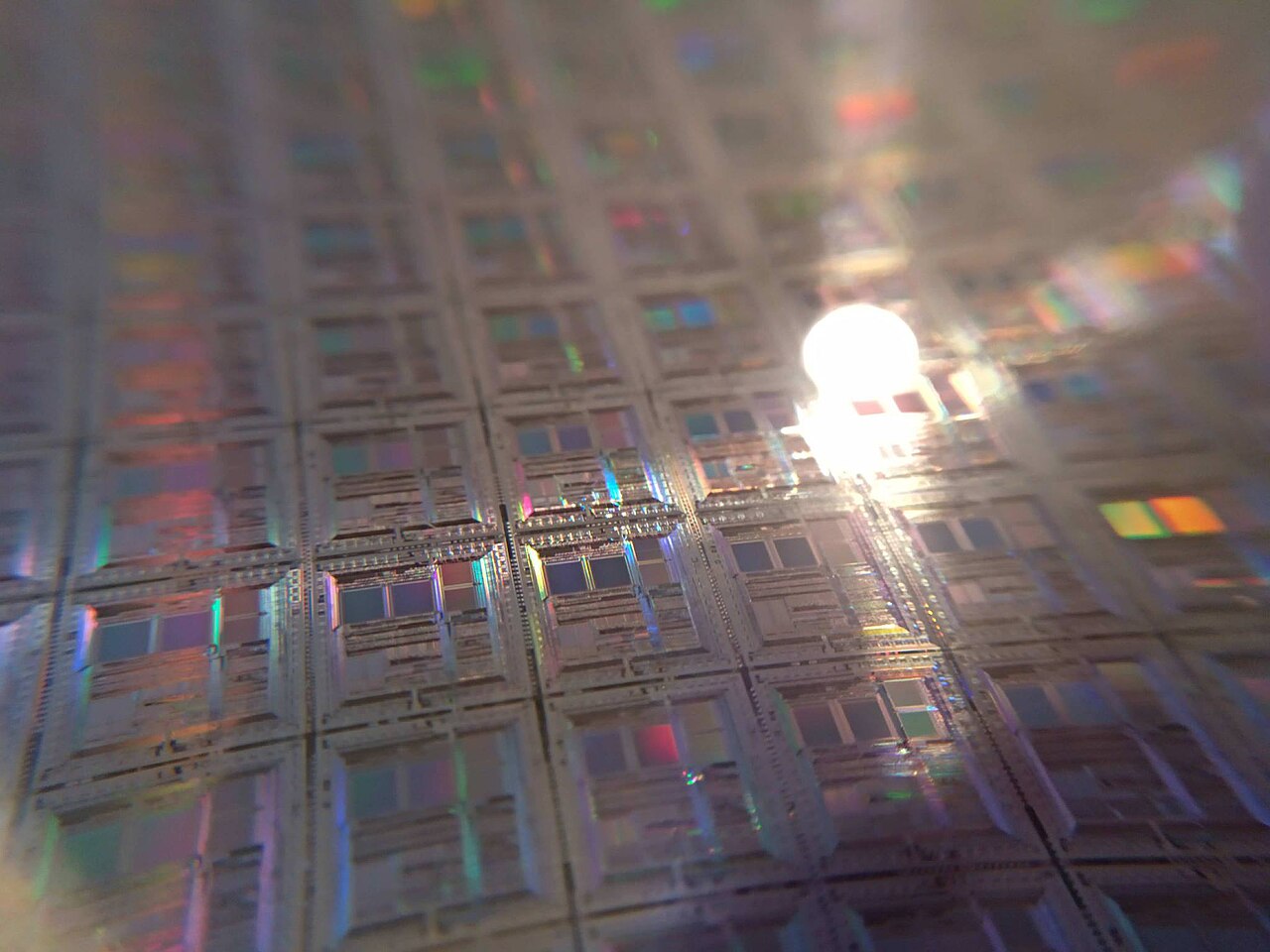
Photo: Le hollandais volant / Wikimedia Commons, CC BY 4.0. Photographed 21 October 2017; archival and not presented as an onsemi wafer. · Illustrative image.
onsemi’s profit recovery is moving much faster than its revenue. The important question is whether AI data-centre demand has changed the business mix—or simply helped fill factories during a cyclical rebound.
For the quarter ended 2 October 2026, revenue increased 11% to $1.722 billion. GAAP gross margin rose to 41.4% from 37.9% a year earlier, while operating income climbed 43% to $378 million. Operating cash flow reached $516 million and the company’s non-GAAP free cash flow was $489 million.
Those are strong economics, but they arrive as onsemi prepares to spend roughly $5.7 billion in cash on Synaptics. For the maintained financial record, see onsemi’s stock profile. This analysis separates the operating recovery from the acquisition decision.
The power business produced most of the improvement
The 10-Q shows that Power Solutions Group revenue increased 21% year on year. Its gross margin jumped 9.7 percentage points to 38.2%, driven by improved utilisation, operating leverage on higher volume and favourable product mix.
That segment generated almost all of the company’s $126 million increase in quarterly gross profit. By contrast, Analog and Mixed-Signal Group revenue rose 2% but its margin slipped to 50.2%; Intelligent Sensing Group revenue also rose 2%, while its margin fell to 31.3%.
This concentration matters. A consolidated margin recovery can look broad even when one segment carries most of it. The strongest interpretation is that onsemi’s manufacturing realignment and differentiated power products are raising the economics of the largest business. The more cautious interpretation is that factory utilisation is cyclical and could reverse if volumes soften.
AI is real, but it is not the whole company
onsemi’s results release says AI data-centre revenue increased 39% from the previous quarter and 175% from a year earlier. The filing provides useful dollar context: Power Solutions Group gained $71.3 million of year-on-year revenue from AI data centres, while Analog and Mixed-Signal Group added $43.3 million.
Industrial demand also contributed, particularly in power products. Automotive was mixed: Power Solutions revenue from automotive fell, even as the analog business recorded growth. Management said some supply was reallocated from automotive to industrial and AI data-centre uses.
That makes AI a meaningful mix driver, not a complete explanation for the quarter. It is also a reminder that revenue allocation can change. If high-demand data-centre products receive scarce capacity, growth in one end market can partly displace another rather than add dollar for dollar.
The company agreed to acquire Ferric, a specialist in power delivery close to AI processors, and raised its 2030 AI data-centre revenue target by $500 million to more than $3 billion. That is management’s target, not recognised revenue. Investors still need evidence that design wins turn into sustained production at attractive margins.
Cash flow is strong because capital intensity has fallen
Quarterly operating cash flow of $516 million exceeded capital expenditure by a wide margin, producing $488.6 million of company-defined free cash flow, or 28% of revenue. Subtracting the two figures implies about $27 million of quarterly capital expenditure.
For the first nine months, free cash flow reached $1.131 billion, up from $933 million. The filing says capital expenditure was about 2% of revenue and expects 2%–3% for the full year. That is a dramatic cash benefit for a semiconductor manufacturer, but it needs to be read alongside manufacturing changes rather than assumed permanent.
onsemi is shrinking or exiting some manufacturing capacity and recorded substantial realignment charges during the first nine months. Lower investment can improve near-term free cash flow, while future supply resilience and product needs determine whether the reduced capital base is enough.
Synaptics changes the financial test
onsemi revised its planned Synaptics acquisition from an all-stock structure to approximately $5.7 billion in cash. The company had about $4.4 billion of cash and short-term investments at quarter end and expects to use cash plus committed borrowing for the transaction.
Management describes the deal as immediately accretive to non-GAAP EPS. Accretion is not the same as value creation. It can be affected by financing, excluded costs and the acquired share count. The economic test is whether Synaptics produces returns above the cost of funding and integration without distracting from the power-margin recovery.
The acquisition also increases the importance of cash durability. A business producing almost $489 million of quarterly free cash flow has options; a large cash purchase commits a meaningful portion of that capacity before the integration outcome is known.
What would confirm the recovery?
Watch Power Solutions gross margin and manufacturing utilisation together. Look for AI data-centre growth that supplements rather than merely reallocates automotive and industrial revenue. Track capital expenditure against product capacity, and assess Synaptics using GAAP results, cash flow and debt reduction—not only adjusted EPS.
onsemi has demonstrated genuine operating leverage, but the next stage carries two separate bets: that the power-margin recovery lasts and that a large acquisition earns its cost. A current valuation and explicit cycle assumptions are still required for a view on the shares; this analysis makes no price target.
Explore Compound’s earnings hub and our guide to investment diversification.
Reported figures are in US dollars and relate to Q3 or the first nine months of 2026 unless stated otherwise. Free cash flow and adjusted measures are non-GAAP. Facts come from onsemi’s results release and Form 10-Q; management targets and explanations are identified, while interpretation is Compound’s. General information, not personal investment advice.
Cover: Le hollandais volant, Wikimedia Commons, under CC BY 4.0. Photographed 21 October 2017. Archival and illustrative; the wafer is not identified as an onsemi product. Resized for publication; display and social-image cropping may apply.