Workday Is Borrowing to Shrink Its Share Count. Is the Business Keeping Up?
Workday's adjusted EPS grew 22% while adjusted net income grew 12%. We test how much a debt-funded buyback is doing, what slower subscription guidance means and whether AI sales can lift growth again.
 Wealth / The Compound journal
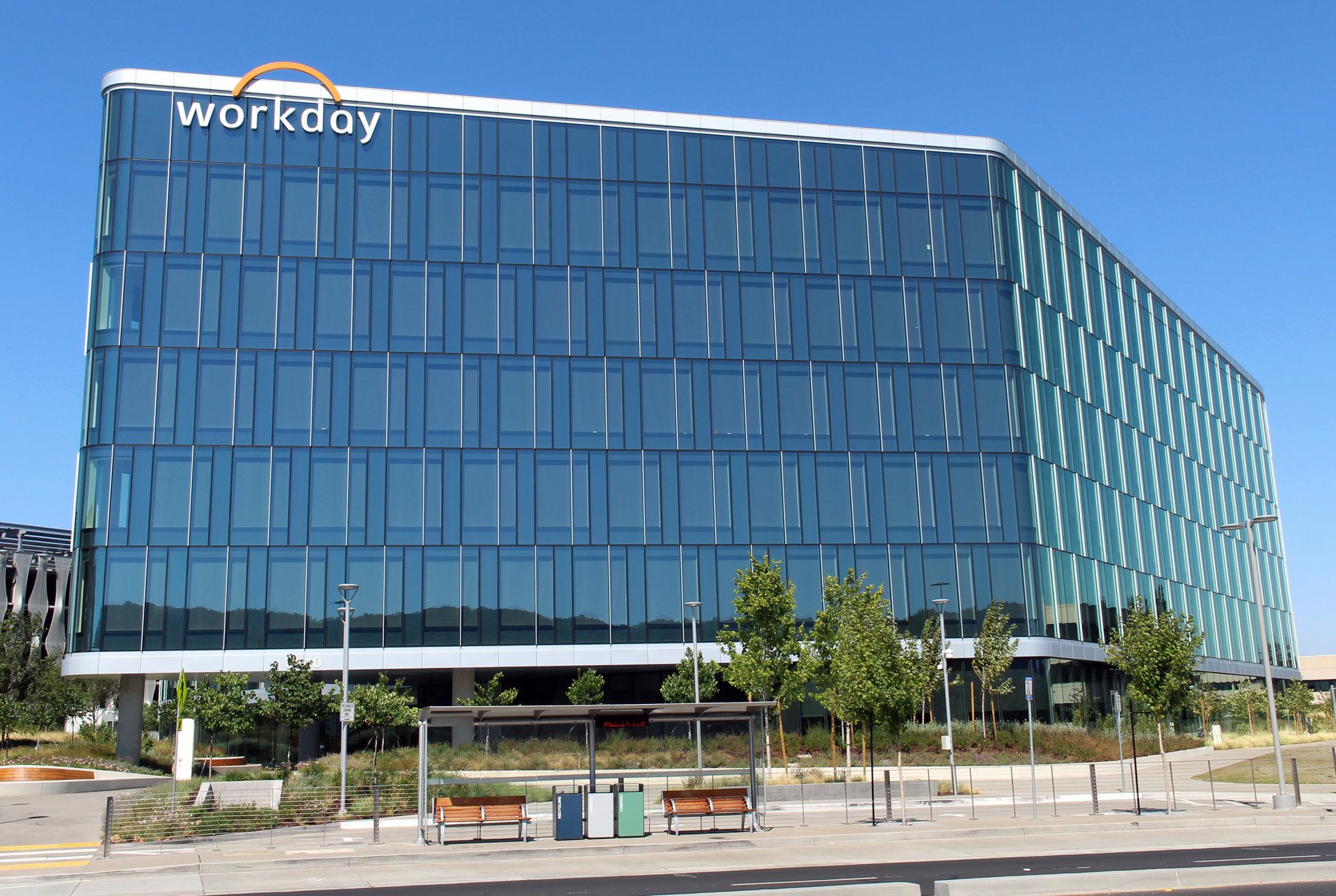
Photo: Coolcaesar / Wikimedia Commons, CC BY-SA 4.0. Workday headquarters, Pleasanton, California, photographed 24 August 2019; archival photograph, resized and cropped under the same licence. · Illustrative image.
Workday, the HR and finance software company, is growing more slowly but earning more per share. Much of the gap comes from buying back stock, and since October part of that has been paid for with new debt. Investors need to know whether AI products can lift growth before the balance-sheet support runs out.
For the third quarter of fiscal 2027, ended 31 October 2026, Workday reported revenue of $2.705 billion, up 11.2%, and subscription revenue of $2.532 billion, up 12.8%. It guided to fourth-quarter subscription revenue of $2.600 billion, growth of 10%, and raised full-year subscription guidance to $9.958 billion, up 13%.
For the maintained quarterly record, see Workday’s stock profile. This article focuses on per-share growth, capital returns and the backlog.
Per-share growth is running ahead of profit
Workday’s non-GAAP operating margin rose to 31.4% from 28.5%. That is a genuine improvement: total costs grew about 9%, more slowly than revenue. GAAP operating margin, which includes share-based pay and $51 million of restructuring costs, was 12.1%.
The per-share figures tell a different story from the profit figures:
- Non-GAAP net income rose from $622 million to $695 million, up about 12%.
- Non-GAAP diluted EPS rose from $2.32 to $2.82, up about 22%.
- Diluted weighted shares fell from 268.6 million to 246.0 million, down about 8%.
Those are Compound’s calculations from the release. Roughly 9 to 10 points of the 22% EPS growth came from having fewer shares, not from higher profit. On a GAAP basis, net income actually fell to $237 million from $252 million, partly because interest and investment income dropped.
The buyback is bigger than free cash flow
In the first nine months of the fiscal year, Workday repurchased 25.6 million shares for $3.66 billion, at an average of $142.66 a share. It also spent $423 million on taxes for shares withheld when employee awards vested. Together that is about $4.1 billion, against free cash flow of $1.77 billion, Compound’s calculation.
The shortfall came from the balance sheet. Cash and marketable securities were broadly flat at $5.64 billion, while debt rose from $2.99 billion to $5.46 billion after Workday sold $2.5 billion of senior notes in October. Net cash, cash and securities minus debt, fell from about $2.46 billion to about $0.18 billion, Compound’s calculation. That is before the roughly $850 million C1.ai acquisition, which completed in November.
The new notes carry coupons of 5.7% to 6.5%. On the company’s disclosed tranche sizes, that is roughly $150 million a year of interest, Compound’s calculation. Workday still has $3.3 billion of buyback authorisation left.
Share-based compensation is also large. It was $1.30 billion in the nine months, equal to about three-quarters of free cash flow.
Near-term backlog is growing, the long tail less so
Workday’s 12-month subscription backlog rose 12.3% to $9.216 billion, which supports next year’s revenue. Its total subscription backlog rose only 6.1% to $27.548 billion.
Subtracting one from the other, the portion due after 12 months grew from about $17.76 billion to $18.33 billion, or about 3%, Compound’s calculation. Workday says backlog can move with renewal timing and contract length, so one quarter does not prove a trend. But slow growth in long-dated commitments is worth watching alongside a guided slowdown to 10% subscription growth.
AI is growing from a small base
Workday says its AI products delivered nearly $150 million of new annual contract value in the quarter, more than three times a year earlier, and that more than 2,200 core customers have bought at least one AI product. These are company metrics with no reconciliation to revenue. For scale, quarterly subscription revenue is $2.5 billion.
AI also brings costs. In October Workday signed a $1.9 billion, five-year non-cancellable commitment for a third-party hosted infrastructure platform. It also announced a September restructuring affecting about 2% of its workforce, with charges of about $65 million.
What would confirm or weaken the thesis
The thesis strengthens if subscription growth stabilises near or above 10%, if long-dated backlog grows faster, and if AI contract value starts to show up in revenue while margins hold above 30%.
It weakens if growth keeps slowing, if Workday keeps borrowing to fund buybacks, or if the infrastructure commitment and acquisitions push costs up without accelerating sales.
Workday is a profitable business with improving margins, but its adjusted EPS growth is flattered by a buyback that now exceeds its free cash flow and is partly debt-funded. The real test is whether AI sales lift subscription growth before that support fades. This analysis makes no price target.
Explore Compound’s earnings hub, our Microsoft share-count analysis and our Zoom growth and capital returns analysis.
Reported figures are in US dollars and are unaudited. Non-GAAP measures and free cash flow are company-defined. AI contract value and customer counts are company metrics. Growth rates for net income, EPS and shares, the buyback gap, net cash, interest cost and the long-dated backlog are Compound calculations. Guidance is a company forecast, not a guarantee. General information, not personal investment advice.
Cover: Coolcaesar, Wikimedia Commons, under CC BY-SA 4.0. Captured 24 August 2019. Archival photograph; resized and cropped under the same licence.