OpenAI Is Building a Business Channel Inside ChatGPT. Who Captures the Value?
OpenAI's new Business Hub and sponsored Business Agents could turn product research into a merchant channel. The economics depend on measurable demand, attribution and user trust.
 Wealth / The Compound journal
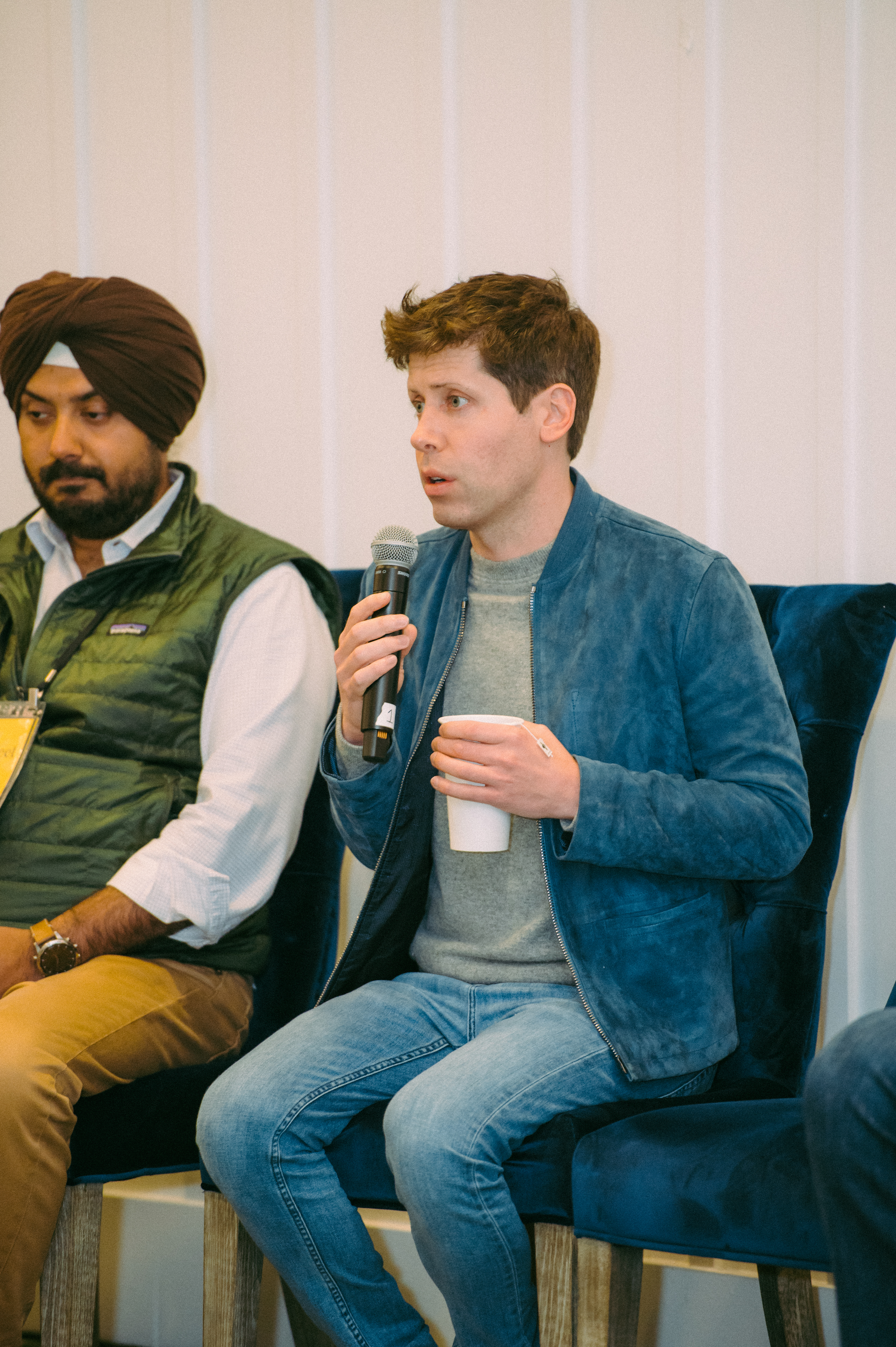
Photo: Village Global / Wikimedia Commons, CC BY 2.0; 17 November 2022 archival photograph, cropped · Illustrative image.
OpenAI’s latest business launch is not another language model. It is a proposed commercial connection between people asking ChatGPT for recommendations and the organisations selling what they might choose. If it works, the opportunity extends beyond subscription fees and API tokens. But a merchant profile, a conversation and a sale are three different economic events, and the company has not yet disclosed what the new channel earns.
On 10 November 2026, OpenAI introduced Businesses in ChatGPT, initially in beta. Its Business Hub lets eligible organisations claim and verify their presence, update details and add product feeds with pricing and availability. Business Agents give certain US ecommerce and online-services businesses a separate conversational interface to answer questions about their offerings. OpenAI also announced sponsored Business Agents and ads that can lead users to them.
That is a materially different business question from this week’s AWS Marketplace launch, which concerns the procurement of ChatGPT Enterprise. This development concerns how merchants might acquire customers inside ChatGPT itself.
The distribution funnel changes at the point of consideration
Traditional online commerce often moves through search results, product pages, comparisons and merchant checkout. A conversational assistant can combine several research steps into one session. Someone shopping for software might ask about a requirement, compare competing options, check a price and ask a follow-up without repeating a search.
OpenAI says a business can be mentioned in a model response and a user can then open its ChatGPT profile. Where an eligible Business Agent exists, the user can deliberately start a separate, labelled conversation with that business. OpenAI says the agent conversation remains distinct from the assistant’s independent answers.
For merchants, the prize is a qualified customer who has already described a need. For OpenAI, the possibility is a new commercial surface layered on top of existing consumer attention. Neither outcome proves itself merely because the product is available in beta. Customers still need relevant choices, trustworthy information and reasons to complete a purchase.
Who owns the information and the customer relationship?
A business can claim its profile and provide its own product feeds, including pricing and availability. That may reduce stale listings and improve how a product is represented. Shopify merchants have an integrated verification route; OpenAI says eligible Shopify Catalog products were already integrated.
But merchant-supplied information is not the same as an independent evaluation. A product feed is strongest for verifiable specifications, prices, stock and delivery terms; it is inherently less objective when claiming a product is better than competitors’. Good product discovery requires the assistant to maintain that distinction.
There is also a question about who captures the final relationship. Does the merchant acquire a repeat customer who returns to its own store, or does the conversational platform become the default starting point for the next purchase? A channel can create incremental demand and still make the merchant more dependent on an intermediary.
That dependency matters for marketing budgets. A merchant should compare sales originating from its agent with sales it might have achieved through ordinary search, existing customers or paid advertising elsewhere. The relevant number is incremental profit after fulfilment and customer support, not simply conversations opened.
The measurement problem: mentions are not revenue
OpenAI says Business Hub provides aggregated counts of business mentions, website clicks and common discovery topics where a business’s site is cited. It also says individual user conversations are not shared with merchants, and reporting requires sufficient activity to meet privacy thresholds.
Those controls address an important privacy concern. They also mean some performance questions remain unanswered. A mention is awareness; a click is an indication of interest; a purchase is a separate conversion. A company could receive many favourable mentions without a proportional increase in sales.
Consider a hypothetical comparison. Suppose 10,000 relevant business-profile views generate 600 site visits and 18 orders. That is a 6% click-through rate and 3% order conversion from those visits. At €40 gross profit per order, that is €720 gross profit before agent management, ad spending and any incremental servicing cost. These are illustrative assumptions, not reported OpenAI or merchant results.
A merchant deciding whether to sponsor an agent should therefore record agreed goals and compare against an appropriate baseline. Without a holdout group, branded traffic and customers already intending to buy may be mistaken for new demand.
Advertising creates opportunity and a trust obligation
OpenAI says sponsored Business Agents can act as destinations for ChatGPT Ads, with sponsored placements labelled and separated from ChatGPT responses. That separation is commercially crucial. If users cannot tell whether an apparent recommendation is independent or paid, short-term advertising revenue could undermine the trust that makes the audience valuable.
The business model therefore has at least two distinct layers: an organic information service designed to answer user questions, and an explicitly commercial path through labelled sponsorship and merchant conversations. It would be premature to claim a specific take rate, advertising price, merchant commission or shopping-market share. OpenAI has not supplied those metrics in the November announcement.
For buyers, the most useful test is whether products are compared on relevant merits even when some participants pay for visibility. For merchants, it is whether sponsored exposure yields measurable incremental customers at an acceptable acquisition cost.
The current rollout is narrower than the ambition
The claiming feature is available to eligible businesses in places where ChatGPT operates, according to OpenAI. But Business Agents initially target eligible ecommerce and online-service businesses in the United States. An Irish merchant should not assume that every advertising or agent function is already supported locally.
OpenAI cites 1.2 billion weekly ChatGPT users for the broader platform. It is a company-reported audience measure, not the number of US Business Agent users, active business profiles, paid advertisers or purchases. Multiplying that audience by a conjectured advertising yield would produce a forecast with little evidential foundation.
There are operational costs on both sides. A retailer must keep feeds current, test what its agent says about products, handle mistaken expectations and route complex requests to staff. OpenAI must manage verification, relevance, abuse prevention and the boundary between objective replies and promotions. None of those cost structures is disclosed.
What to watch before calling it a commerce business
The next useful evidence will be concrete: how many verified businesses maintain active feeds, what share of eligible visitors voluntarily use an agent, whether merchants report incremental orders rather than redistributed traffic, and whether paid placements remain clearly distinguishable from independent answers.
A bigger audience is valuable only if its trust survives monetisation. The central OpenAI business question is not whether a conversational agent can explain a product; it is whether a neutral assistant can connect buyers and sellers without becoming a paid catalogue in disguise.
Follow the OpenAI private-company research hub for related developments, including the distinct enterprise procurement case. OpenAI is privately held: no segment profit figure, paid-agent uptake, return on investment or investable share price should be inferred from this launch.
Research checked 13 November 2026. The official product announcement is dated 10 November. Hypothetical conversion calculations and commercial interpretations are Compound analysis; they are not OpenAI performance disclosures. Cover: Village Global, 17 November 2022, archival photograph under CC BY 2.0, cropped; it does not depict the November 2026 announcement.