Jacobs Has a Record Backlog. Is Cash Keeping Up With It?
Jacobs grew backlog 24% and adjusted EPS 20% in fiscal 2026, but reported free cash flow fell and debt rose after the PA Consulting buyout. We test cash conversion, pass-through revenue and the 2027 targets.
 Wealth / The Compound journal
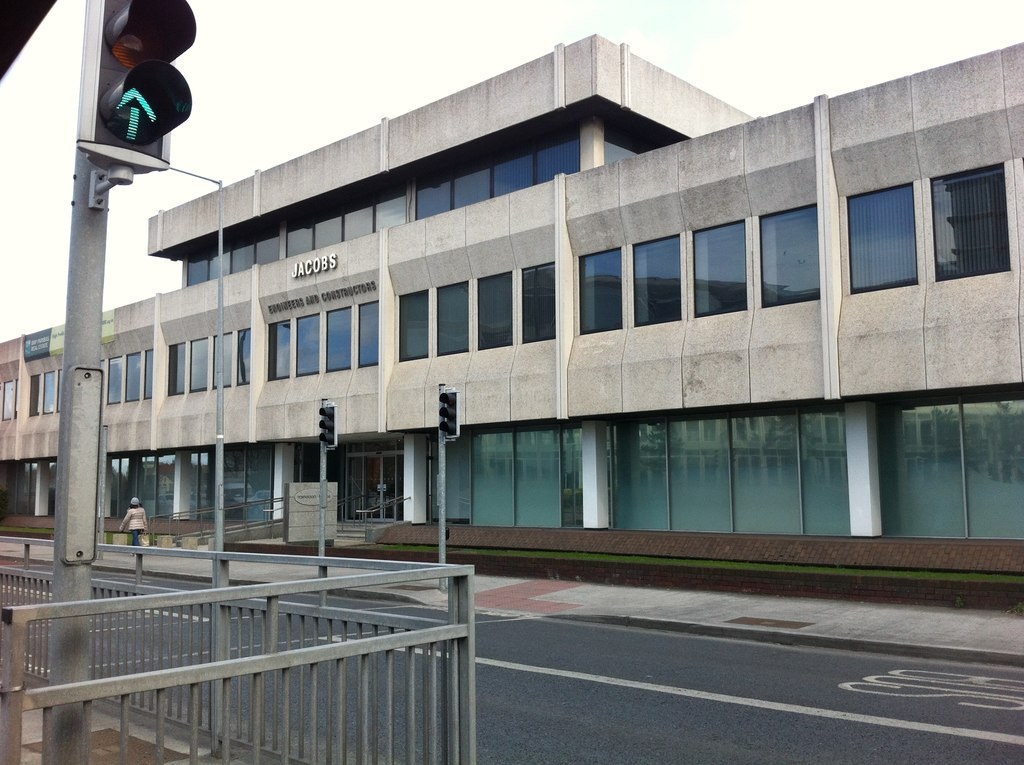
Photo: Darrin Antrobus / Geograph Ireland, CC BY-SA 2.0. Jacobs office on Merrion Road, Dublin, photographed 15 March 2013; re-encoded for publication. · Illustrative image.
Jacobs ended fiscal 2026 with a record backlog. The weak link is cash. Reported free cash flow fell, receivables grew faster than the business, and debt rose to fund the buyout of PA Consulting. The 2027 investment question is whether the backlog turns into cash as quickly as it turns into adjusted earnings.
For the year ended 2 October 2026, Jacobs Solutions reported gross revenue of $15.777 billion, up 31.1%, and adjusted net revenue of $9.592 billion, up 10.3%. Adjusted EPS from continuing operations rose 19.6% to $7.32. GAAP EPS from continuing operations was $3.37.
Backlog reached $28.652 billion, up 24.2%. Jacobs expects about $12.7 billion, or 44.3%, of it to become revenue in fiscal 2027.
For the maintained quarterly record, see Jacobs’ stock profile. This article focuses on how much of that growth is reaching the cash flow statement.
Most of the headline revenue growth is pass-through
The 31% gross revenue figure overstates Jacobs’ economic growth. Pass-through revenue, which covers subcontract labour, materials and equipment Jacobs buys on a client’s behalf at little or no mark-up, jumped to $6.185 billion from $3.335 billion, an increase of about 85%.
Pass-through work rose to about 39% of gross revenue from 28%, Compound’s calculation. Adjusted net revenue, which strips it out, is the better guide to Jacobs’ own fee-earning activity, and it grew 10.3%.
That mix shift matters for cash. Pass-through work can enlarge receivables and payables together, so working-capital swings become larger even when profit is unchanged.
Adjusted earnings and GAAP earnings are far apart
The gap between adjusted EPS of $7.32 and GAAP EPS of $3.37 was $3.95 per share. Jacobs’ reconciliation attributes $1.20 to transaction costs, mainly linked to buying the rest of PA Consulting, $0.42 to restructuring, $0.80 to amortisation of acquired intangibles and $1.54 to other items, mostly the final vesting of PA Consulting incentive arrangements.
Many of those costs relate to a deal that closed on 20 March 2026 and should not recur at the same scale. Amortisation will continue. Investors should check whether the fiscal 2027 gap narrows as the company implies, or whether new transaction and restructuring charges replace the old ones.
Operating cash flow went the wrong way
Net cash from operating activities fell 9% to $622.6 million. After $94.1 million of capital spending, reported free cash flow was $528.5 million, down from $607.5 million, Compound’s calculation. That is about 5.5% of adjusted net revenue.
Jacobs’ own adjusted free cash flow was $870.9 million, or about 9.1% of adjusted net revenue. The difference is $342.4 million of payouts to PA Consulting employees that formed part of the deal consideration. That adjustment is reasonable as a one-off, but it is still cash that left the business.
Working capital was the other drag. Receivables and contract assets rose 31% to $3.906 billion, faster than adjusted net revenue. Accounts payable rose 57% to $1.980 billion, which largely funded that increase. Fourth-quarter operating cash flow was $269.9 million, down from $383.1 million a year earlier.
Debt funded the buyout and the buybacks
Long-term debt rose to $3.580 billion from $2.236 billion, including $1.20 billion of new term loans maturing in 2029 and 2031. Jacobs spent $924.9 million buying out the redeemable noncontrolling interests in PA Consulting, $721.1 million on buybacks and $165.6 million on dividends. Shares outstanding fell 2.2% to 116.5 million.
Long-term debt minus cash was about $2.32 billion, roughly 1.6 times fiscal 2026 adjusted EBITDA of $1.417 billion, Compound’s calculation. A year earlier the same ratio was about 0.8 times. The company says net leverage is near its target, and it has $1.5 billion of undrawn revolving credit. Interest expense still rose to $183.4 million from $145.8 million.
The 2027 guide asks for much better cash conversion
For fiscal 2027 Jacobs guides adjusted net revenue of $10.0 billion to $10.35 billion, or growth of about 4% to 8%, Compound’s calculation. It expects adjusted EBITDA margin of 15.4% to 15.7%, against 14.8% in 2026, and adjusted EPS of $8.05 to $8.45, up 10% to 15%.
It also targets a free cash flow margin of 8.5% to 9.5%, measured against adjusted net revenue. At the guided revenue range, that implies roughly $850 million to $983 million, Compound’s calculation, well above the $528.5 million reported in 2026 and similar to or above the adjusted figure.
What would confirm or weaken the thesis
The case strengthens if receivables grow no faster than adjusted net revenue, quarterly cash flow recovers without new adjustments, and net debt falls while backlog keeps converting.
It weakens if adjusted free cash flow again relies on large one-off add-backs, pass-through work keeps diluting cash conversion, or buybacks continue to be funded with borrowing.
Jacobs’ demand story is well supported by its backlog. The open question is cash: fiscal 2026 showed earnings rising faster than reported cash flow, with debt filling the gap. Fiscal 2027 is the year that has to prove the conversion. This analysis makes no price target.
Explore Compound’s earnings hub, our IES data-centre growth analysis and our guide to portfolio diversification.
Reported figures are in US dollars and follow US GAAP for continuing operations. Fiscal 2026 ended 2 October 2026. Adjusted net revenue, adjusted EPS, adjusted EBITDA and adjusted free cash flow are company-defined measures; reported free cash flow, pass-through share, leverage and guidance-implied figures are Compound calculations. Backlog is not guaranteed revenue. Guidance is a company forecast, not a guarantee. General information, not personal investment advice.
Cover: Darrin Antrobus, Geograph Ireland, under CC BY-SA 2.0. Captured 15 March 2013 on Merrion Road, Dublin. Archival photograph; re-encoded for publication.