Dell's $132 Billion AI Backlog: Who Is Paying for the Build?
Dell doubled revenue and lifted its AI backlog to $132.3 billion. We test how the build is being funded, through supplier credit, customer financing and new debt, and what that means for cash returns.
 Wealth / The Compound journal
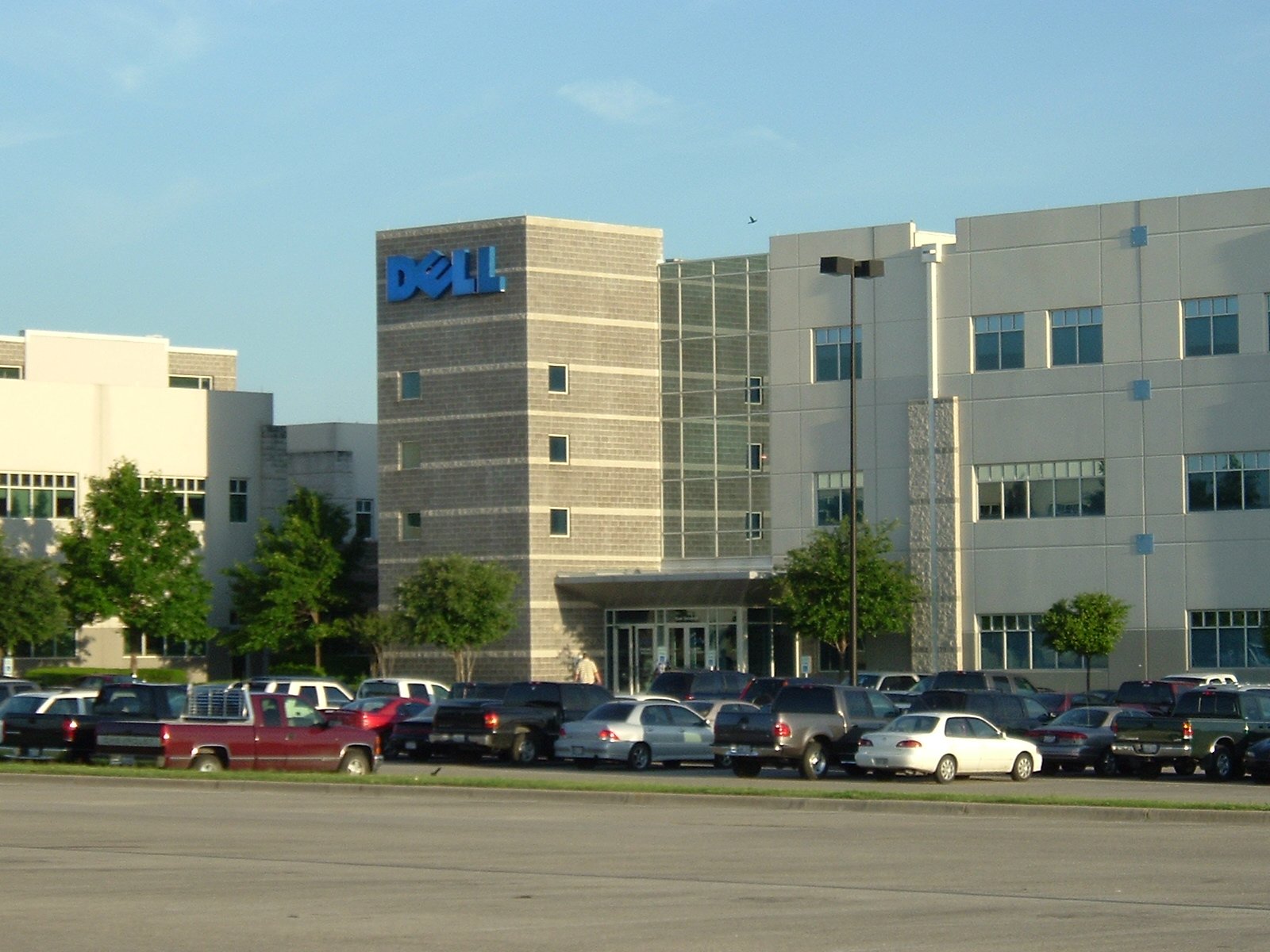
Photo: Tim Patterson / Wikimedia Commons (via Flickr), CC BY 2.0. Dell headquarters, Round Rock, Texas, photographed 27 April 2004; archival photograph, resized for publication. · Illustrative image.
Dell Technologies has become one of the biggest winners of the AI data-centre build-out. Revenue doubled in its latest quarter and its AI server backlog reached a record $132.3 billion. The investment question is less about demand than about money: who is financing the inventory, customer credit and share buybacks that sit behind the growth?
For the third quarter of fiscal 2027, ended 30 October 2026, Dell reported revenue of $54.9 billion, up 103%, and GAAP diluted EPS of $8.82, up 287%. AI-optimised server revenue rose 291% to $22.0 billion. Dell raised its full-year revenue guidance to $202 billion from $192 billion.
For the maintained quarterly record, see Dell’s stock profile. This article focuses on the balance sheet behind the backlog.
The profit case is real
The growth has not come at the expense of margins. Dell’s Infrastructure Solutions Group (ISG), which sells servers, networking and storage, earned $7.1 billion of operating income, or 17.0% of its revenue, against 12.4% a year earlier. ISG now provides 91% of Dell’s segment operating income.
Group gross margin edged up to 21.0% from 20.7%, even as lower-margin AI servers grew to 40% of revenue. Operating expenses fell to 7.5% of revenue from 12.9%, because costs grew far more slowly than sales.
The backlog also kept growing. Dell said it exited the second quarter with a $95 billion AI backlog, then booked $60.2 billion of AI orders and shipped $22.0 billion of AI servers in the third quarter. It ended at $132.3 billion. Dell describes those orders as “rigorously vetted” for customer quality and access to capital, land and power. That is a management claim, not something investors can check.
Suppliers are carrying much of the inventory
The less visible part of the story is working capital. Between 30 January and 30 October 2026:
- Inventories almost tripled, from $10.4 billion to $29.4 billion.
- Accounts payable, money Dell owes suppliers, rose from $33.6 billion to $57.8 billion, an increase of $24.2 billion.
- Trade receivables rose from $17.6 billion to $28.9 billion.
In the third quarter alone, inventories rose by $8.2 billion and payables by $8.1 billion, Compound’s calculation from the two balance sheets. In other words, extra supplier credit covered almost exactly the quarter’s inventory build.
That is normal for a hardware assembler in a boom, and it helps cash flow now. It also works in reverse. If orders slow, Dell would keep paying suppliers while new payables shrink, and cash flow would weaken quickly. At the end of July, Dell also reported $34.8 billion of purchase obligations, $24.6 billion of them due within 12 months, and said committed component purchases would keep rising.
Customer financing is growing fast
Dell also lends to customers through Dell Financial Services. Net financing receivables rose from $14.3 billion in January to $20.9 billion at the end of October, Compound’s calculation from the short- and long-term balances. Dell’s 10-Q for the second quarter said the increase was primarily driven by demand for ISG products. The principal charge-off rate on that portfolio was 0.5% in the second quarter, up from 0.1% a year earlier, which is still low.
This matters for how Dell presents cash. Its standard free cash flow was $7.6 billion for the first nine months. Its “adjusted free cash flow” was $15.6 billion, because it adds back $7.1 billion of cash tied up in financing receivables and $1.0 billion of equipment leased to customers. Both are company-defined non-GAAP measures. The adjusted figure treats customer lending as if it were not a use of cash; investors should judge the business on both.
Buybacks have outrun free cash flow
Dell spent $9.8 billion on share repurchases, $0.6 billion on shares withheld for employee taxes and $1.3 billion on dividends in the first nine months. That is $11.6 billion, about $4.1 billion more than free cash flow, Compound’s calculation.
The gap was covered by borrowing. Dell raised $14.7 billion of debt and repaid $8.3 billion, a net $6.4 billion. Total debt rose from $31.5 billion to $37.7 billion. Some of that is financing-business debt backed by customer receivables, which Dell reports separately from its core debt. Shareholders’ equity remained slightly negative at minus $456 million.
The buybacks have cut the diluted share count by about 5% to 643 million, which lifts per-share growth. The board added another $25 billion to the repurchase authorisation.
How much of the backlog ships soon?
Dell guided to $78 billion of AI server revenue for the full year. After $54.6 billion in the first nine months, that implies roughly $23.4 billion in the fourth quarter, Compound’s calculation. On that basis, most of the $132.3 billion backlog would be delivered after January 2027. That gives visibility, but it also means the cash and margin outcome depends on customers taking delivery and paying over a longer period.
The personal computer business, by contrast, is soft. Client Solutions revenue rose only 3%, consumer sales fell 15% and segment operating income fell 6%.
What would confirm or weaken the thesis
The thesis strengthens if inventories stabilise while revenue keeps rising, if free cash flow (before adding back customer financing) starts to cover buybacks and dividends, and if financing charge-offs stay low.
It weakens if inventories keep growing faster than shipments, if payables stop rising, if Dell keeps adding debt to fund buybacks, or if large AI customers delay deliveries from the backlog.
Dell’s AI growth and profitability are genuine, but suppliers, customer financing and new debt are carrying a growing share of the build. The cash test is whether ordinary free cash flow can soon fund the returns on its own. This analysis makes no price target.
Explore Compound’s earnings hub, our Cisco AI networking analysis and our Sanmina cash-conversion analysis.
Reported figures are in US dollars and are unaudited. Non-GAAP measures, free cash flow and adjusted free cash flow are company-defined. Backlog and order figures are company statements. Balance-sheet changes, cash-return gaps and the implied fourth-quarter AI revenue are Compound calculations. Guidance is a company forecast, not a guarantee. General information, not personal investment advice.
Cover: Tim Patterson, Wikimedia Commons, under CC BY 2.0. Captured 27 April 2004. Archival photograph; resized for publication.