Deere Expects a Large-Ag Upturn in 2027. Why Does Its Profit Guide Barely Move?
Deere guides to higher large-ag sales and margins in fiscal 2027, yet its net income range is centred on 2026's level. We trace where the recovery is offset and what cash is left after higher capex.
 Wealth / The Compound journal
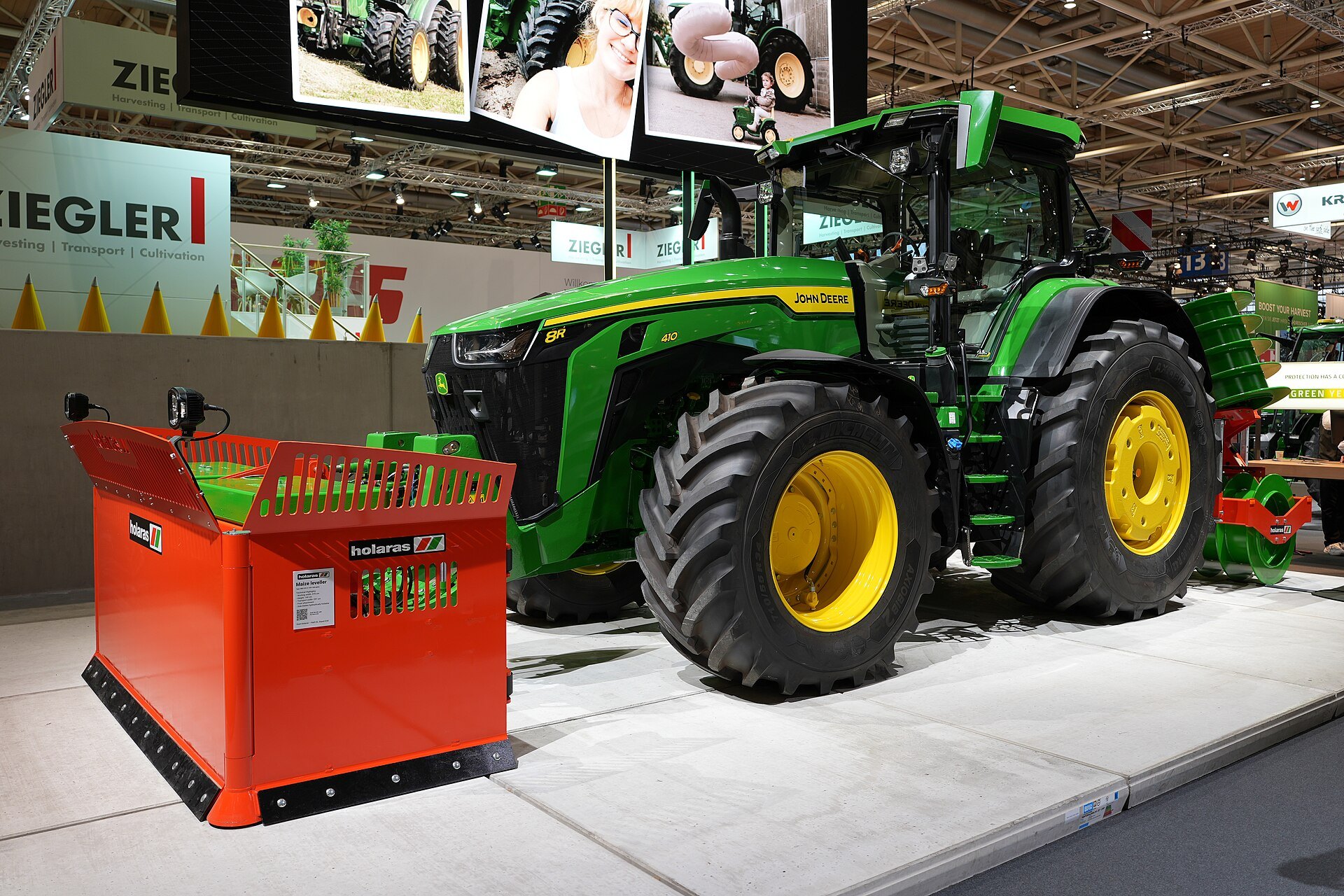
Photo: MarcelX42 / Wikimedia Commons, CC BY-SA 4.0. John Deere 8R 410 at Agritechnica, photographed 11 November 2025; resized for publication. · Illustrative image.
Deere enters fiscal 2027 forecasting a return to growth in its large farm-equipment business. Yet its net income range of $4.50 billion to $5.25 billion is centred almost exactly on what it earned in fiscal 2026. The investment question is where that recovery leaks away, and how much cash is left once spending rises.
Deere & Company reported net income of $4.860 billion, or $17.95 per diluted share, for the year ended 1 November 2026, down from $5.027 billion. Net sales and revenues rose 4% to $47.704 billion. Fourth-quarter net income was $1.051 billion, against $1.065 billion a year earlier.
The midpoint of the 2027 range is $4.875 billion, about 0.3% above 2026, a Compound calculation. That headline understates the operating forecast, but it also shows that a better large-ag year does not translate one-for-one into group profit.
For the maintained quarterly record, see Deere’s stock profile. This article focuses on what the 2027 guidance implies.
The recovery is concentrated in large ag
Deere’s Production & Precision Agriculture segment, which sells large tractors, combines and sprayers, had a hard year. Sales fell 9% to $15.682 billion and operating profit fell 33% to $1.778 billion, an 11.3% margin. The fourth quarter was weaker still: sales were down 15% and the margin fell to 10.1% from 12.7%.
For 2027 Deere forecasts US and Canadian large-ag industry demand up 5% to 15%, and segment sales up by the same range, including about 3% price realisation. It expects the margin to recover to 12.5% to 14.5%.
Applied to 2026 sales, those ranges imply large-ag operating profit of roughly $2.06 billion to $2.61 billion, Compound’s calculation, against $1.778 billion this year. That is the recovery case: about $0.3 billion to $0.8 billion more segment profit.
Two other segments give some of it back
The surprise is Small Agriculture & Turf. It was Deere’s standout in 2026, with sales up 15% to $11.739 billion and operating profit up 47% to $1.771 billion, a 15.1% margin. For 2027 Deere guides sales roughly flat with a margin of 12.5% to 13.5%. On flat sales, that is about $1.47 billion to $1.58 billion of profit, Compound’s calculation, so roughly $0.19 billion to $0.30 billion less.
Construction & Forestry earned $1.473 billion in 2026 on $13.871 billion of sales, a 10.6% margin. Deere guides sales flat to up 10% and a margin of 9.5% to 11.5%, so its contribution could fall or rise modestly.
Financial Services is guided to about $0.90 billion of net income, close to 2026’s $885 million. Its fourth-quarter profit fell 21% to $231 million on unfavourable financing spreads, a smaller average portfolio and a higher provision for credit losses.
A one-off charge and a fading tariff benefit
The 2027 range also includes an estimated one-time, non-cash pension settlement charge of $0.25 billion to $0.40 billion, linked to a voluntary lump-sum offer to some US salaried retirees. Adding back the midpoint of that charge, $0.325 billion, gives an underlying midpoint of about $5.20 billion, roughly 7% above 2026. That is Compound’s calculation; Deere does not present an adjusted figure.
There is a second baseline issue. Deere recorded $383 million of tariff recoveries in 2026. Readers should not assume the same benefit repeats when comparing next year’s margins.
Cash after capex is guided lower
Deere’s equipment operations, which exclude the finance arm, generated $4.944 billion of operating cash flow in 2026 and spent $1.141 billion on property and equipment. That leaves about $3.80 billion of simple free cash flow, Compound’s calculation. The operating figure includes $874 million of dividends received from Financial Services, down from $1.368 billion in 2025.
Deere paid $1.753 billion in dividends, repurchased $796 million of stock and spent $455 million on acquisitions, mainly the $439 million purchase of construction-technology business Tenna. Equipment-operations cash fell to $5.180 billion from $6.340 billion.
For 2027 Deere guides equipment operating cash flow of $4.5 billion to $5.5 billion and capital expenditure of about $1.5 billion. At the midpoints, free cash flow would be roughly $3.5 billion, Compound’s calculation and about 8% below 2026. Buybacks may therefore depend on where in the range the year lands.
Dealer stock is a warning sign
Deere’s appendix shows US and Canadian dealer inventory of 100-plus horsepower two-wheel-drive tractors at 31% of trailing 12-month retail sales, up from 23% a year earlier. Its own retail sales of those tractors were flat over the three months to October. Combine inventory was lower at 4%, against 8%.
Higher dealer stock can delay factory orders even when farmer demand improves. If the large-ag upturn is real, that ratio should fall through the first half of 2027.
What would confirm or weaken the thesis
The case strengthens if large-ag orders and the dealer inventory ratio improve together, margins move into the 12.5% to 14.5% range without tariff help, and cash flow lands in the upper half of guidance.
It weakens if Small Ag & Turf margins slide below the guided range, credit losses keep rising in Financial Services, or high-horsepower tractor inventory stays elevated into the spring selling season.
Deere’s 2027 guide does contain a real large-ag recovery. But a softer Small Ag & Turf margin, a pension charge and higher capital spending absorb much of it, so investors should judge 2027 by segment margins and free cash flow rather than the headline profit range. This analysis makes no price target.
Explore Compound’s earnings hub, our Caterpillar margin analysis and our guide to portfolio diversification.
Reported figures are in US dollars and follow US GAAP. Fiscal 2026 ended 1 November 2026. Segment profit ranges, the underlying net income midpoint and free-cash-flow figures are Compound calculations from Deere’s published ranges and statements; 2027 figures are company forecasts, not guarantees. General information, not personal investment advice.
Cover: MarcelX42, Wikimedia Commons, under CC BY-SA 4.0. Captured 11 November 2025. Archival product photograph; resized for publication.