Anduril and HD Hyundai Built a 600-Tonne Autonomous Ship. Who Will Pay for a Fleet?
The 12 November launch of ASV Alpha turns Anduril and HD Hyundai's 2025 partnership into a ship at sea—but US Navy orders, sea trials and unit economics remain to be proven.
 Wealth / The Compound journal
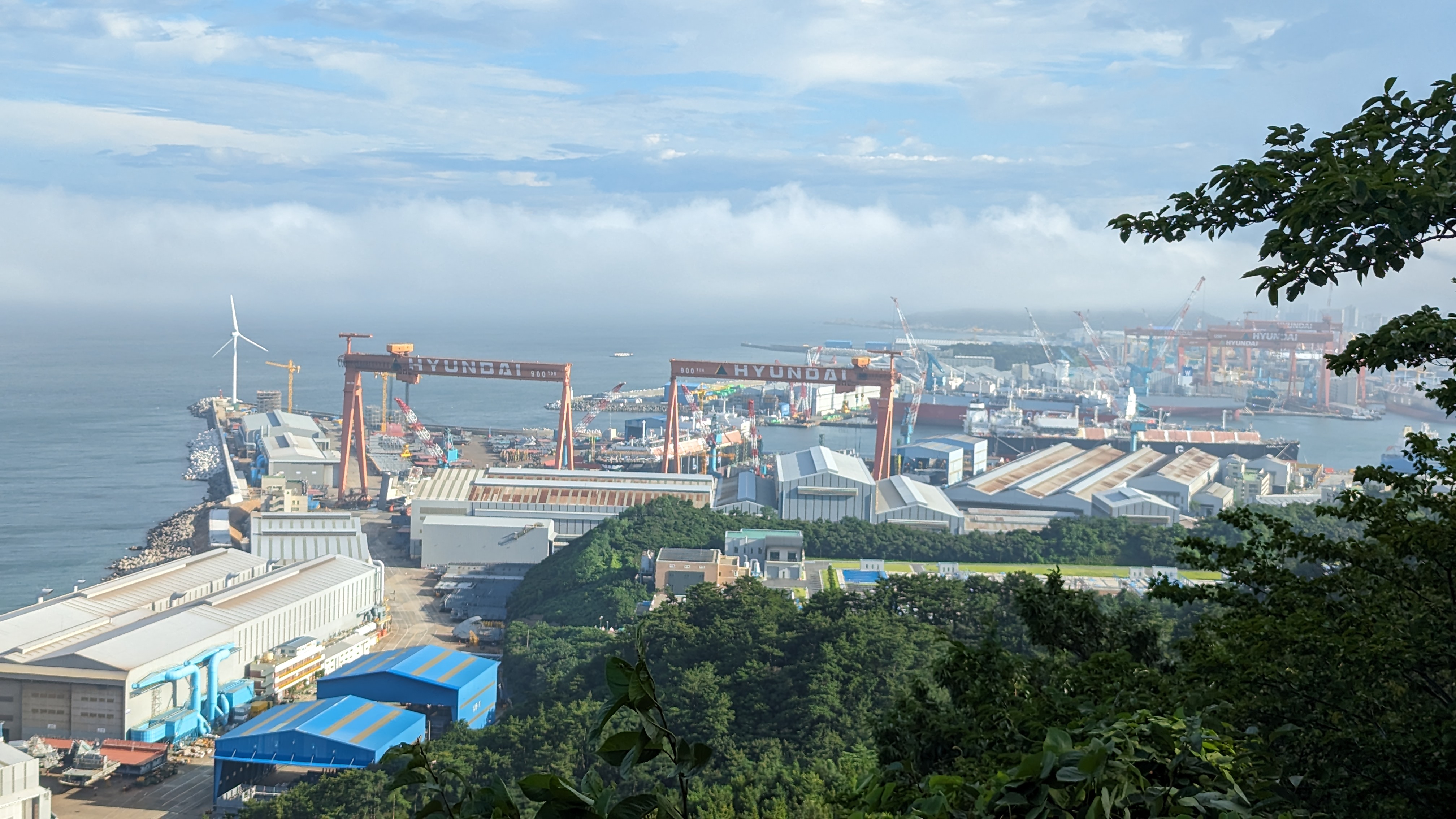
Photo: Wvdp / Wikimedia Commons; CC0 1.0 (https://creativecommons.org/publicdomain/zero/1.0/), 24 July 2023 archival photograph, cropped · Illustrative image.
A new warship in the water is a significant manufacturing achievement. It is not yet a purchase order. That is the central financial distinction in Anduril Industries’ collaboration with South Korea’s HD Hyundai Heavy Industries, which has produced the prototype ASV Alpha for future autonomous naval missions.
The 600-tonne-class uncrewed surface vessel was launched at HD Hyundai’s Ulsan yard on 12 November 2026. The shipbuilder disclosed the achievement on 15 November; trade publications followed on 16 November. The three dates should not be conflated into a fictitious 19 November launch. The partners have not announced an awarded US Navy production order for Alpha or a disclosed selling price.
What has actually been delivered?
The vessel physically exists and is intended to complete sea trials off Ulsan before moving to the United States for further demonstrations in early 2027. The companies signed their ship-development arrangement in November 2025, and the prototype reached launch in roughly 12 months. The achievement concerns hull construction and the integration programme; it does not demonstrate that every maritime mission or naval acceptance test has passed.
The vessel is designed to operate without an onboard crew, leaving internal space otherwise used for accommodation available for fuel and modular mission payloads. It combines HD Hyundai’s VAone shipboard autonomy—covering navigation and machinery-related functions—with Anduril’s Lattice mission-control system. Those are different layers. A ship that navigates itself must still prove the reliability of navigation, damage response, sensing, payload control, communications and human command arrangements.
The Anduril partnership statement originally emphasised modular payloads and a future family of dual-use vessels. It also said future ships designed for US Navy requirements would be manufactured in the United States, while Korea would provide early prototyping expertise. A launched Korean prototype does not establish that US domestic production is already at scale.
Private capital is taking a bet on a public buyer
WorkBoat reported on 16 November that the partners financed the prototype without a Navy or other government production order. That makes the commercial sequence unusually important: development spending precedes a demonstrated customer commitment.
Public defence contracts can be reported as enormous multi-year values, but a ceiling for potential orders is not revenue earned, let alone profit received. For Alpha, neither the firms’ development expenditure nor the terms for any future manufacturing sale have been disclosed in the source material. Treating the prototype as an awarded 30-ship contract would misrepresent the risk taken by the companies.
If the programme wins orders, Anduril could potentially earn through mission software, integration, systems engineering, support and vessel production work. HD Hyundai could benefit from shipbuilding expertise and future supply relationships. The actual division of future contract revenue, margins, ownership of intellectual property and recurring service charges has not been publicly quantified.
Why a 12-month build can matter without proving a ninefold cost saving
A shorter prototyping cycle can help a company reach customers earlier and learn from tests sooner. It may also limit some engineering and overhead expense—if design changes and rework do not erase those advantages. But a roughly one-year prototype timeline cannot be directly compared with the full design, construction, certification and acceptance cycle of a traditional crewed combatant.
The new vessel has not yet provided publicly measured combat reliability, an audited per-ship cost, qualification across its planned mission modules or repeat-build throughput. In shipbuilding, a prototype can be fast because it uses dedicated attention and expensive one-off work. Economies of scale require predictable manufacturing drawings, repeatable supplier deliveries, stable requirements, skilled labour and a funded order book.
That uncertainty is material to investors trying to assess a privately held defence company without public segment accounts. Large ambition is not a substitute for realised contractual gross margin.
A deliberately hypothetical fleet calculation
Imagine a customer eventually orders 20 vessels at an illustrative $60 million each. That would be a $1.2 billion gross contract value before maintenance, price changes, taxes and financing. If a hypothetical supplier earned a 15% gross margin, gross profit would be $180 million, before corporate overhead, R&D, financing and taxes. These numbers are simple editorial scenarios—not a published price for Alpha, a Navy budget, an Anduril forecast or evidence of a contract.
Change the unit price to $40 million and the same 20-vessel fleet would generate $800 million of hypothetical revenue. Change the gross margin to 5% and gross profit on that smaller example would be $40 million. The sensitivity shows why fleet count alone cannot reveal profits.
Nor should naval savings automatically be equated with the wages of a removed crew. Autonomous systems require communications, testing, remote operators, cybersecurity, software maintenance, sensors, fuel and new procedures. The absence of berths can improve space efficiency, but the full lifecycle cost must include procurement, deployment, failures and support.
The Navy is a large possible customer, not an established one
Naval News reports that the US Navy outlined plans in September 2026 for 30 medium-sized autonomous surface vessels. The report describes Alpha’s development as a bid to serve that evolving requirement. It does not establish that Anduril and HD Hyundai won those orders.
An actual procurement path can involve demonstrations, trials, funded prototype lots, open competition, requirements changes and acceptance. The pair face other shipbuilders and autonomous-vessel firms already developing competing systems. Their technology could be attractive without being selected for the next production award.
A separate October demonstration off Long Beach used a modified 368-tonne former Navy test vessel, not the new Alpha hull. Reported tests covered autonomous navigation, mission changes and responses to simulated problems. That earlier demonstration supports technical progress; it cannot replace the 2027 tests planned for the new vessel.
The three milestones that would change the investment thesis
First, watch for completed sea trials and disclosed test outcomes, rather than a demonstration schedule. Second, look for a funded customer order specifying quantity, scope and delivery conditions. Third, check evidence of repeatable US manufacturing and support capacity capable of turning a prototype into a maintained fleet.
Those milestones are distinct. A successful trial validates some technology. A contract validates demand and procurement decisions. A dependable production system begins to validate economics. All three are required before a prospective fleet can be interpreted as a durable business.
Our conclusion is restrained: Anduril and HD Hyundai have put an ambitious real asset in the water rapidly, but neither the US Navy order nor fleet profitability is established. Investors should separate demonstrated hardware, corporate claims and unawarded future opportunities.
Follow the Anduril company research profile, Blue Origin’s return-to-flight economics and the Compound finance directory for complementary discussion of capital-intensive technology businesses. Anduril is privately held; no listed Anduril stock quotation is implied.
Research checked 19 November 2026. Launch 12 November, first company announcement 15 November, detailed trade reporting 16 November. Illustration inputs are invented only for transparent sensitivity analysis, not reported company figures. Cover: HD Hyundai Ulsan yard, 24 July 2023, Wvdp, CC0, archival and not a photograph of Alpha.