Google Chose Blue Origin for Space-Based AI Computing. Who Captures the Economics?
Google's 19 November agreement gives New Glenn a proposed 2029 mission for space-based AI infrastructure, but launch revenue and the satellite business model remain undisclosed.
 Wealth / The Compound journal
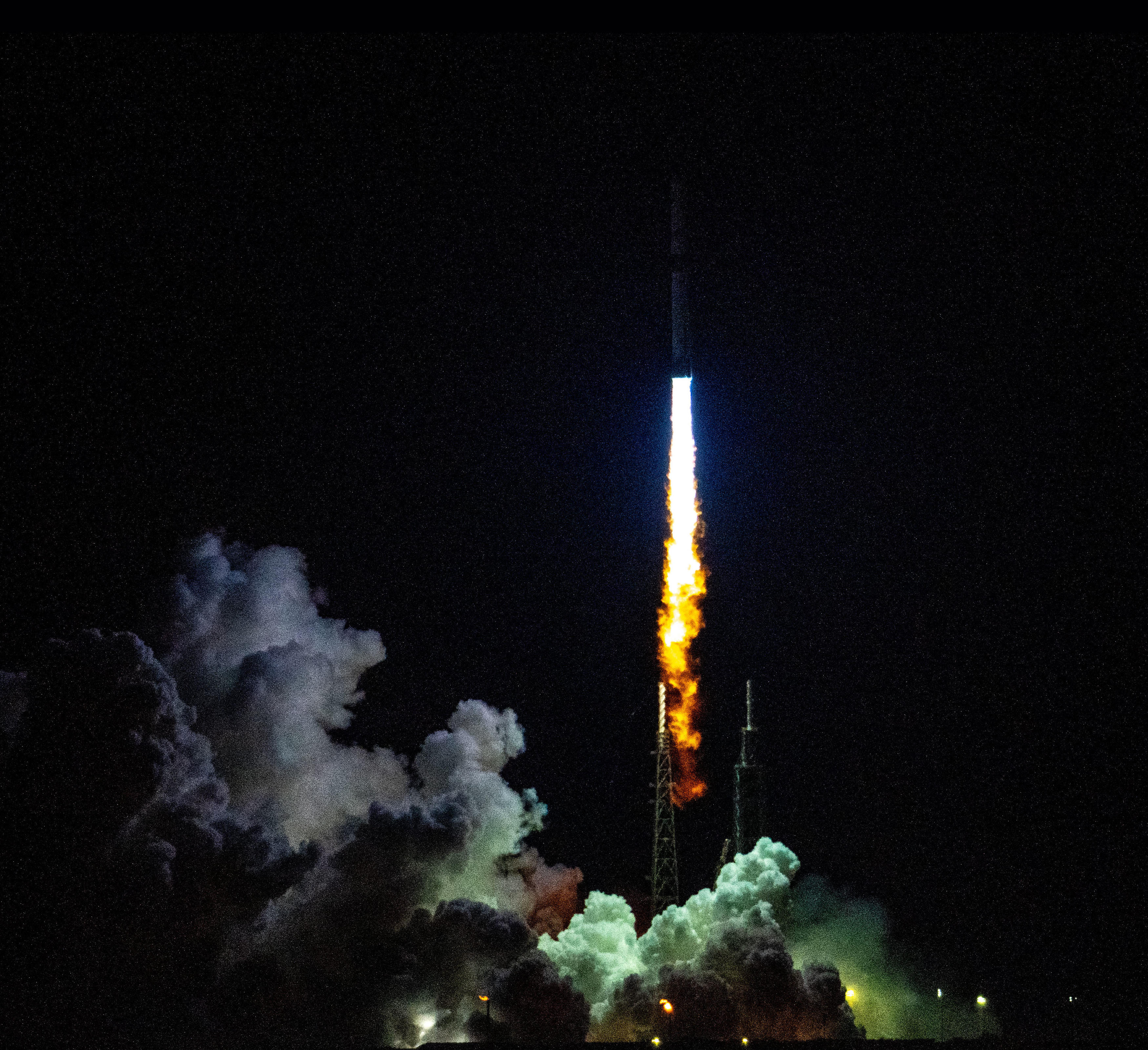
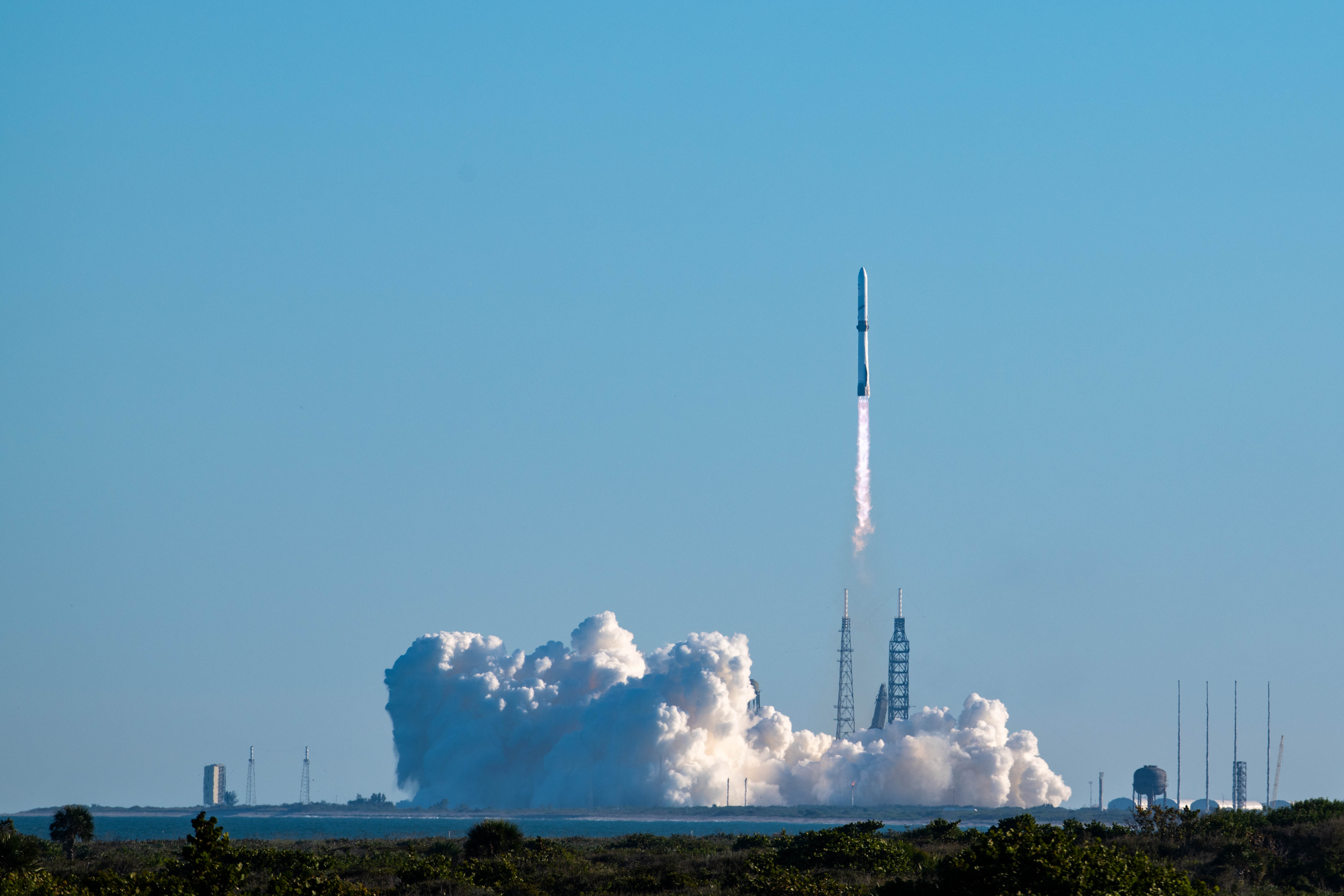
Photo: Senior Airman Samuel Becker / US Space Force, public domain federal work; actual New Glenn launch 13 November 2025, archival photograph adapted for crop · Illustrative image.
A launch contract for orbital AI infrastructure is a real commercial signal. It is not evidence that space-based computing is cheaper than a terrestrial data centre. That distinction is central to Blue Origin’s latest customer announcement and to the broader economics of private launch companies.
On 19 November 2026, Blue Origin announced that Google selected its New Glenn vehicle for the first dedicated heavy-lift launch for Project Suncatcher. Google’s research project envisages a network of solar-powered satellites equipped with Tensor Processing Units (TPUs), interconnected to perform machine-learning computation in orbit. The announced mission is targeted for the first quarter of 2029. It has not flown.
The parties describe a launch-services agreement, but neither publishes a contract price, number of subsequent missions, advance-payment schedule, launch margin or expected Google compute-service revenue. Those omissions should shape any investment analysis.
A launcher and an orbital compute customer are two businesses
Blue Origin is providing a rocket service. Google’s proposal concerns a much larger system: satellites, AI processors, solar power, communication links and operations across an orbital network. Their financial exposures are not interchangeable.
The customer wants to test whether sunlight, space-based infrastructure and specialized chips could eventually help scale AI computation. The launch provider wants to sell heavy-lift capacity. Even if the launch is successful, Blue Origin would not automatically own the satellites, sell the resulting compute, or receive a share of a future cloud-service subscription. No such revenue-sharing arrangement is disclosed.
Google says the planned satellites would each have computing capacity roughly comparable with a data-centre rack. That is a description of intended computing capability, not a verified rack-equivalent cost, GPU count, useful orbital lifetime or price per unit of model inference. A rack of processors in orbit is not a rack running workloads profitably on Earth.
Why 2029 is a target, not a booked year’s earnings
Space missions face manufacturing, integration, launch-readiness, ground-operations and regulatory milestones. Blue Origin’s release says the launch is targeted for Q1 2029, not that a date or outcome is guaranteed. Treating the agreement as completed 2026 revenue or a 2029 certainty would misstate both timing and execution risk.
The challenge is compounded by launch vehicle reliability and cadence. In an unrelated 10 November engine update, Blue Origin described qualification of a modified BE-4 main oxygen valve following an earlier hotfire anomaly and a fleet retrofit. That is evidence of work on a particular hardware issue, not proof that every future mission is cleared.
Blue Origin has also described construction at Launch Complex 36B to support expanded New Glenn operations. Additional infrastructure can support more launches over time, but it also requires capital and reliable operating demand. One announced future mission does not establish a recurring launch cadence.
A transparent launch-only scenario
Consider one hypothetical launch sold for $150 million, with an illustrative 20% gross margin. That would represent $30 million of gross profit before corporate overhead, research spending, financing and taxes. A launch at a 10% margin on the same invented price would produce $15 million. At $200 million and 20%, the illustrative gross profit would be $40 million.
| Invented launch case | Gross revenue | Assumed gross margin | Gross profit |
|---|---|---|---|
| Low-margin illustration | $150m | 10% | $15m |
| Mid illustration | $150m | 20% | $30m |
| Higher-price illustration | $200m | 20% | $40m |
These numbers are not disclosed Blue Origin prices, costs, margins, contract terms or forecasts. They illustrate sensitivity only. A launch could also lose money; gross margin says nothing about the invested capital needed to build reusable stages, launch infrastructure or the firm’s other programmes.
The scenario says nothing about the profitability of orbital AI. Google must solve different unit-economics problems, including satellite manufacturing, deployment, radiation tolerance, inter-satellite bandwidth, ground links, replacement cycles, operations, heat rejection and useful compute delivered to customers. Those costs cannot be inferred from Blue Origin’s launch statement.
The challenge behind the orbital-data-centre headline
Electricity is not the only cost of AI computation. Data centres pay for land, grid connections, cooling, backup systems, networking, processors and frequent hardware replacement. Space-based systems may access abundant solar energy, but they must also manage thermal radiation, orbital debris, maintenance limitations and latency to Earth. Solar availability alone does not determine end-to-end cost per useful AI task.
The critical comparison is fully delivered compute cost at a defined service level, not sunlight versus a grid electricity tariff. A serious benchmark would include launch and satellite replacement, lifetime usable processing hours, data transfer, effective uptime and all operational costs. The parties have not published sufficient information to calculate that comparison.
If Google’s mission succeeds, it could validate some engineering assumptions and create a new category of high-value payloads. If it fails, Blue Origin could still learn operationally from serving a demanding customer, although the direct contract economics remain unknown. The two commercial cases must be judged separately.
What investors and readers should watch
First, look for a confirmed integration and launch timetable, including evidence of completed readiness milestones. Second, look for repeat launch orders rather than automatically extrapolating one mission into a fleet. Third, watch for Google reporting measured orbital compute performance and lifecycle costs compared with terrestrial alternatives. Only then can a reader move beyond the appeal of the concept toward a defensible business model.
Blue Origin is privately held, with no public stock ticker or quarterly reporting from which to infer the profit on Project Suncatcher. Google is an Alphabet subsidiary, but Alphabet investors should also avoid treating this research project as a disclosed new cloud revenue line.
For context, compare Compound’s New Glenn return-to-flight analysis, Blue Origin research profile, and Alphabet AI economics. These offer different views of capital intensity without pretending that an undisclosed launch contract provides a company valuation.
Research checked 20 November 2026. Agreement announced 19 November; mission aimed for Q1 2029. All numerical commercial scenarios are invented illustrations. Cover: an actual 13 November 2025 New Glenn launch photographed by US Space Force Senior Airman Samuel Becker; public domain, archival and not a picture of Google’s proposed mission.