Alphabet’s $48 Billion Data-Centre Backstops Grew as Their Book Value Fell
Alphabet’s maximum exposure under executed data-centre backstops rose while its recorded liability fell. The difference matters when assessing the capital behind AI growth.
 Wealth / The Compound journal
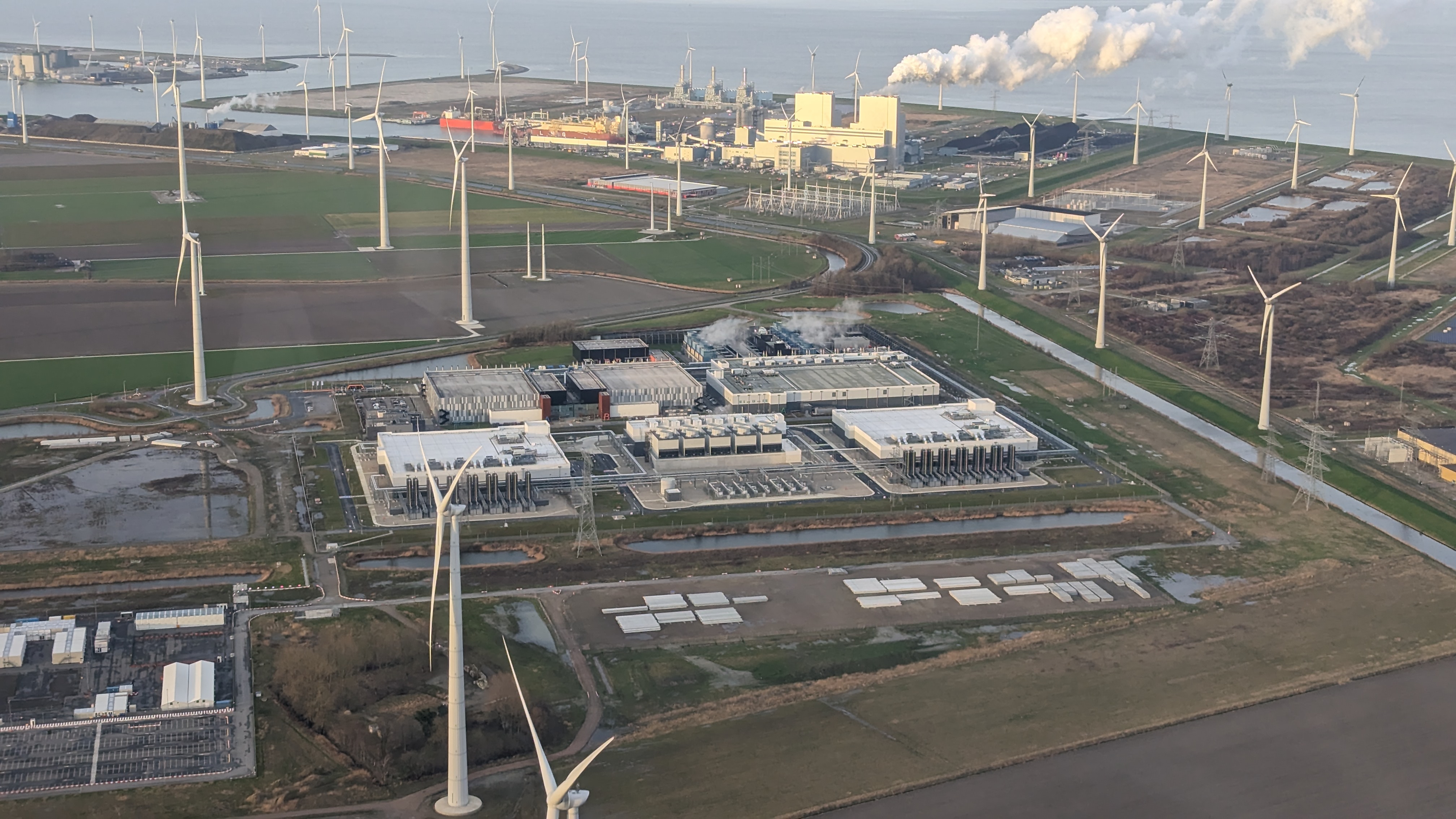
Photo: Wvdp / Wikimedia Commons, CC0 1.0. Archival photograph, 6 January 2023. Resized and cropped. · Illustrative image.
Alphabet’s AI expansion asks shareholders to assess more than the cash spent on servers. The company also puts its balance sheet behind other parties’ data-centre payments. A comparison of its latest two quarterly filings reveals why the size of that support and its accounting value need separate attention.
At 30 September 2026, executed credit backstops had a $48.012 billion notional amount, while their recorded fair-value liability was $606 million. The September Form 10-Q describes the notional amount as maximum potential payments under specified default scenarios. It is neither a bill due today nor a forecast loss.
More exposure, a smaller recorded liability
The June filing, Note 3, supplies the comparison:
| Executed credit derivatives | 30 June 2026 | 30 September 2026 |
|---|---|---|
| Maximum potential payments, or notional amount | $43.785bn | $48.012bn |
| Fair-value liability | $815m | $606m |
Compound’s calculations show that potential payments increased $4.227 billion, or 9.7%, while the liability declined $209 million, or 25.6%. Dividing liability by notional gives approximately 1.86% in June and 1.26% in September.
Those ratios are not probabilities of default. The June filing explains that valuation uses models incorporating counterparty risk, default rates, interest rates and contractual rights. Different payment dates and recoveries also make a dollar payable in a bad future outcome different from a dollar of liability today. The two balances alone cannot establish why the valuation changed.
For investors, the practical error would be to conclude that the smaller liability means the total undertaking shrank. The opposite happened to the disclosed payment ceiling. Equally, subtracting the entire ceiling from equity value as a certain loss would discard the conditions attached to it.
What could Alphabet receive if it has to pay?
The June disclosure describes contracts lasting up to 15 years, with exposure declining as underlying payments are fulfilled. Following default, Alphabet can take over leases for its own use or sublet them. Certain arrangements permit termination payments, potentially offset by cash or equity receipts that are excluded from notional exposure.
That creates an operational question alongside the credit question: would the inherited capacity be useful at the moment Alphabet needed to take it over?
If a tenant failed for reasons specific to that business while demand for computing remained strong, usable space and power could have considerable value. If several customers struggled because industry demand disappointed, spare capacity might be harder to redeploy profitably. These are analytical scenarios, not reported defaults or predictions about any counterparty.
A single percentage haircut applied to all backstops would conceal that difference. Location, power availability, lease pricing and the equipment needed to use a site could matter as much as the headline commitment.
The $48 billion is only the executed portion
September’s filing separately identifies $27.7 billion of future backstops, producing $75.7 billion of total data-centre support on its rounded figures. $10 billion relating to Crux AI is included in the future portion; adding it again would double-count it. These are commitments, not reported cash outflows. Crux is an unconsolidated related-party venture; these figures do not establish its standalone creditworthiness.
This distinction also prevents a false quarter-to-quarter growth calculation: the $75.7 billion combined figure should not be compared with June’s executed-only $43.785 billion. The table above keeps the same category on both sides.
The return test for shareholders
On the third-quarter earnings call, management said it expected returns on invested capital to remain meaningfully above its cost of capital. That is an expectation, not a realised return on these backstop agreements.
The strongest investment case is that financial support helps secure infrastructure whose commercial value exceeds its full cost and risk. The concern is that an investor counting only current cash expenditure could overstate how much expansion risk has been transferred to partners.
Future filings should therefore be read for three separate developments: growth in executed exposure, changes in its valuation, and evidence of actual payments or capacity taken over. A larger ceiling need not be bad capital allocation, but a smaller book liability is insufficient evidence that the commitment has become less consequential.
See the Alphabet stock profile, the separate cash-flow and capital-expenditure analysis, and Waymo’s borrowing terms for other parts of the group’s funding picture.
Research checked 20 November 2026. Figures describe filed historical positions; calculations and scenarios are Compound analysis, not company guidance or personalised investment advice.
Archival cover: Google’s Eemshaven data centre, photographed by Wvdp on 6 January 2023. Original image, CC0 1.0. Resized and cropped. It illustrates physical infrastructure; it does not identify a property covered by these backstops.