Tesla's Roadster Flew. Can It Actually Move the Business?
Tesla's October 2026 Roadster unveiling was a striking engineering demonstration. But a simple revenue model shows why its significance to shareholders may be more about the brand than sales.
 News / Wealth
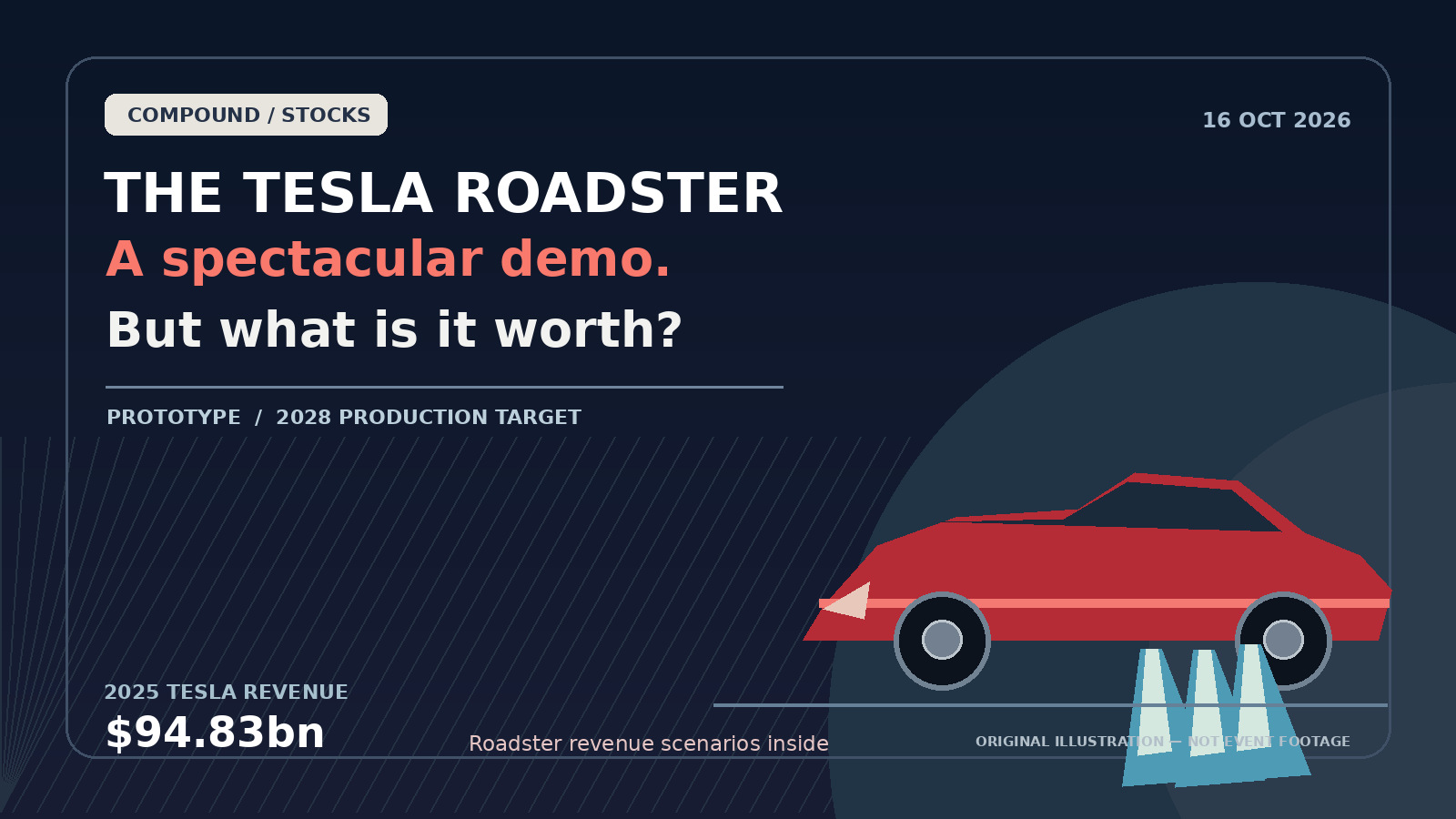
Photo: Original editorial illustration: Compound.ie · Illustrative image.
The new Tesla Roadster has finally had its moment. At a 15 October 2026 event at SpaceX’s McGregor facility in Texas, a prototype used fans and thrusters to negotiate an inverted ramp, turn in the air and jump past a lineup of Tesla vehicles. The display was extraordinary. It also left the most important investor question unanswered: how much money can this car realistically make?
Tesla says production will begin in 2028. That is a target, not a delivered production vehicle. The Roadster was originally shown in 2017 with a 2020 delivery ambition. Nor did Thursday’s event establish a final selling price, an annual production volume or a product-level profit margin. Reuters’ event report makes those limitations clear.
THE INVESTOR TAKEAWAY
The Roadster could be an exceptional halo product without being a material profit engine. The next earnings report matters more than the stunt for measuring Tesla's business.
For the ongoing financial picture, see Tesla’s updating stock and SEC earnings dashboard. This article is the first in Compound’s weekly Magnificent Seven research series.
What did Tesla actually demonstrate?
The car on stage was a prototype, not proof of a road-legal consumer production model. Reports from Reuters and TechCrunch describe a combination of powerful fans, suction and compressed-air thrusters that helped the vehicle move across unusual surfaces and briefly travel through the air. That is not the same as demonstrating sustained, practical flight.
Tesla also demonstrated an extremely fast 0–60mph run, while giving a tentative production start of 2028. Whether the final vehicle will include the same capabilities, under what regulatory restrictions, and how safely they could be used outside a controlled facility remain open questions.
The important distinction for shareholders is between a working demonstration, a manufacturable product and a product that produces attractive returns on invested capital. Each requires a different kind of evidence.
How big could Roadster sales be?
Tesla reported $94.827 billion of total revenue in 2025, including $69.526 billion of automotive revenue and $12.771 billion from energy generation and storage. Those numbers are in its 2025 Form 10-K.
We can model hypothetical Roadster economics without pretending to know Tesla’s eventual price or sales forecast. The table assumes $200,000 revenue per delivered car purely as a convenient illustration, inspired by the historic 2017 price indication. Tesla did not announce a final 2026 Roadster price. We also assume a 25% gross margin in each scenario; Tesla has not guided to that figure.
COMPOUND / ORIGINAL SCENARIO MODEL
Roadster revenue versus Tesla's 2025 business
Hypothetical annual delivery volumes at a fixed $200,000 realised selling price. Not company guidance.
| Annual Roadsters | Sales revenue | Share of 2025 Tesla revenue | Gross profit at 25% |
|---|---|---|---|
| 1,000 | $200m | 0.21% | $50m |
| 5,000 | $1.0bn | 1.05% | $250m |
| 10,000 | $2.0bn | 2.11% | $500m |
Roadster sales as a share of Tesla's 2025 revenue (maximum visual scale: 2.11%)
Method: delivered units × illustrative $200,000 per vehicle; percentage = Roadster sales ÷ Tesla's actual 2025 revenue of $94.827bn; illustrative gross profit = revenue × 25%. The 25% gross margin is an assumption, not Tesla guidance. These scenarios do not deduct product development, overhead, financing, taxes or capital expenditure. Gross profit is not net income, free cash flow or shareholder value.
Even the very large 10,000-cars-per-year hypothetical would equate to only around 2.1% of Tesla’s 2025 company-wide sales. And that says nothing about how realistic 10,000 annual luxury-supercar deliveries might be. It is an intentionally stretching scenario, not a forecast.
This makes the financial case more interesting: a Roadster that sells in small volumes may still be strategically valuable, but it is unlikely to transform Tesla’s consolidated earnings through car sales alone.
The stronger bull case: a halo product
Supercars can serve a purpose beyond their own profit-and-loss account. A highly visible demonstration could strengthen the perception that Tesla still takes engineering risks, help attract talent, and create attention for the wider brand.
The original 2008 Roadster helped position electric powertrains as exciting rather than merely economical. The latest Roadster could play a similar communications role. A successful halo product might support demand for more mainstream vehicles even if it never becomes a mass-market earner.
There is also a credible engineering argument: teams working on advanced controls, power electronics, lightweight structures and thermal management might develop knowledge applicable elsewhere. But spillover benefits must be demonstrated, not assumed. Thrusters suitable for a one-off stunt do not automatically improve the economics of a Model Y, Cybercab or battery installation.
This is why the appropriate investor question is not simply whether the Roadster succeeds. It is whether the brand or technology benefit justifies the time, investment and complexity relative to Tesla’s larger opportunities.
The bear case: expensive distraction and execution risk
The Roadster has been delayed repeatedly since its 2017 introduction. The new 2028 target is another promise that must be judged against an actual production line and eventual deliveries, not against the stage demonstration.
Compressed-air propulsion, fan systems, safety hardware and aerial manoeuvres could complicate vehicle weight, certification, reliability and service requirements. There is a material difference between impressing a controlled audience and maintaining a road-going product safely across years of customer use.
Reservation deposits should not be confused with revenue. Reuters reported reservation requirements for various trims but also noted final pricing remained undisclosed. A deposit signals potential customer interest; it does not establish a profitable sale or guarantee a delivery date.
For shareholders, opportunity cost matters. An engineering programme allocated to a bespoke Roadster cannot simultaneously work on manufacturing efficiency, automotive margins, autonomy or energy storage unless capacity is genuinely additive.
What matters more in Tesla’s next earnings?
Look at Tesla’s existing scale. Its Q2 2026 Form 10-Q recorded $28.236bn in quarterly revenue, including $20.516bn in automotive revenue and $3.139bn in energy generation and storage revenue. Its GAAP operating income was only $398m for that quarter, despite the large revenue figure.
That is where a small movement in operating margins could outweigh an entire year of Roadster profits under many plausible scenarios.
Reuters reported that Tesla’s third-quarter results were scheduled for 21 October 2026. Investors should focus on these measurable disclosures rather than extrapolate from a product launch:
- Automotive operating and gross-margin trends: Is the main vehicle business improving sustainably, excluding temporary credits or exceptional items?
- Energy storage growth and profitability: Is Tesla expanding a business with meaningful incremental earnings and cash flow?
- Cash generation versus investment: How much does capital expenditure consume, particularly around AI, robotics and new manufacturing?
- Roadster execution milestones: Is a production-ready design validated, and are cost, schedule and volumes disclosed?
- Potential related-party collaboration: What are the financial terms of Tesla–SpaceX technology sharing, and how are shareholder conflicts managed?
The event revived discussion of Tesla and SpaceX’s relationship. But technology collaboration is not evidence of a binding corporate merger. For that separate question, read our Tesla–SpaceX merger research and shareholder analysis.
The verdict for Tesla investors
The Roadster reveal succeeded as an engineering show. It did not establish a new revenue forecast, a margin target, reliable delivery timing or a direct valuation uplift. Our scenario analysis shows just how substantial hypothetical deliveries would need to become before the Roadster represented even a modest share of today’s Tesla.
The better bull argument is that the Roadster becomes a halo for Tesla’s technology and brand. The stronger bear argument is that the demonstration represents a costly distraction with a long record of delays. Both are reasonable hypotheses; neither is proved by the stunt.
The next result worth watching is a filing, not a flying car. Start with the Tesla stock and earnings dashboard for continuously updated SEC-backed numbers.
Research note: Published 16 October 2026. All dollar figures are US dollars. Scenarios are original Compound calculations from explicitly hypothetical assumptions and Tesla’s filed historical revenue. No personalised investment recommendation is made.