November fuel prices fall slightly, but Irish public EV charging rises sharply
AA Ireland's November survey puts petrol at €1.96 and diesel at €2.13 a litre, while ESB pay-as-you-go fast charging rises to 83c/kWh. We calculate the difference.
 News / Wealth
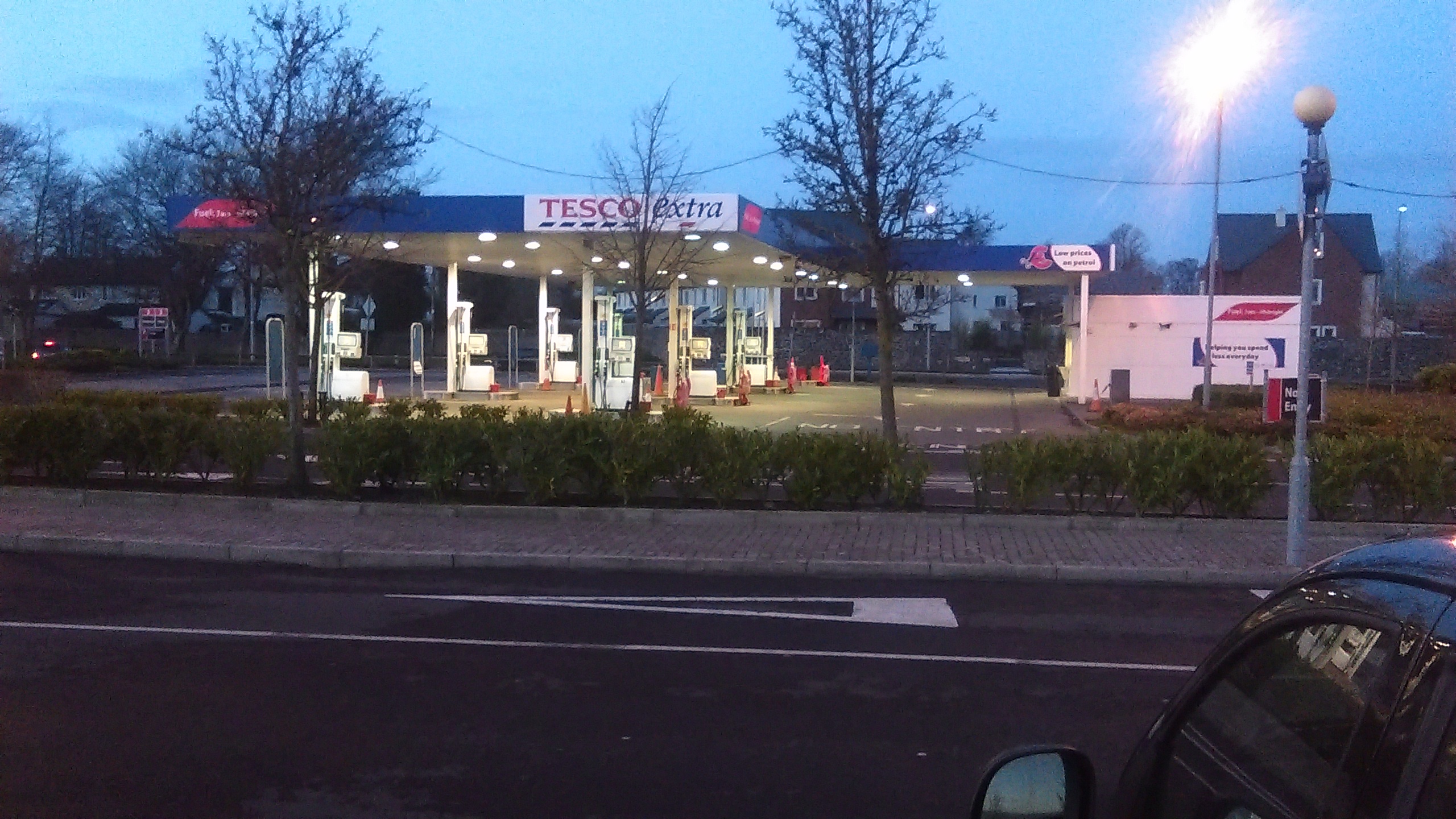
Photo: IFP2016, Tesco petrol station, Maynooth, 26 December 2016, Wikimedia Commons, CC BY-SA 4.0 · Illustrative image.
AA Ireland’s November fuel price survey, released on Monday 9 November, brings modest relief at Irish petrol pumps, but a different result for drivers who rely on public EV chargers. Average petrol is €1.96 a litre and diesel €2.13, each down by roughly 1% on October. Meanwhile, the AA reports a new increase in ESB public charging charges effective from 2 November.
The useful question is not whether petrol has become cheaper in the abstract. It is how much a tank or charging session costs, which tariff applies, and whether a household can charge its EV at home.
What does the November pump-price change save?
| AA Ireland survey | October average | November average | Monthly movement |
|---|---|---|---|
| Petrol | About €1.98/L | €1.96/L | Down 2.26c/L |
| Diesel | About €2.15/L | €2.13/L | Down 1.87c/L |
| Petrol, 40-litre fill | About €79.26 | €78.36 | Saving roughly €0.90 |
| Diesel, 50-litre fill | About €107.39 | €106.45 | Saving roughly €0.94 |
These are national survey averages, not pump prices guaranteed at an individual forecourt. The fill figures are the AA’s published examples, using its underlying unrounded averages; multiplying the rounded €1.96 and €2.13 figures gives slightly different totals. Four similar fills in a month would save around €3.62 for petrol or €3.74 for diesel compared with October, before changes to mileage or driving style. AA survey and worked examples
The November decline also follows a much larger October increase: 11.3c per litre for petrol and 20.56c for diesel, according to the AA. Prices therefore have not returned to earlier levels.
ESB fast charging: what does 83c per kWh mean?
AA Ireland says the pay-as-you-go price in the ESB app increased from 72c to 83c/kWh for fast chargers on 2 November, while its standard charger rate rose from 60c to 70c/kWh. These figures relate to the stated pay-as-you-go channel, not every subscription, fleet or roaming tariff.
| Illustrative charging session | Previous rate | November rate | Additional cost |
|---|---|---|---|
| 30kWh at an ESB fast charger | €21.60 | €24.90 | €3.30 |
| 50kWh at an ESB fast charger | €36.00 | €41.50 | €5.50 |
| 50kWh at a standard charger | €30.00 | €35.00 | €5.00 |
These examples multiply billed energy by the unit price and assume no extra parking, overstay or other fees. A 50kWh session is energy delivered, not the battery’s advertised capacity. Actual cost depends on the energy required and the price displayed in the operator’s app before charging. AA’s November findings
Is an EV still cheaper to run?
The answer depends heavily on where and when the car charges. At an illustrative consumption of 18kWh per 100km, buying all electricity at 83c/kWh costs €14.94 per 100km before charging losses and ancillary fees. At a hypothetical home tariff of 17c/kWh it is €3.06 per 100km on the same energy basis. A petrol car using 6 litres per 100km at €1.96/L costs €11.76 per 100km in fuel. These are comparable arithmetic examples, not claims about a particular vehicle or household tariff.
A driver who uses home or workplace electricity most of the time can have a very different bill from someone dependent on fast chargers. Check the price of energy actually billed, any standing charges or subscription fees, and the vehicle’s real consumption. The EV versus petrol and diesel guide explains the wider ownership decision. The electricity tariff guide explains why the cheapest charging window can matter more than a headline unit rate.
What to do: Look at your last two fuel or charging statements, calculate your litres or kWh per month, and apply your own supplier’s current tariff rather than assuming the national average is your price. For EV owners paying to charge publicly, verify the displayed price immediately before a session.
Cover: IFP2016, archive photograph of a Maynooth petrol station, 26 December 2016, Wikimedia Commons, CC BY-SA 4.0. Cropped for web/social display. The photograph does not show November 2026 fuel prices.