What happens when you stop taking a GLP-1 medicine?
Weight regain is common in withdrawal trials, but the headlines need context. What the evidence shows, what it cannot predict, and how to plan the next stage of care.
 Health / The Compound journal
Illustration: Compound.
Evidence checked 14 September 2026. This guide concerns adult weight-management treatment. It is not a stopping, tapering or restarting schedule.
Starting a medicine comes with instructions. Stopping can feel much less clearly mapped out.
Perhaps the cost has become difficult to sustain. Perhaps side effects are interfering with everyday life, or pregnancy is being planned. Perhaps treatment has helped and the question is whether it is still needed. Those are different situations, but all deserve a conversation about what happens next.
The research gives one clear reason to have that conversation: people commonly regain weight after semaglutide or tirzepatide is withdrawn. It does not establish that everyone regains everything, or that an individual has failed if their weight increases. The useful question is how to keep care in place when the treatment changes.
What “two-thirds regained” actually means
The widely reported figure comes from the STEP 1 extension. Researchers followed a subset of 327 adults from a trial of semaglutide 2.4 mg for overweight or obesity; participants did not have diabetes. Medication and the structured lifestyle intervention both ended after 68 weeks.
In the semaglutide group, average weight loss was 17.3% at that point. Over the following year, participants regained about two-thirds of the weight previously lost. The reported average net reduction from their original weight was still 5.6% at week 120. Several cardiometabolic improvements moved back towards baseline. Wilding and colleagues, STEP 1 extension
Two-thirds refers to the previous loss, not two-thirds of someone’s body weight. For a simple illustration, regaining two-thirds of a 15 kg loss would mean regaining 10 kg. That arithmetic explains the phrase; it is not a forecast for a person who has lost 15 kg.
This was an exploratory extension in a subset of participants, with lifestyle support withdrawn too. It cannot cleanly separate the effects of ending each part of care. The study was funded by Novo Nordisk. Those limitations belong alongside the headline.
A stronger test: continue treatment or switch to placebo
In SURMOUNT-4, 670 adults without diabetes were randomised after 36 weeks of tirzepatide: continue 10 mg or 15 mg, as tolerated, or switch to placebo for 52 weeks. Lifestyle counselling continued in both groups.
By week 88, total average weight loss from the original baseline was 25.3% with continued treatment and 9.9% after switching to placebo. Aronne and colleagues, SURMOUNT-4
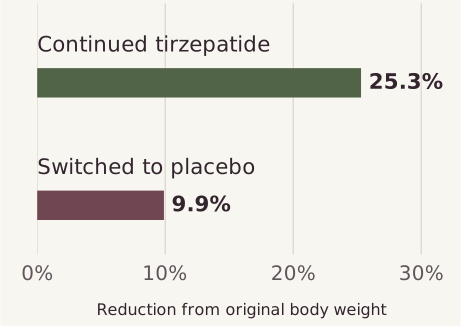
The reported 14% regain uses weight at week 36 as its denominator. It cannot simply be subtracted from the initial percentage loss. The chart uses one reference point throughout.
Randomisation strengthens the evidence. However, participants had already reached this stage on treatment; they do not represent every starter. Eli Lilly funded the trial.
Semaglutide shows the same broad pattern
STEP 4 provides another randomised comparison. After a 20-week semaglutide run-in, 803 adults without diabetes continued semaglutide 2.4 mg or switched to placebo, with lifestyle intervention in both groups.
During the next 48 weeks, the continued-treatment group lost a further 7.9% on average; the placebo group gained 6.9%. Both changes are measured from week 20, not from the original pretreatment weight. Rubino and colleagues, STEP 4
That supports the finding that continued medication helps maintain weight reduction. It still does not compare every possible approach to stopping. The trial selected people able to reach the treatment stage required for randomisation, and Novo Nordisk funded it.
Taken together, these studies make regain something to plan for. They do not justify treating it as inevitable in exactly the same amount for everyone.
Does this mean treatment has to last forever?
These trials cannot answer a lifetime question. They followed people for defined periods, using particular doses and study conditions. None establishes the best duration for every patient, or a personalised taper that reliably prevents regain.
The World Health Organization’s December 2025 guidance conditionally supports long-term GLP-1 treatment for adults with obesity, excluding pregnant women. It explicitly notes gaps around long-term use, maintenance and discontinuation, alongside costs and access. Structured dietary and physical-activity support may also be offered, but the certainty of evidence for that additional recommendation is low. WHO guidance
Long-term treatment should therefore mean ongoing review, not an assumption that the prescription can never change. Equally, having reached a target weight does not by itself answer whether the treatment’s benefits are still needed.
An honest review can hold both ideas: a medicine may be doing useful work, and continuing it may be difficult, unsuitable or no longer the preferred option for that person.
Build the follow-up plan before the last prescription
These are useful questions to take to the prescriber. They are a conversation guide, not a universal monitoring protocol.
| Ask about | A concrete answer to leave with |
|---|---|
| The reason for stopping | Is the issue cost, symptoms, pregnancy planning, treatment response or something else? What options are appropriate? |
| Follow-up | Who will review you, when, and which changes should prompt an earlier appointment? |
| Health beyond weight | Which existing conditions or measurements need attention, and whether other prescriptions need review. |
| Practical support | What dietary, activity or psychological support is available and realistic for your circumstances. |
| If circumstances change | Who to contact if symptoms, affordability or access change again. Avoid improvising with remaining medication. |
If money is the deciding factor, say so before the prescription runs out. The Irish funding guide explains the schemes and their limits. It cannot promise an alternative will be funded, but it can help make the conversation more specific than “I cannot keep paying.”
If side effects are driving the decision, their severity matters. Use our side-effects and warning-sign guide to distinguish symptoms for a routine review from those needing urgent care. A planned appointment is not a reason to delay urgent assessment.
Three situations that need their own advice
Treatment for diabetes. The withdrawal studies above excluded diabetes. Their weight findings are not a diabetes-management plan. Ozempic is authorised for type 2 diabetes, so stopping it requires attention to the condition it is treating, not just body weight. EMA: Ozempic
Planning pregnancy. Product-specific timing matters. Wegovy information says semaglutide should be discontinued at least two months before a planned pregnancy; Mounjaro information specifies at least one month for tirzepatide. Discuss this with the prescriber in advance, including any diabetes care. Wegovy product information, Mounjaro product information
Restarting after a gap. Do not assume the old dose is the right starting point. Wegovy’s product information says a reduced starting dose should be considered when reinitiating after multiple missed doses. Ask for product-specific advice rather than treating a leftover pen as a restart plan. EMA: Wegovy, section 4.2
The last injection does not have to be the last point of contact. Agreeing the next appointment, the reasons to seek help sooner and the support available gives the next stage some structure. That remains worthwhile whether weight stays steady, rises or falls.
More on GLP-1 medicines in Ireland
- GLP-1 medicines in Ireland: evidence, benefits and access — The main Irish GLP-1 overview.
- How to get Ozempic in Ireland — Understand prescription access and alternatives.
- Wegovy, Mounjaro and Ozempic costs in Ireland — The cost of staying on treatment.
- GLP-1 side effects and when to seek help — Common effects and warning signs.
- GLP-1 medicines and the HSE / Medical Card — How current Irish funding works.