IDEXX's Recurring Diagnostics Engine Is Expanding. How Durable Is It?
IDEXX is growing recurring veterinary diagnostics revenue faster than its installed base. The test is whether innovation and testing volumes can sustain that momentum.
 Wealth / The Compound journal
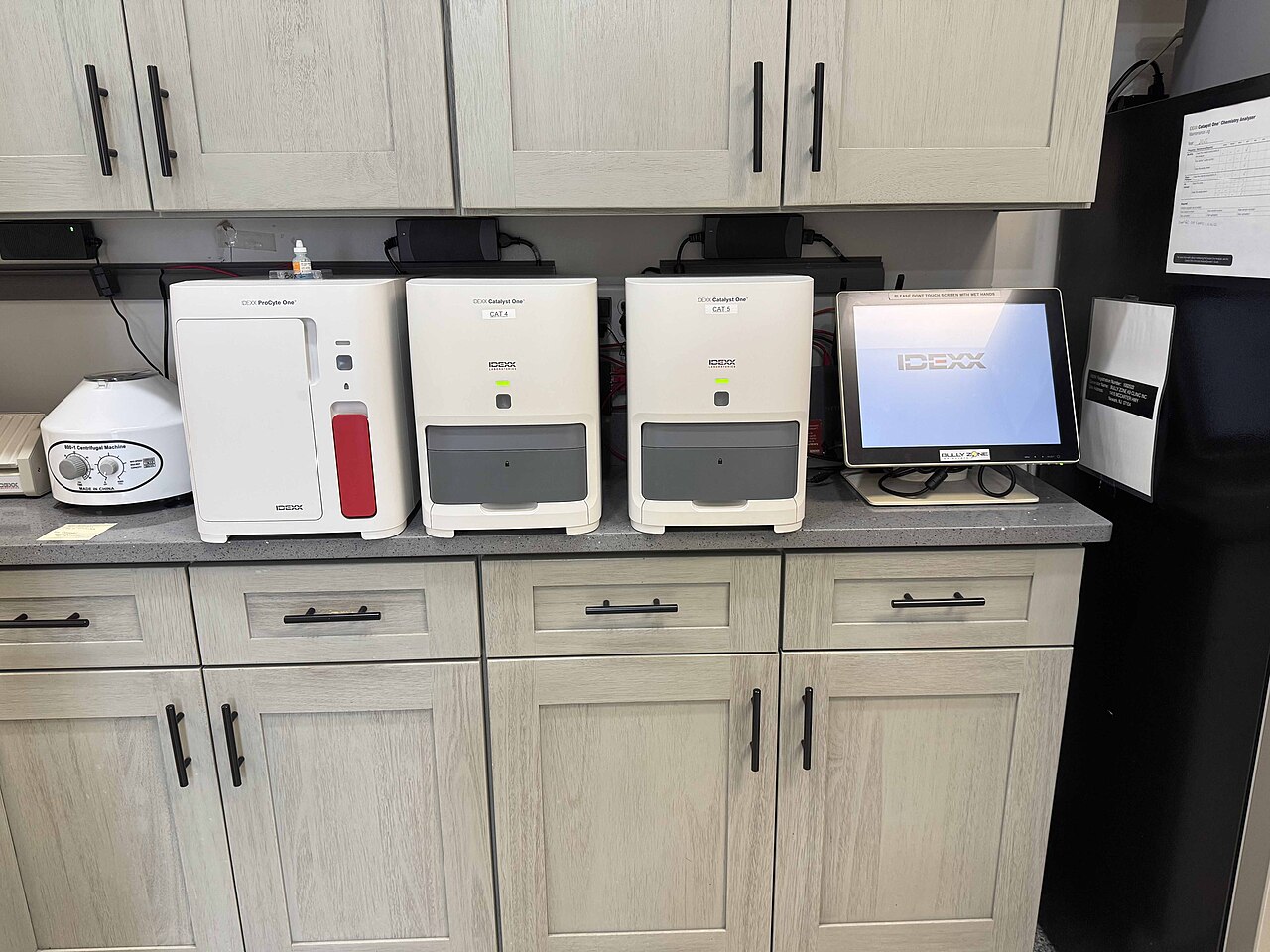
Photo: Ali Merchant / Veterinarian Pet Alliance / Wikimedia Commons, CC BY 4.0. Photographed 2 June 2026; archival clinic photograph. · Illustrative image.
IDEXX sells diagnostic instruments, but the more important economics arrive after installation. Consumables, reference-laboratory tests and software can turn a one-off placement into a recurring relationship with a veterinary practice.
That engine strengthened in the quarter ended 30 September 2026. IDEXX reported $1.214 billion of revenue, up 10%, while Companion Animal Group diagnostics recurring revenue increased 11% on both a reported and organic basis. Gross margin rose 1.1 percentage points to 62.9%, and operating margin reached 33.1%.
The investment question is whether this is a durable installed-base effect or a particularly strong period for testing volumes and pricing. For the maintained financial record, see IDEXX’s stock profile. This analysis focuses on the business behind the quarterly figures.
The installed base matters because it creates repeat demand
IDEXX’s Q3 results release says the global installed base of premium instruments expanded 11%. The company also placed more than 1,900 inVue Dx analysers during the quarter, taking that product’s installed base to nearly 11,000.
Instrument revenue itself was flat. Higher placements were offset by lower realised prices linked to placement programmes. That is not necessarily a weakness: an instrument can be economically useful even if the initial sale carries a modest margin, provided it drives profitable consumable use and testing over time.
The evidence is in the recurring categories. VetLab consumables revenue grew 14% as reported and 15% organically. Reference-laboratory diagnostic and consulting revenue rose 10%. Both benefited from higher volumes and prices, while the installed base and expanded test menus helped consumable demand.
The model resembles a flywheel. More instruments create more places where IDEXX tests can be run; a broader menu can increase use per instrument; and higher testing activity strengthens the value of the system to clinics. The risk is that this logic can be overstated if placements require progressively heavier discounts or if practices do not increase utilisation.
Growth was not just a price story
IDEXX’s 10-Q attributes recurring diagnostics growth to both volumes and realised prices. It cites more testing by existing customers, new customer additions and use of an expanded menu. Reference-lab volume increased across all major regions.
That mix is healthier than growth driven only by price. Veterinary practices and pet owners have limits, and repeated price increases can eventually reduce testing or encourage alternatives. Volume growth suggests that the clinical workflow and product offering are contributing too.
One category shows the constraint. Rapid-assay revenue increased only 1%, with price gains largely offset by lower testing volumes. Some pancreatic-lipase testing also moved to IDEXX’s Catalyst instrument platform. The shift may retain economics inside the wider system, but it shows why category-level trends matter: not every part of diagnostics is expanding at the same rate.
International recurring diagnostics revenue grew faster than the US—13% reported and 14% organic, against 10% in the US. That broadens the opportunity, though currency, local pricing and different veterinary markets can make international growth less predictable.
Margin expansion makes the growth more valuable
Quarterly gross profit increased 12%, faster than revenue. IDEXX said the margin gain reflected higher consumable volumes, favourable business mix, productivity and net pricing, partly offset by inflation. Operating expenses still grew 10% as the company invested in commercial capacity and innovation, yet operating margin expanded by one percentage point.
That is the attractive version of an installed-base model: recurring revenue grows, higher-margin activity becomes a larger part of the mix, and fixed infrastructure supports operating leverage.
However, full-year guidance contains a useful caution. IDEXX raised its 2026 revenue range to $4.741 billion–$4.767 billion and lifted its EPS range to $14.96–$15.16, but lowered its reported operating-margin outlook to 32.1%–32.3% from 32.3%–32.5%. Recent acquisitions, including veterinary software business CoVet, are part of that bridge. A strong quarter does not guarantee that every investment converts immediately into margin.
Cash conversion supports investment, but compare like with like
For the first nine months of 2026, operating cash flow rose to $1.063 billion from $826 million. Net income was $934 million, so operating cash flow exceeded accounting profit over that period. IDEXX estimates about $160 million of capital expenditure for the full year and guides to free cash flow equal to 95%–100% of net income.
Free cash flow is the company’s non-GAAP measure after capital spending. It still needs context: working-capital timing helped the year-on-year cash comparison, while the CoVet acquisition appears in investing cash flow rather than ordinary capital expenditure.
The best outcome is continued recurring-volume growth alongside stable customer economics, margin expansion and strong cash conversion. The weaker outcome would be placements growing faster than use, pricing carrying too much of revenue growth, or acquisitions adding cost without strengthening diagnostics demand.
IDEXX’s recurring engine is currently doing more than its instrument sales alone suggest. The next proof is sustained testing growth per installed system, not simply another large placement number. A valuation conclusion also requires a current share price and explicit assumptions; this analysis makes no price target.
Explore Compound’s earnings hub and our guide to investment diversification.
Reported figures are in US dollars and relate to Q3 or the first nine months of 2026 unless stated otherwise. Facts come from IDEXX’s SEC-furnished results release and Form 10-Q; management explanations are attributed and interpretation is Compound’s. General information, not personal investment advice.
Cover: Ali Merchant / Veterinarian Pet Alliance, Wikimedia Commons, under CC BY 4.0. Photographed 2 June 2026 at a veterinary clinic in Newark, New Jersey; the visible analysers are IDEXX-branded. Archival and resized for publication; display and social-image cropping may apply.