Databricks Wants Genie to Work Without Being Asked. Who Pays for the Always-On Agent?
Databricks' 11 November announcement moves Genie toward persistent autonomous enterprise work. The value depends on governed context, reliable task completion, and operating cost—not a demo.
 Wealth / The Compound journal
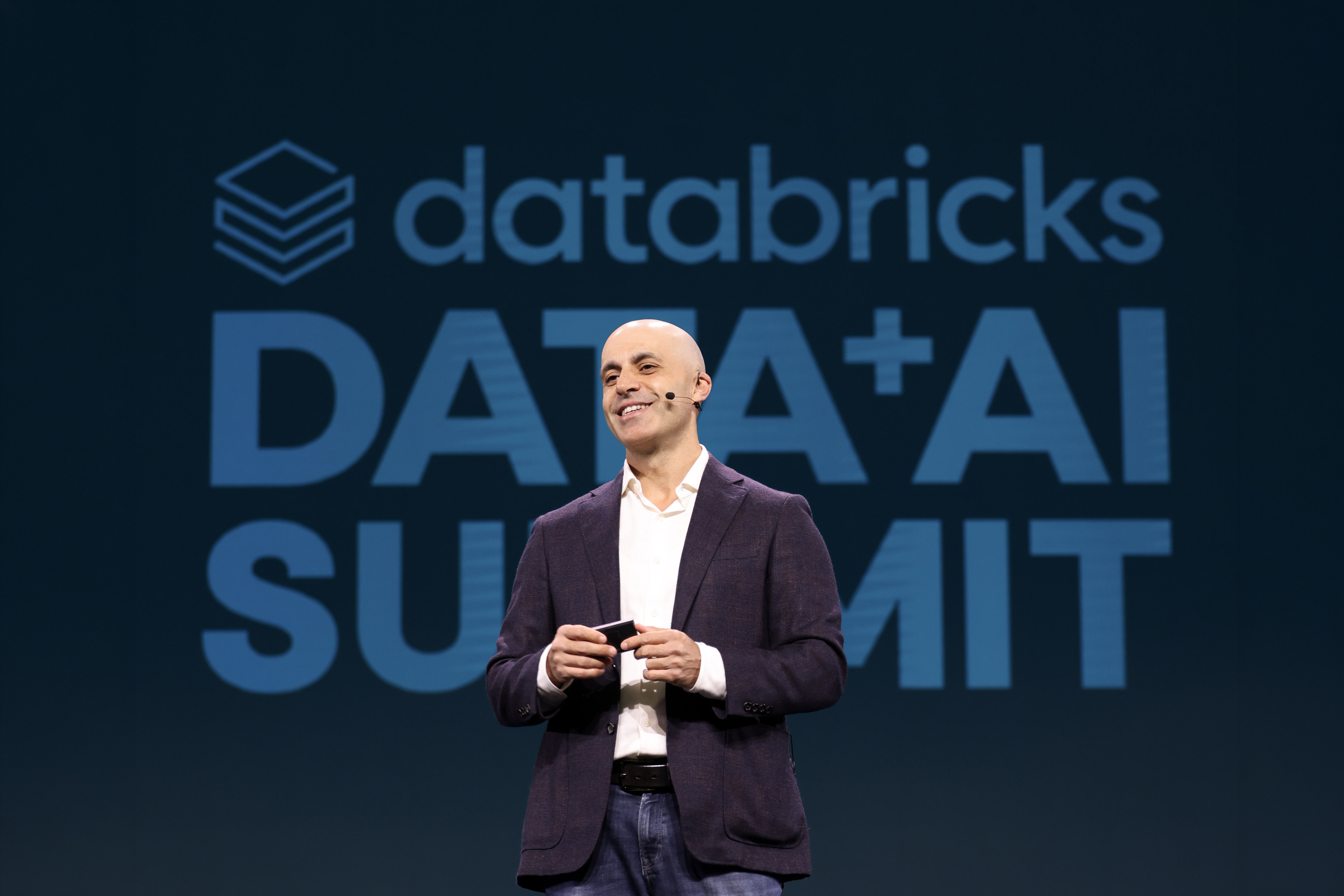
Photo: Databricks Comms / Wikimedia Commons, CC BY-SA 4.0 (https://creativecommons.org/licenses/by-sa/4.0/); 15 June 2026 archival photograph, adapted crop under same licence · Illustrative image.
Databricks has proposed a more ambitious version of the workplace assistant: an agent that continues working when nobody is chatting with it. The economic promise is fewer hours spent gathering information, chasing decisions and preparing reports. The risk is that persistent software can also produce persistent costs, incorrect actions and a larger governance burden.
On 11 November 2026, Databricks introduced the second generation of Genie. The announcement describes an always-on mode that accepts a goal, coordinates subagents, monitors progress and contacts people through a priority inbox or email when an approval is needed.
The important qualifier is availability. Databricks says Genie and Genie Ontology are generally available, while Genie Search, Ontology Manager and the new always-on Genie are still coming to preview or beta. Treating the announced autonomous workflow as an already proven, generally available service would overstate the release.
From questions answered to work completed
A traditional analytics chatbot waits for someone to ask a question. An always-on agent instead monitors a task over time: identify changing customer behaviour, prepare a forecast, follow up on missing inputs and escalate exceptions.
That creates a more valuable unit of work than a single answer. Managers rarely need another explanation of what happened yesterday; they need an accurate report delivered when decisions are still possible, with a record of which data and definitions were used.
Databricks says Genie Ontology connects data, people and business definitions so an agent understands what a company’s metrics mean. Genie Search is designed to reach information across 100-plus data sources and connector strategies, including Google Drive, Jira and Confluence. This is a company-stated capability, not a claim that every integration is fully available now or flawless under production load.
Such context matters because the same word—“revenue”, “customer” or “active”—can have materially different meanings across departments. An automated report using the wrong definition can be worse than no report at all.
The original calculation: labour saving is not economic profit
Imagine an illustrative enterprise where 500 recurring weekly tasks each currently require 12 minutes of human preparation. That represents 6,000 minutes, or 100 hours per week. If an agent genuinely eliminates two-thirds of that time, gross time released is about 66.7 hours.
At a hypothetical loaded labour cost of €45 per hour, the apparent labour-capacity value is about €3,000 per week. But this is not €3,000 of cash saved unless staffing costs fall or that capacity creates measurable additional output.
Now assume the system adds 15 hours of weekly supervision, exception handling and data-quality work. Net time released falls to roughly 51.7 hours, with a notional capacity value around €2,325 before agent compute, software licences, integration, security reviews and failed-task remediation.
These are invented inputs for an economic illustration, not Databricks customer results or a forecast. The correct metric is incremental contribution from work completed at the required quality, less all new operating costs.
Always-on also means a continuous compute meter
Databricks says the autonomous Genie mode runs in the background using its own compute. That raises a different pricing question from an occasional assistant prompt. A persistent workflow may search, re-evaluate priorities, call tools, delegate to subagents and retry failures while the human user is away.
The costs depend on frequency, context retrieval, number of agent steps and how often the system seeks approval. Long-running work can be useful, but unbounded loops or repetitive checks may waste money. An enterprise should budget by completed outcome, not merely tokens or wall-clock execution time.
Databricks says Unity Catalog and Unity Gateway provide permission controls, approvals, spending limits and auditability. Those are important product design features, but no security layer guarantees that every business instruction is interpreted correctly. Businesses still need to define limits on which actions an agent may take without human review.
A useful test is to compare a supervised automation against the previous human-led process, recording true end-to-end completion, rework, compute cost, queue delays and exceptions.
Why the ontology may matter more than the model
Businesses already have large volumes of data and many competing AI models. Databricks is positioning its governed business context as the durable layer that allows agents to use that data correctly across applications.
If that works, enterprises may be less interested in switching between individual model vendors and more interested in who supplies consistent semantics, permissions and audit trails. That would strengthen Databricks’ role as a platform, rather than simply another seller of AI-generated answers.
It would also create a dependency risk. If the ontology is wrong, stale or poorly governed, every connected agent may make the same mistake at scale. Buyers should ask how business terms are approved, how changes propagate and how inaccurate outputs can be traced back to sources.
The 11 November release names Slack and HelloFresh customers and quotes a HelloFresh team member reporting a 75% reduction in time to identify advertising winners. That is a vendor-selected customer statement about a specific process, not independently audited evidence that Genie’s always-on edition will improve every company’s productivity by the same amount.
What its financial disclosures do—and do not—tell us
Databricks reported in August 2026 that it had surpassed a $7 billion annualised revenue run-rate and had closed a $5 billion financing at a $190 billion valuation. These are dated company disclosures, not a current share price, an audited annual revenue statement, or an indication of how much the new Genie features earn.
The company also announced on 11 November a plan to invest roughly $3 billion across Europe and the Middle East over three years. That is a forward-looking regional commitment, not proof the funds have already been spent. It indicates Databricks wants more engineering, sales and customer support capacity as enterprise AI grows, but it provides no separate margin or cash-burn figure for Genie.
A higher enterprise revenue run-rate alone cannot establish the unit economics of persistent agents. There are material differences between selling software licences, charging for ongoing compute, and performing task-specific work that requires customer data integration.
What buyers should demand before scaling
In a preview, start with a small repeatable workflow whose inputs and success conditions are easy to audit. Specify a human approval threshold, expiry times for scheduled work, a cost ceiling and a rollback procedure. Count not only successful answers but completed tasks that arrive before the decision deadline.
Then compare performance against the old process over the same demand mix. Failure recovery and access-control exceptions are part of the cost, not outliers to hide from the return-on-investment calculation.
The core thesis is that enterprise agents become valuable when governed context turns model capability into dependable work completion. Databricks has announced a credible architecture and a significant strategic direction. It has not yet published production-wide economics or general availability for the new always-on Genie.
Follow the Databricks private-company profile for later availability milestones and the company’s dated funding and operating disclosures. Databricks is privately held; its August valuation is not a publicly tradable share quote.
Research checked 14 November 2026. New Genie and regional investment announcements are dated 11 November; financial figures are August company disclosures. The ROI example is hypothetical Compound analysis. Cover: Databricks Comms, Data and AI Summit, 15 June 2026, Wikimedia Commons CC BY-SA 4.0; adapted archival crop shared under the same licence.