Canva Now Lets Users Turn Off Generative AI. Could More Choice Be Good for Its Business?
Canva's 19 November opt-out and discovery settings raise a commercial question: can giving customers less generative AI make the design platform more useful and defensible?
 Wealth / The Compound journal
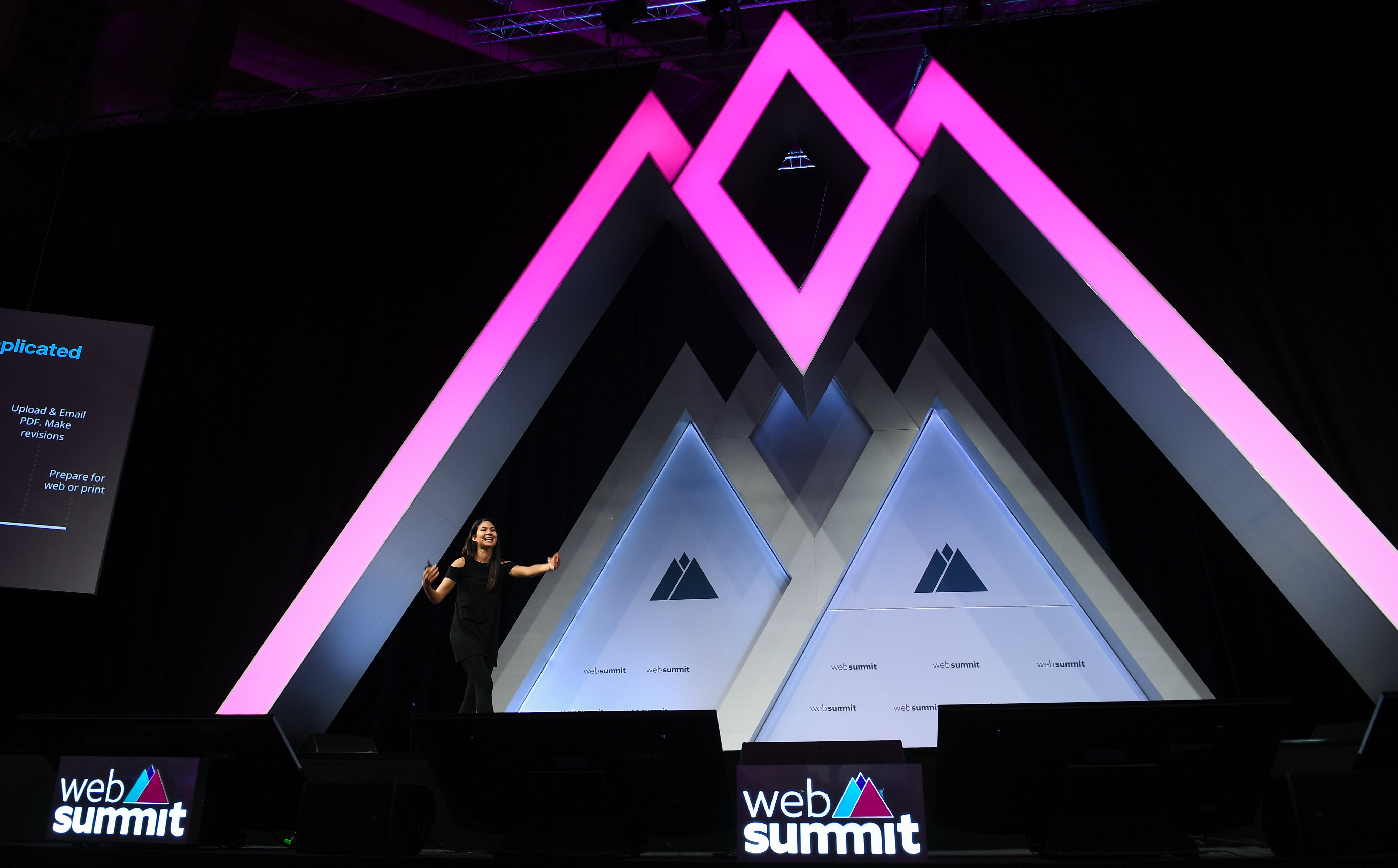
Photo: Eóin Noonan / Web Summit via Sportsfile, Wikimedia Commons CC BY 2.0 (https://creativecommons.org/licenses/by/2.0/), original 5 November 2019 photograph; adapted crop · Illustrative image.
A design platform that lets people say no to generative AI might retain customers that an AI-everywhere strategy would alienate. That is the business question raised by Canva’s new controls. The features themselves are straightforward, but their implications reach beyond a settings menu: user trust, demand for human-made assets, creator income and how software companies justify subscription prices in the AI era.
On 19 November 2026, Canva announced two controls for Free and Pro users, available that day at no extra charge. The first lets an individual switch generative AI features off or on. The second reduces AI-generated items in library search and recommendations. These are separate functions. Neither announcement promises that a paying customer will see a lower bill for declining AI.
Two switches solve different problems
The Generative AI Control, located under Profile, Settings and Permissions according to Canva, hides generative features when disabled. It can be turned back on. That can help a designer who wants to work manually or a team member whose work has particular contractual rules about generated material.
The AI-Generated Content Control, found under Profile, Your account and AI Personalization, affects what a person finds while browsing Canva’s content library. Canva says it reduces AI-generated search and recommendation results; it does not say it removes every generated asset or rewrites existing designs. A promise to reduce content is not the same as an enforceable zero-AI guarantee.
Canva distinguishes generative creation from what it calls assistive editing. Tools such as Background Remover and Magic Grab remain available even when generative AI is switched off. That technical and product distinction matters for organisations with approval rules. A customer’s internal policy might classify tools differently from Canva’s interface, so a team should decide whether its own rules cover generated text, image manipulation, AI-selected assets or all of them.
Why an opt-out might strengthen a subscription business
AI features are costly to develop and run, and many technology companies use them as upgrade incentives. An opt-out can look commercially counterintuitive: why build an expensive capability and encourage users to ignore it?
The answer may be choice and retention. A creative professional who dislikes generated imagery can still value brand templates, collaboration, editing, print layouts and distribution tools. If forcing AI into the workflow drives that customer to another provider, a switch preserving the rest of Canva’s utility may be commercially valuable. This is a hypothesis, not a measured Canva churn result.
Choice may also reduce friction in large organisations. A brand team might use AI for ideation while a legal reviewer insists final client-facing assets have clear provenance. Canva’s statement says organisations on Business, Enterprise, Teams and Education already had administrator AI permissions. The new announcement chiefly extends individual controls to Free and Pro; it should not be described as Canva’s first enterprise governance capability.
Importantly, Canva did not disclose how many people will turn the features off, the cost of providing the option or whether the change will alter conversion to paid plans. Its statement that users have invoked Canva AI tools more than 38 billion times is a cumulative company-reported use count, not 38 billion paying customers, current annual tasks or independently audited revenue. https://www.canva.com/newsroom/news/ai-controls-canva/
The creator side of the marketplace
Canva operates both software tools and a library of creator-made templates and design elements. In its announcement, it says creators receive payments when customers use their work. Generative images competing for attention could change demand for those assets, even if total design activity rises.
The new discovery setting could make human-made assets easier to find for people who want them. But a user preference does not guarantee creators higher revenue. Outcomes depend on the number of searches, the ranking system, conversion to actual asset use and the platform’s payment rules. Canva has not published a before-and-after royalty forecast tied to these switches.
There is another trade-off. Some users prefer AI-generated drafts because they are quick; others prefer human-made visual details or need provenance. Both groups can be customers. A marketplace that allows them to filter may segment demand more effectively, but maintaining useful search results and metadata is a continuing operational obligation.
How to test the commercial effect without guessing revenue
A useful analysis would compare three cohorts: users who keep AI enabled, users who disable generation but continue using assistive tools, and users who also request fewer generated library assets. For each cohort, track retained paid subscriptions, completed designs, support issues, creator-asset use and how often settings are reversed.
Consider a purely hypothetical service with 10,000 paid customers, a fictional €10 monthly fee and a 4% monthly cancellation rate. If better product choice reduced cancellation to 3.5%, the difference would be 50 customers in that month. At the assumed €10 fee, their next month’s gross billings would be €500 before discounts, taxes or service costs. This is not Canva pricing, retention data or an estimate of its actual revenue; it demonstrates why even modest retention changes could matter.
| Invented monthly example | Before | After |
|---|---|---|
| Starting paid customers | 10,000 | 10,000 |
| Monthly cancellation assumption | 4.0% | 3.5% |
| Customers cancelling | 400 | 350 |
| Customers retained due to assumed difference | — | 50 |
A full model would consider acquisition, reactivation, annual prepayments, changes in pricing and customer lifetime. The announcement supports none of those numerical conclusions for Canva, so a large valuation uplift would be unjustified.
Where Canva AI 2.0 fits
Canva previously described Canva AI 2.0 as a research-preview move toward conversational, editable and agent-assisted design. The opt-out announcement does not reverse that strategy. Instead it suggests two tracks: make sophisticated AI available to people who want it, while preserving an experience for customers who do not.
That balance creates real product complexity. Design assets need credible origin labels; customer controls need to persist across sessions; admins and users need to understand which permissions take priority. Controls that are difficult to find or unreliable could frustrate both audiences.
For Irish individuals and small businesses, the practical step is to inspect the actual settings, check internal client or employer requirements and evaluate output quality before choosing a workflow. Turning off a feature does not certify an entire design as legally original or remove normal copyright responsibilities.
What would prove the business case?
The most useful future disclosures would be paid-plan retention by usage preference, uptake of the controls, creator-content engagement and any change in customer support or moderation demands. Those measurements would make the commercial case testable.
Canva remains privately held, and its 19 November announcement supplies no new audited financial results, valuation, planned IPO date or per-control costs. We should not translate a policy feature into invented subscription growth. For context see the Canva private-company profile and Compound’s finance research directory.
Research checked 21 November 2026; the product event occurred 19 November. Historical cover photograph: Canva co-founder Melanie Perkins at Web Summit in November 2019, Eóin Noonan / Web Summit, CC BY 2.0; it does not depict the 2026 feature launch.