Bath & Body Works Approved a $500 Million Buyback. Is the Core Business Ready?
Bath & Body Works authorised a $500 million buyback while US and Canadian store sales and margins remain under pressure. We test the cash, debt and holiday dependence.
 Wealth / The Compound journal
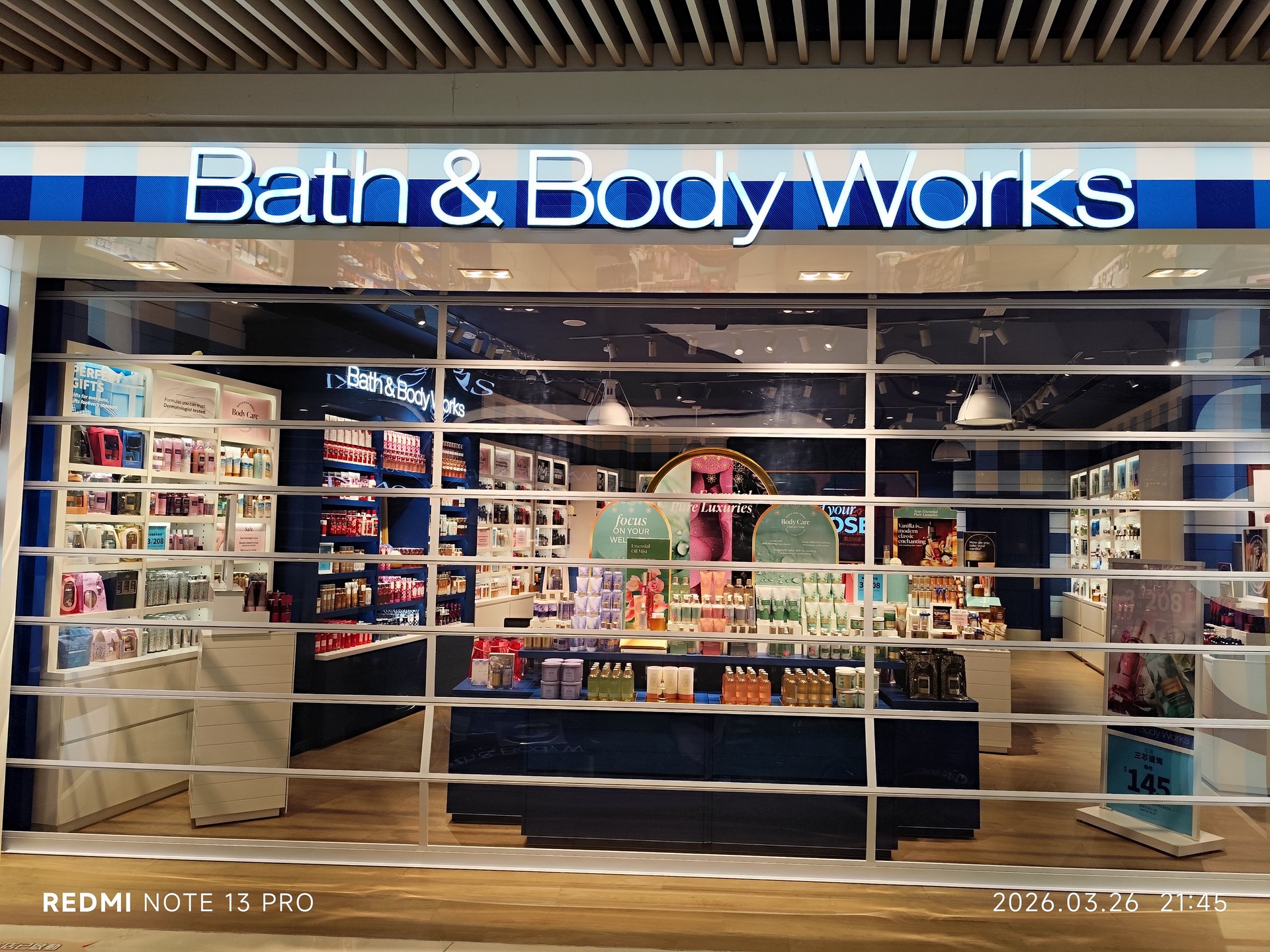
Photo: MAIDNWOMWN BANKWO / Wikimedia Commons, CC0 1.0. Bath & Body Works shop photographed 26 March 2026; cropped and resized for publication. · Illustrative image.
Bath & Body Works has authorised another $500 million of share repurchases while its largest sales channel is shrinking and most annual cash is still expected in the holiday quarter. The authorisation may prove well timed, but it should be judged against operating recovery—not simply a lower share price.
For the quarter ended 31 October 2026, net sales fell 1.0% to $1.577 billion. US and Canadian store sales declined 4.3% to $1.169 billion, while direct sales rose 2.6% and international and other revenue rose 39.3% from a much smaller base.
GAAP operating income fell to $108 million from $161 million. Gross profit was $638 million, implying a margin of about 40.5%, compared with 41.3% a year earlier. The investment question is whether emerging channels can repair the core economics before capital returns reduce balance-sheet flexibility.
Compound does not currently maintain a dedicated Bath & Body Works stock profile, so this analysis does not invent one.
The growth channels do not yet outweigh store pressure
International and other revenue reached $101 million, and direct revenue reached $307 million. Together they show that the brand can travel beyond a traditional North American mall store. Management is also working on product innovation, marketing and a broader customer base.
But the channel arithmetic remains clear. US and Canadian stores supplied roughly three-quarters of quarterly sales and declined by about $52 million. The combined increase in direct and international revenue was about $35 million using reported figures, not enough to offset the core-store reduction.
That does not make the newer channels unimportant. It makes their economics—not just growth rates—the next evidence investors need. International franchise or wholesale revenue can carry different gross margins, inventory commitments and brand-control costs from owned stores. Digital growth can be attractive, but fulfilment costs can offset some store savings.
Margin pressure turns a sales problem into a cash question
Quarterly net income fell to $38 million from $77 million. Adjusted operating income was $121 million and adjusted earnings per share were $0.26; those company-defined measures remove specified charges and should not replace the reported result.
For the first nine months, operating cash flow was $251 million and capital spending was $155 million. That leaves about $96 million of simple free cash flow before dividends, debt repayments and buybacks.
Management still expects approximately $815 million of full-year operating cash flow and $215 million of capital expenditure, or about $600 million of free cash flow. If achieved, more than $500 million of the year’s cash generation would arrive in the fourth quarter. Seasonality is normal for a holiday retailer, but it concentrates execution risk in a short selling period.
Inventory provides another useful signal. It rose 2.4% to $1.281 billion while quarterly sales fell 1%. That is not proof of excess stock: retailers deliberately build inventory ahead of holidays, and mix and timing matter. It does increase the importance of sell-through and markdown discipline.
The $500 million is permission, not a cheque already written
The new repurchase authorisation begins after the existing January 2025 programme. It does not require Bath & Body Works to spend the full amount or commit to a timetable.
Scale still matters. The authorisation equals about 83% of management’s $600 million full-year free-cash-flow outlook. It is also roughly 1.6 times the $318 million of cash held at quarter-end and more than five times the $96 million generated in the first nine months. Those are Compound comparisons, not liquidity forecasts, because fourth-quarter cash generation and the existing programme change the available pool.
The company has already directed substantial cash to the balance sheet. In the first nine months, it repaid $542 million of debt, paid $120 million of dividends and spent $59 million on repurchases. Cash declined by $635 million to $318 million. Long-term debt remained $3.367 billion.
That sequence is more prudent than treating every dollar as immediately distributable. Yet debt and a seasonal cash profile mean the next repurchase should compete with refinancing flexibility, store investment and inventory needs. The reported shareholders’ deficit of $1.109 billion is an accounting balance influenced by historic distributions; it is not by itself a finding of insolvency, but it reinforces the need to follow debt and cash rather than book equity alone.
What would confirm the thesis?
The case would strengthen if core-store sales stabilise, gross margin recovers without aggressive discounting and fourth-quarter cash flow lands close to guidance. International and direct growth should add profit, not merely relocate sales. A falling diluted share count after employee equity issuance would show that repurchases are reaching owners.
It would weaken if holiday sell-through requires heavier markdowns, inventory remains elevated or repurchases continue while net debt rises. The company’s full-year sales outlook of a 3.4% to 2.1% decline still implies a difficult fourth quarter, even after the range was improved.
Bath & Body Works has the brand and seasonal cash potential to make repurchases sensible. It has not yet shown that the core store engine and margin have recovered enough to make a $500 million programme the best use of capital. Authorisation preserves choice; execution should wait for the evidence. This analysis makes no price target.
Explore Compound’s earnings hub, our guide to dividend investing in Ireland and our guide to portfolio diversification.
Reported figures are in US dollars and relate to Q3 2026 unless stated otherwise. Adjusted operating income, adjusted EPS and free-cash-flow guidance are company-defined. Facts come from Bath & Body Works’ results release, investor presentation and Form 10-Q; ratios and comparisons are Compound’s. General information, not personal investment advice.
Cover: MAIDNWOMWN BANKWO, Wikimedia Commons, dedicated to the public domain under CC0 1.0. Captured 26 March 2026 at Yoho Mall, Hong Kong. Cropped and resized for publication.