Palmer Luckey's SLAB Project: $1B Valuation, Costs and Floating City Economics
Palmer Luckey says SLAB was valued at $1 billion in 2017. We separate that valuation from its unknown construction budget and model the cost of an offshore industrial city.
 News / Wealth
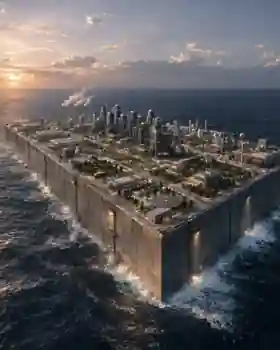
Photo: SLAB concept artwork shared with Palmer Luckey's announcement on X; image supplied for this article. This is a visualisation, not a photograph. · Illustrative image.
Financial analysis | 18 November 2026. The cover is a concept image, not evidence that a finished offshore city exists. All monetary figures are US dollars unless stated otherwise.
Palmer Luckey has revealed SLAB, a proposed offshore industrial settlement with a 1,000-year design-life ambition. The Oculus and Anduril co-founder says he and a handful of friends capitalised the project at a $1 billion valuation in 2017 and have recently added more money. But one fact matters more than the spectacular image: a $1 billion valuation is not a $1 billion construction budget, and neither construction spending nor a current independent valuation has been disclosed.
In his 18 November post on X, Luckey described a seastead intended to make certain industrial activities cheaper than operating on land. Potential sectors include metals processing, medical research and treatment, desalination, oil refining and chemical engineering. He framed it as a way to strengthen US industry, not as an attempt to abandon the United States.
Luckey said SLAB predates the current artificial-intelligence boom. He objected to suggestions that it was simply a new floating AI data-centre venture. No public budget, confirmed site, dimensions, tenant contracts, construction timetable or audited project accounts accompanied the statement. That leaves the central investment question open: can expensive offshore infrastructure produce enough recurring cash flow to justify its capital costs?
What is the SLAB project?
SLAB is Luckey’s proposed long-life offshore seastead: a platform or settlement at sea that could accommodate industrial facilities and supporting infrastructure. The accompanying image shows an immense city-like structure behind sea walls. It is conceptual artwork, not a measured engineering plan, a scale model or a construction photograph.
Luckey traced its origins to the money he received after Facebook acquired Oculus in 2014. Meta’s original acquisition announcement put the transaction at approximately $2 billion in cash and shares, with a possible additional $300 million earn-out. That was the agreed value of the whole company transaction, not Luckey’s personal proceeds and not the amount invested in SLAB.
SLAB is also not an announced Anduril product. Luckey is associated with both ventures, but no evidence was provided that the defence company owns SLAB or that its shareholders have a claim on this project.
Is SLAB really worth $1 billion?
The distinction between a valuation, fundraising and construction cost is essential.
| Figure | What it actually means |
|---|---|
| $2bn Oculus acquisition (2014) | Announced value of Facebook’s purchase of Oculus, not Luckey’s personal payout |
| $1bn SLAB valuation (2017) | Luckey’s description of how the project was capitalised with friends; not independently verified here |
| 2026 additional investment | Luckey says the group is adding funds, but gives neither the amount nor the financing terms |
| SLAB construction budget | Undisclosed |
| Current SLAB valuation | Undisclosed |
| Reported SLAB revenue or profit | Undisclosed |
A business can be valued at $1 billion before producing revenue, especially if investors are underwriting scarce intellectual property, regulatory optionality or an ambitious infrastructure opportunity. Conversely, building an offshore facility could ultimately cost far more than the value ascribed to the development company.
An equity round valued at $1 billion could theoretically involve $10 million of new investment for a small stake, or hundreds of millions for a much larger one. Luckey has not published enough information to determine which, if either, is applicable. Treating $1 billion as money already spent on sea walls would be incorrect.
How much could an offshore industrial city cost to build?
There is no defensible public estimate for the actual SLAB construction bill, because investors do not yet know its location, footprint, structural design, distance from shore, power requirements or industrial mix. Those variables can shift cost by orders of magnitude.
The obvious expenses go well beyond concrete or a floating hull:
- Marine civil engineering: structural foundation or hull, wave loading, corrosion protection, moorings, dredging and construction vessels.
- Utilities: high-capacity electricity generation or subsea cables, potable water, wastewater and hazardous-waste treatment.
- Industrial readiness: berths, cranes, storage, pipelines, fire suppression, chemical containment and robust telecommunications.
- Operating resilience: housing, medical facilities, emergency evacuation, navigation safety, repairs and ongoing marine insurance.
- Financing and compliance: design studies, contingency, interest during construction, permits, security and legal risk.
For scale, Shell’s Prelude floating LNG installation is a real example of industrial processing at sea. Industry estimates of its cost have commonly been in the $10.8bn-$12.6bn range, although Offshore Magazine notes that Shell has not disclosed a definitive cost figure. Prelude is a specialised LNG facility, not a cost estimate for SLAB. Its relevance is that ambitious marine engineering can require multibillion-dollar funding long before returns arrive.
Our illustrative SLAB cost and break-even model
To make the economics tangible, assume only for this scenario that SLAB creates one square kilometre (1,000,000 m²) of gross platform area, of which 60% is available for paying industrial tenants. Neither dimension is a disclosed SLAB specification.
Assume annual capital return of 8% on invested construction capital and annual maintenance and platform operating expenditure of 2% of that capital. This simplified 10% annual carrying-cost test is not an estimate of SLAB’s actual financing terms, cost of capital or depreciation.
| Hypothetical construction capital | 8% annual capital return + 2% operating allowance | Annual charge per rentable m², at 60% occupancy |
|---|---|---|
| $2 billion | $200 million | $333/m²/year |
| $5 billion | $500 million | $833/m²/year |
| $10 billion | $1 billion | $1,667/m²/year |
Example: Under the $5bn case, $400m a year of required capital return plus a $100m operating allowance produces a $500m annual revenue hurdle. Spreading that across 600,000 rentable square metres equals about $833 per m² per year, or $69 per m² per month.
This is not a forecast, a quoted rental rate or a full break-even calculation. It excludes returning the original principal, tenant fit-out and plant costs, taxes, port fees, energy, replacement capital, downtime and other costs. Some tenants would pay for utilities or processing services rather than rent alone. A lender would also need its actual debt-service profile. The model demonstrates why capital intensity and usable area matter so much.
A one-thousand-year design-life goal does not let investors spread today’s bill evenly over a millennium. Investors will demand returns over much shorter periods, while pumps, electrical systems, pipelines and surface equipment will require repeated replacement. Long-life structural ambition is very different from 1,000 years of maintenance-free operation.
How could SLAB make money?
Industrial-site leases are the most straightforward model: manufacturers pay for controlled industrial space, port access and shared infrastructure. SLAB could also potentially earn utility tariffs, cargo-handling fees, processing or laboratory services, and long-term capacity reservations from anchor customers.
The investment case depends on four things:
- Price premium or savings for customers. Would an operator genuinely save enough on land, permitting delays, energy or transport to pay a substantial offshore charge?
- Anchor tenancy. A large industrial customer agreeing to a long-term take-or-pay contract could make financing possible; speculative occupancy would be much harder.
- Financing structure. Equity alone may be expensive. Project debt requires predictable revenue, enforceable concessions, clear jurisdiction and manageable construction risk.
- Reliable logistics and energy. Smelters, refineries and data centres are energy intensive. Any savings from reduced land use could be erased by power generation, marine transport, cooling or insurance costs.
An AI data centre could be an offshore tenant, especially where cooling infrastructure is valuable, but Luckey explicitly rejected describing the entire SLAB programme as a newly conceived floating AI data-centre project. Revenue projections based on a data-centre operator or a gigawatt power specification would be speculative.
Would building offshore avoid US laws and taxes?
Not automatically. The image of an artificial city beyond a coastline does not imply independent sovereignty, a zero-tax zone or a blanket exemption from environmental and safety law.
Under the UN Convention on the Law of the Sea, a coastal state’s territorial sea can extend up to 12 nautical miles from its baseline. The convention’s Article 60 gives coastal states extensive authority over artificial islands and installations in their exclusive economic zones, including jurisdiction over fiscal, health, safety, customs and immigration matters. Artificial islands do not acquire the legal status of natural islands or generate their own territorial waters.
US offshore regulatory requirements depend on the facility’s location and purpose. For example, the US Maritime Administration’s deepwater-port framework requires relevant oil and gas port projects to demonstrate financial capability, environmental safeguards and other approvals. That specific framework should not be assumed to regulate every possible version of SLAB, but it is a reminder that going offshore is not synonymous with going unregulated.
Regulatory uncertainty is itself a financial cost: it can raise required returns, delay construction, deter tenants and make long-term lending more difficult.
Who could fund SLAB and what would make it investable?
At an early stage, the venture could rely on founders and private backers. A large-scale facility might ultimately require infrastructure funds, strategic industrial partners, equipment finance, project debt or government-supported industrial arrangements. None of those structures has been announced as a committed SLAB financing package.
Before treating the concept as a bankable investment, investors would need:
- A defined site and legal regime, plus environmental and engineering studies.
- A credible capital budget with contingencies and a multi-year cash-flow forecast.
- Proof that marine operations are competitive with an onshore industrial park.
- Anchor customers, firm power and utility arrangements, and an insurable operating plan.
- Disclosure of ownership, financing terms, construction milestones and actual capital committed.
SLAB may eventually prove to be a significant attempt to relocate high-value industry offshore. But its economic claim is stronger when expressed as a measurable test than a futuristic picture: the cost per productive square metre, the value created for tenants and the time needed to return invested capital.
Bottom line: is Palmer Luckey’s SLAB a $1bn floating city?
SLAB is a privately backed offshore industrial ambition that Luckey says was valued at $1 billion in 2017. It is not yet a publicly costed, financed or operational $1 billion floating city. The notion of moving heavy industry offshore is technically imaginable, but the expense of marine infrastructure and the reality of maritime law make cost savings far from assured.
The next meaningful disclosures would be a location, platform size, signed industrial tenants, engineering design, construction budget, amount of new funding and an independent estimate of the project value. Until those exist, the headline valuation is interesting; the cash-flow economics are the real story.
Sources checked 18 November 2026. The cost table contains original Compound.ie hypothetical scenarios, not company projections or investment advice. The uploaded cover art is a conceptual illustration.