Who Would Pay for Palmer Luckey’s SLAB? The First Customer Could Decide
Rotterdam’s port expansion shows why early customers matter. Our worked example explains what a first industrial contract could mean for SLAB’s financing.
 News / Wealth
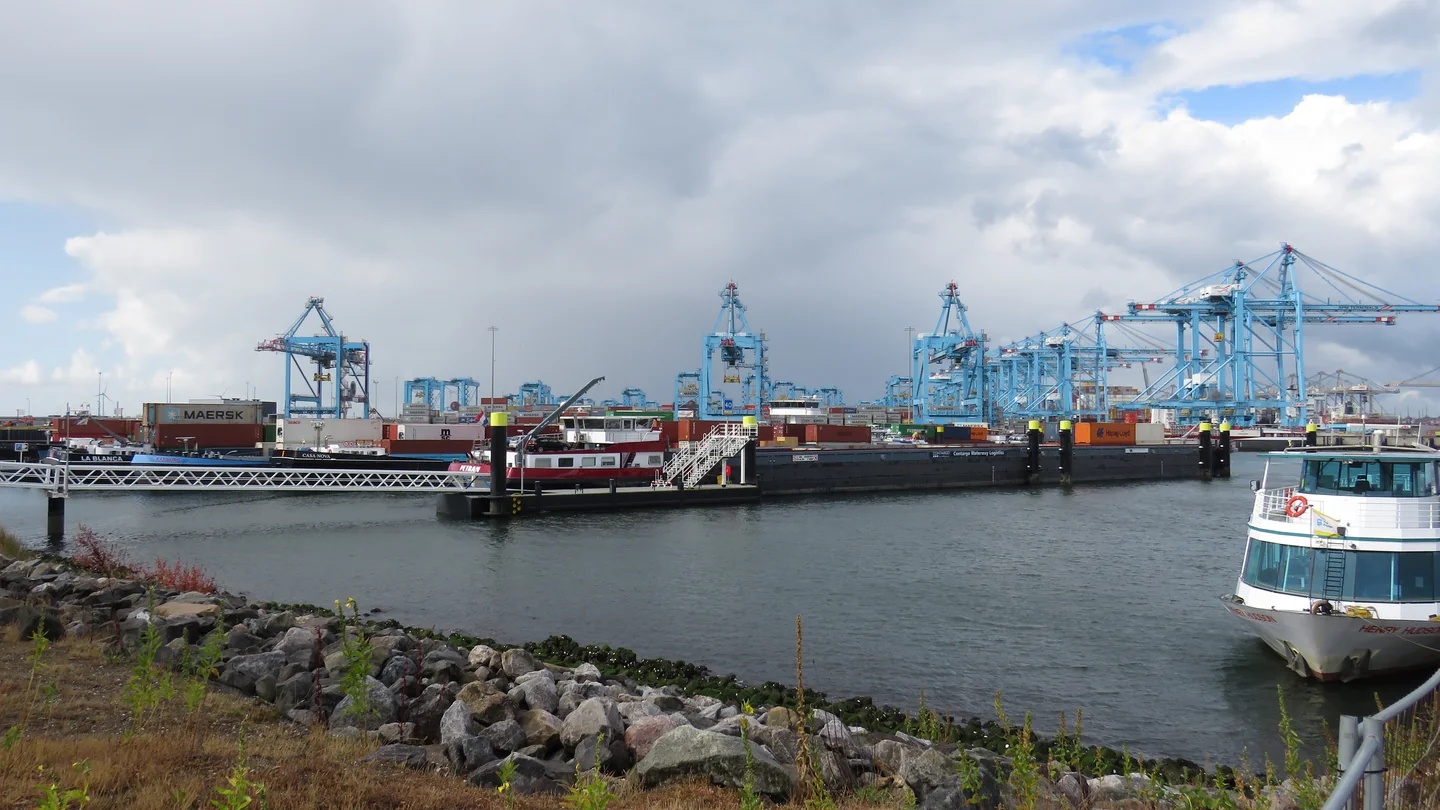
Photo: APM Terminals Maasvlakte 2, Rotterdam, 10 August 2018. Photo by Adl252 via Wikimedia Commons, CC BY-SA 4.0 (resized and cropped). · Illustrative image.
The first customer for Palmer Luckey’s SLAB would have to answer a practical question. What can an offshore site do for its business that a cheaper coastal site cannot? If the answer is valuable enough to put in a long-term contract, that customer could help finance the first facility. Without such a commitment, the founders would have to take more of the risk themselves.
Luckey named metals processing, desalination and other industries when he unveiled his offshore settlement. The announcement gave no customer names or signed contracts. Our original SLAB analysis covered the claimed $1 billion valuation and construction economics. Here the question is what a first customer would need to buy, and how much that commitment could matter to a lender.
Rotterdam had customers before its port expansion opened
At Maasvlakte 2, the Port of Rotterdam Authority created new industrial land connected to an existing port. APM Terminals and Rotterdam World Gateway signed for large plots before the new port area opened in 2013. Both terminals officially opened in 2015, and the authority’s annual report says they still operated below full capacity that year. Early commitments gave the port named customers and a clear use for the site. Cargo volumes still took time to build. Port of Rotterdam’s project history and 2015 annual-report highlights.
The port authority and APM Terminals announced a further expansion valued at more than €1 billion in 2023. The authority took on construction of the new quay walls, and the terminal operator planned to add about two million standard-container units of capacity. The agreement illustrates how the owner of shared infrastructure and an industrial operator can take responsibility for different parts of the same project. Rotterdam’s existing shipping and inland transport connections make its costs a poor basis for estimating SLAB’s. Port of Rotterdam’s expansion announcement.
What could SLAB’s first customer actually buy?
A desalination plant illustrates the problem. The buyer could be a utility purchasing a reliable supply of treated water. It would compare the delivered price with a coastal plant, including the cost of bringing the water ashore. If an offshore site adds a pipeline, pumping and marine maintenance, the developer would need another saving large enough to offset those expenses.
A metals processor might pay for a berth, industrial space and firm power. Its comparison would include electricity costs, inbound and outbound freight, and the cost of downtime. A favourable rent would carry little weight if power interruptions repeatedly stopped production. In either case the contract would need to specify what the operator delivers, when payments begin and who carries the cost when service falls short.
What would a first contract need to cover?
Suppose a smaller first phase cost $500 million, with $300 million in debt and $200 million in equity. At 7% interest over 20 years, with level annual payments, debt service would be about $28.3 million a year. An assumed lender coverage requirement of 1.30 times annual debt service would call for roughly $36.8 million in annual cash available for debt service. Add $20 million in annual cash operating costs and the phase would need about $56.8 million in annual revenue under this simplified test.
| Annual minimum payment from the first customer | Annual revenue still needed to meet the test |
|---|---|
| $20m | $36.8m |
| $40m | $16.8m |
| $60m | $0m, with $3.2m above the target |
The example assumes the debt is fully drawn when operations begin. It excludes construction-period interest, taxes, reserve funding, major renewals and any required equity return. These are model assumptions. Luckey gave no comparable financing terms or revenue figures in his announcement.
A $40 million minimum could make a big difference, provided the buyer can pay and the contract survives long enough to support the loan. The remaining $16.8 million would still need to come from other customers, or the developer would need to revisit the phase size, the debt amount or the operating costs. If payments start only once the site is ready, the developer still needs to fund overruns and delays before it earns its first dollar.
The disclosure that would move the story forward
A named customer and a signed minimum-payment contract would show what someone is willing to buy from SLAB. The useful details would be the service, the annual commitment, when it takes effect and who pays for the infrastructure connecting the facility to shore. Those figures would give investors a basis for judging whether the first phase can support debt and whether it can compete for a second customer.
Cover photograph shows Rotterdam’s Maasvlakte 2 in 2018. Creative Commons Attribution-ShareAlike 4.0.