How Ireland exercises: walking dominates, gyms are second and work gets in the way
New CSO data show 72.5% of people aged 15–74 took part in sport or physical exercise in Q3 2025. Walking and hiking lead by a huge margin, gym activity is second, and lack of time because of work is the biggest barrier.
 News / Life
Photo: Thomas balabaud on Pexels · Illustrative image.
News analysis · 26 September 2026. The CSO published these results on 24 September 2026, but the survey questions relate to Quarter 3 of 2025. Participation in more than one activity was possible, so individual activity percentages should not be added together.
If you picture sport in Ireland, you might think first of a GAA pitch, a five-a-side game, a rugby field or a packed stadium.
The way Ireland actually keeps active is much less dramatic.
Walking and hiking are, by a huge margin, the country’s most common form of sport or physical exercise.
New data from the Central Statistics Office show that 2.966 million people aged 15 to 74 — 72.5% of that population — said they participated in at least one sport or physical activity in Q3 2025.
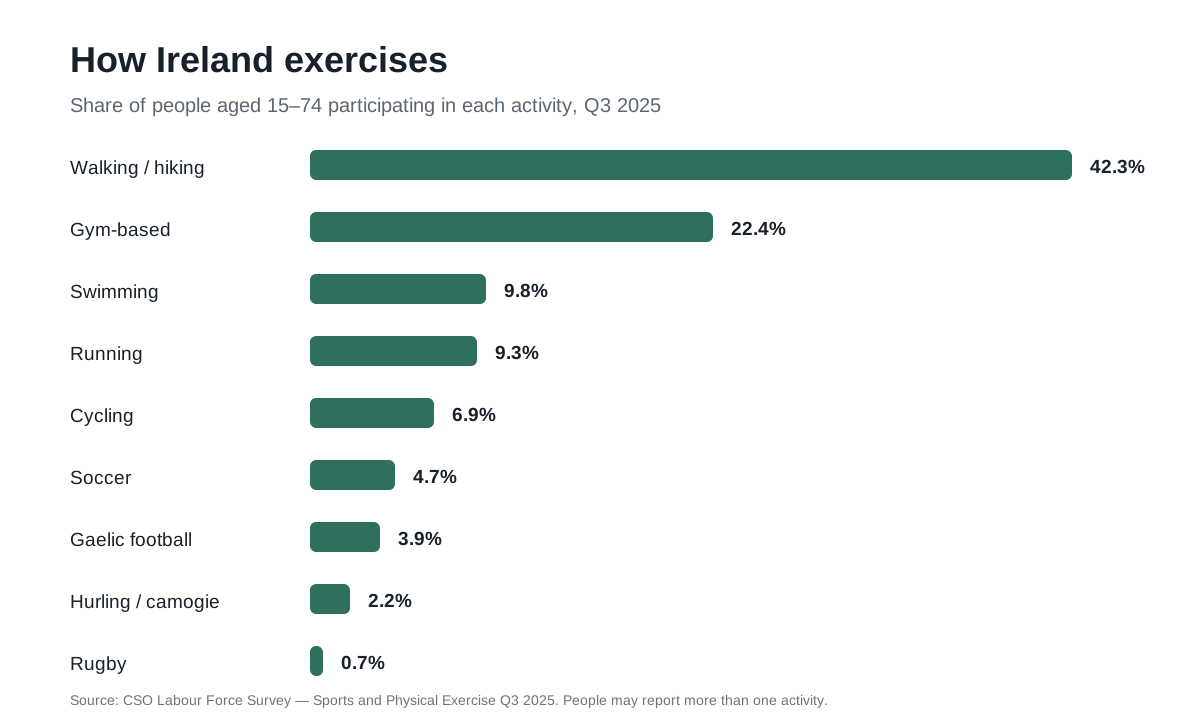
Walking or hiking was reported by 42.3%.
Gym-based activity was a distant second at 22.4%.
Swimming, running and cycling followed. The traditional team sports that loom so large in Irish culture accounted for much smaller shares of participation.
The figures offer a useful snapshot of how Ireland actually moves — and of what gets in the way when people do not.
Ireland’s most popular forms of exercise
Here is the national picture.
| Activity | Share of people aged 15–74 |
|---|---|
| Walking / hiking | 42.3% |
| Gym-based activities | 22.4% |
| Swimming | 9.8% |
| Running | 9.3% |
| Cycling | 6.9% |
| Soccer | 4.7% |
| Gaelic football | 3.9% |
| Hurling / camogie | 2.2% |
| Rugby | 0.7% |
Source: CSO Labour Force Survey — Sports and Physical Exercise Q3 2025.
The first thing to notice is the size of the gap.
Walking and hiking were reported by almost twice as many people as gym-based activity, and more than four times as many as swimming or running.
The CSO estimates that about 1.731 million people walked or hiked for exercise during the period.
That makes Ireland’s exercise culture look less like organised competitive sport and more like something that can happen on a road, trail, footpath or local loop.
The data do not tell us why walking is so dominant. But it has obvious practical characteristics: it does not require a team, a fixed training session or specialist equipment, and it can be fitted around daily life more easily than many organised sports.
The gym has become a major part of Irish exercise
The second-biggest category is also striking.
22.4% of people aged 15 to 74 reported gym-based activity.
That puts the gym far ahead of any individual team sport.
Among people in the labour force, gym participation was even higher at 25.3%, compared with 14.7% among those outside the labour force.
And the age split is clearer still.
For 15–24-year-olds, gym-based activity was the single most common activity in the survey.
| Activity among 15–24-year-olds | Participation |
|---|---|
| Gym-based activity | 28.1% |
| Walking / hiking | 27.0% |
| Soccer | 13.6% |
| Gaelic football | 13.6% |
Overall, 78.5% of 15–24-year-olds participated in at least one sport or physical exercise — the highest rate of the three age groups reported by the CSO.
That is a useful counterweight to the idea that younger adults are abandoning physical activity entirely.
They are active, but the mix is different.
The gym now sits alongside football and GAA as a major part of how young people exercise.
As people get older, walking becomes even more important
The pattern changes substantially with age.
Participation in at least one activity was:
- 78.5% among 15–24-year-olds;
- 70.8% among 25–44-year-olds;
- 71.6% among 45–74-year-olds.
But the headline participation rate hides a large shift in what people do.
Among 45–74-year-olds, 52.0% walked or hiked for exercise.
Gym activity fell to 15.5%, while swimming was reported by 9.9%.
So participation does not simply disappear with age. It changes form.
The sports that require a team, scheduled fixtures, speed or higher-impact movement become less prominent, while walking becomes much more central.
That matters because Ireland’s national physical activity guidelines explicitly count brisk walking as moderate-intensity aerobic activity when it raises breathing and heart rate while still allowing conversation.
Women and men participate at almost the same overall rate
There is very little difference in the overall participation rate by sex.
72.9% of women and 72.1% of men reported taking part in sport or physical activity.
The more interesting difference is the activity chosen.
The CSO found that women were more likely to report:
- walking or hiking;
- gym-based activity;
- swimming.
Men were more likely to report:
- cycling;
- soccer;
- Gaelic games;
- golf;
- running.
So a simple headline about whether men or women are “more active” misses most of the story.
Overall participation is extremely similar. The activity mix is not.
Team sport matters culturally — but it is not how most adults exercise
Soccer was the most common team sport in the data, at 4.7%.
Gaelic football followed at 3.9%, hurling or camogie at 2.2%, and rugby at 0.7%.
Those percentages should not be interpreted as measures of the cultural importance, attendance, volunteering or fandom surrounding those sports.
They answer a narrower question: what activities people themselves took part in.
That distinction is important in Ireland.
A sport can play a huge role in community life while still being directly played by a minority of the overall 15–74 population at a given point in time.
It also helps explain why organised sport is only one part of the national physical-activity picture.
A person walking five evenings a week may never describe themselves as “sporty” — but they are still physically active.
Dublin is gym-heavy. The Border is more GAA-heavy.
Participation also varies by region.
The Mid-West — Clare, Limerick and Tipperary — had the highest overall participation rate at 74.7%.
It was followed by:
- South-West: 74.5%;
- Dublin: 74.1%;
- Mid-East: 73.2%.
At the other end:
- Border: 68.5%;
- Midlands: 68.1%;
- South-East: 67.7%.
The differences in type of exercise are revealing too.
Walking and hiking were the most common activity in every region.
But 27.8% of people in Dublin reported gym-based activity, 5.4 percentage points above the national rate.
Dublin also had the lowest Gaelic football participation in the CSO comparison at 2.3%.
The Border region had the highest, at 5.7%.
That does not mean one region has a “better” exercise culture than another. It shows that access, demographics, settlement patterns and local sporting traditions can produce very different activity mixes.
Why do Irish people exercise?
The main motivation is straightforward.
Among people who participated in sport or physical activity:
| Reason | Share |
|---|---|
| Improve physical health and fitness | 87.1% |
| Improve mental wellbeing | 49.5% |
| Social element | 27.2% |
| Improve performance | 13.7% |
| Competition | 9.4% |
Health is overwhelmingly the leading reason.
But almost half of participants also cited mental wellbeing.
And more than a quarter cited the social element.
That last number is worth noticing because exercise can do more than fill an activity target. Walking groups, clubs, classes and team sports can create repeated contact with other people — something that becomes harder to manufacture in adult life.
Compound’s guide to making friends as an adult in Ireland looks at why repeated, low-pressure contact matters when building new friendships.
What stops people exercising?
This may be the most practically important part of the release.
Among people who said they did not participate, the most common barrier was not cost or lack of facilities.
It was time.
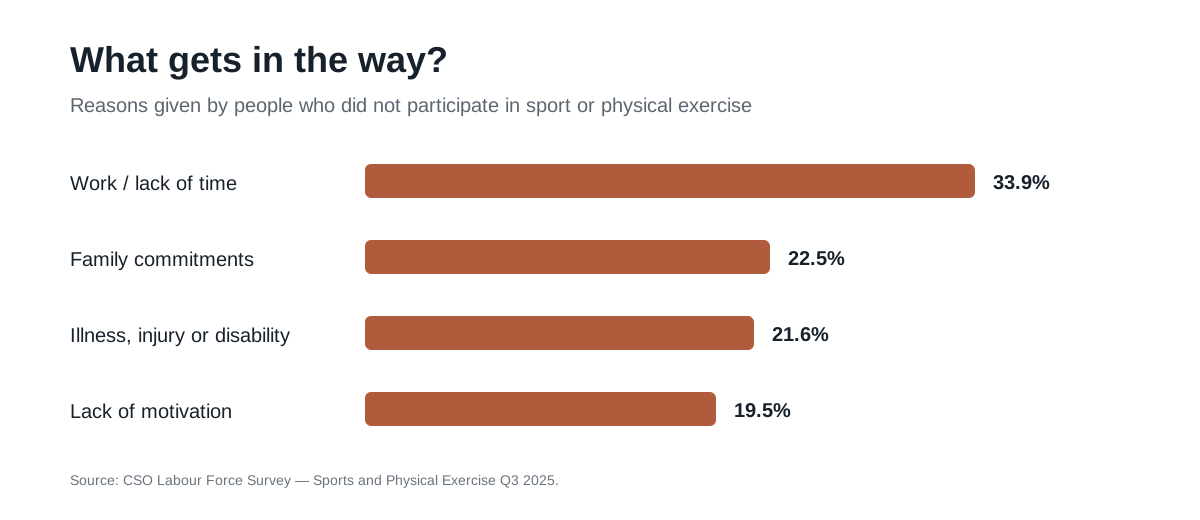
| Reason for not participating | Share |
|---|---|
| Lack of time due to work | 33.9% |
| Lack of time due to family commitments | 22.5% |
| Illness, injury or disability | 21.6% |
| Lack of motivation | 19.5% |
The sex split adds another layer.
Among men who did not participate, 41.0% cited lack of time due to work.
Among women, family commitments were the most common reason at 27.3%, followed closely by work at 26.7%.
Those are not trivial distinctions.
If time pressure is a major reason people are inactive, telling people simply to “be more motivated” addresses only part of the problem.
For some people, the realistic opportunity may be a walk before work, a short session close to home, active commuting, or movement broken across the week rather than a long scheduled workout.
For others, illness, disability or caring responsibilities may change what is practical altogether.
Does 72.5% participation mean Ireland is active enough?
No.
This is one of the most important caveats in interpreting the CSO number.
Participating in at least one sport or physical activity is not the same as meeting Ireland’s physical activity guidelines.
For adults, Ireland’s current guidelines recommend 150–300 minutes of moderate-intensity aerobic activity each week, or 75–150 minutes of vigorous activity, or an equivalent combination.
Adults are also advised to do muscle-strengthening activity involving the major muscle groups on two or more days a week and to reduce sedentary time.
A separate Sport Ireland survey using a different methodology found that 38% of adults met the national activity guidelines through sport and recreational walking in 2025.
That figure should not be directly compared as if it were measuring exactly the same thing as the CSO’s 72.5%.
The surveys use different questions and definitions.
But together they make the underlying point clear:
taking part in some exercise is not necessarily the same as accumulating enough activity to meet the weekly guideline.
Walking may be the most important number in the whole dataset
It is easy to focus on gyms, running trends or the fortunes of individual sports.
But the biggest national participation number belongs to something much simpler.
42.3% of people walked or hiked for exercise.
And among 45–74-year-olds, the figure reached 52%.
That matters because walking has a low barrier to entry and can count toward the national aerobic-activity target when done at sufficient intensity.
For somebody starting from very little activity, the HSE’s guidance is also explicit that any activity is better than none, and sedentary time should be replaced with movement where possible.
You do not need to become a runner or join a competitive team for movement to matter.
The real picture of exercise in Ireland
The latest CSO data give us a much broader definition of an active Ireland.
It is the teenager going to the gym.
The adult fitting in a run after work.
The swimmer at the local pool.
The GAA player training twice a week.
And, more than any of them, it is the person going out for a walk.
The national picture can be summarised in four numbers:
72.5% took part in at least one sport or physical activity.
42.3% walked or hiked.
22.4% did gym-based activity.
And among people who did not participate, 33.9% said work left them without enough time.
The lesson is not that everyone should choose the same activity.
It is almost the opposite.
Ireland is active in many different ways, and the most widely used form of exercise is also one of the simplest.
If you are trying to understand your broader health numbers, Compound’s Nutrition Needs Calculator can estimate activity-adjusted energy and protein needs, while the BMI Calculator explains BMI alongside its important limitations rather than treating it as a verdict on fitness.
Sources and methodology
The main figures in this article come from the CSO Labour Force Survey — Sports and Physical Exercise Q3 2025, published on 24 September 2026.
The survey covered people aged 15 to 74. Respondents could participate in more than one sport or activity, so activity percentages overlap.
The article also uses Ireland’s Every Move Counts physical activity guidelines and the HSE’s physical activity guidance.
The Sport Ireland figure on meeting national guidelines comes from the Irish Sports Monitor 2025. Its methodology differs from the CSO survey, so the figures should not be treated as like-for-like measures.