Padel in Ireland: Rules, Courts, Costs & How to Start Playing
The complete guide to padel in Ireland: what it is, the 2026 rules, scoring, glass walls, where to find courts, how much playing costs, rackets, clubs and a practical beginner's plan.
 Life / The Compound journal
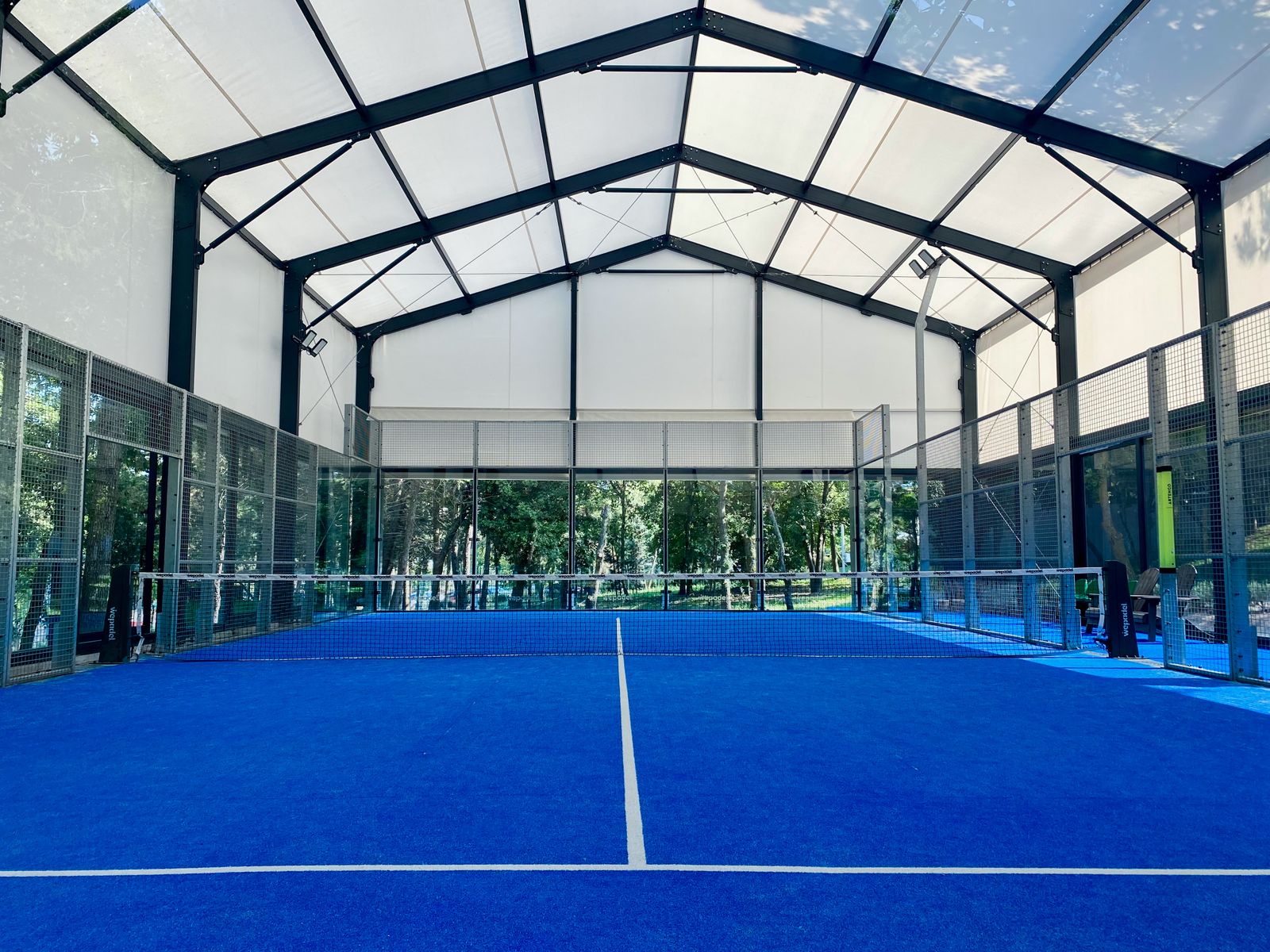
Photo: Ercan Evcimen on Pexels · Illustrative image.
Padel is one of those sports that can look confusing from outside the court.
Four people play something resembling tennis inside a glass enclosure. The ball hits a back wall, comes bouncing back towards a player, and the rally carries on as though nothing unusual has happened.
That is precisely what makes it different.
Padel combines the familiar scoring of tennis with a compact enclosed court, short solid rackets and a game built around angles, teamwork, patience and the walls. You do not need a strong serve or a background in tennis to try it.
And in Ireland, there are now enough clubs, indoor courts, outdoor courts, coaching sessions and social games for many people to give it a go without committing to membership or buying expensive equipment.
Quick answer
Padel is a racket sport normally played as doubles on a 20m × 10m enclosed court, with glass and mesh walls that can be used during rallies. Players use short, solid, perforated rackets and a pressurised ball. The scoring resembles tennis, but serves must be made after bouncing the ball and struck at or below waist height.
New to the sport? Check the Padel Federation Ireland club finder, book a beginner session or a court for four people, and ask whether rental rackets are available before you buy one.
Last checked: 8 October 2026. The playing rules are based on the International Padel Federation's rules effective 1 January 2026. Irish venues, prices and booking terms can change; verify them directly with the operator.
Padel in Ireland at a glance
| Question | Answer |
|---|---|
| What is padel? | A racket sport played on an enclosed court, usually by four people in doubles. |
| Court size | 20 metres long × 10 metres wide inside the playing enclosure. |
| Equipment | Solid perforated padel racket, padel balls, court shoes and compulsory racket wrist cord. |
| Serve | After a bounce, diagonally and at or below waist height; two attempts are available. |
| Scoring | 15, 30, 40, game; usually best of three sets, with different deuce formats possible. |
| Typical Irish peak court hire | About €46–€49 per court per hour in one July 2026 published-price survey, often split four ways. |
| Governing organisation | Padel Federation Ireland (PFI). |
| Where to find a venue | National club directory and map. |
What is padel?
Padel, sometimes searched for as padel tennis or incorrectly as paddle tennis, is a racket sport that originated in Mexico and became especially popular in Spain and Argentina.
It resembles tennis in how points and sets work, but the court is considerably smaller. The key difference is the enclosure: after the ball bounces on your side of the court, it may strike the glass or walls and you can still return it before a second ground bounce.
That gives padel an unusual rhythm. A shot that would be a winner in tennis may stay alive after it rebounds off the back glass. Instead of simply trying to hit harder, players learn to defend, recover position and construct the next shot.
The normal format is two against two. Partners cover different areas of the court, move together and communicate constantly.
That doubles-first approach is a big part of its social appeal.
Why is padel becoming popular in Ireland?
Padel is spreading from specialist courts into established tennis clubs, leisure facilities and new commercial venues. Padel Federation Ireland maintains a growing public club directory across the provinces; its directory lists more than 250 courts at the time of review, although totals differ between live federation pages and third-party trackers.
Those numbers are directory counts, not audited national participation figures, and should not be treated as a permanent precise census.
The attraction is straightforward:
- Four-player bookings: friends can split the court hire.
- A manageable-sized court: you do not need the same coverage as singles tennis.
- Quick first rallies: many beginners can start keeping the ball in play in their first session.
- Room to improve: good players use lobs, positioning, controlled overheads and rebounds, not just power.
- Indoor and covered options: useful during an Irish winter.
- A social club structure: beginner introductions, mixed games, group coaching and leagues can make it easier to find playing partners.
Padel is not effortless. Good players move quickly, change direction frequently and can hit the ball hard. But it has an approachable entry point without requiring months of lessons before your first game.
Where did padel come from?
The International Padel Federation traces the sport to 1969 in Acapulco, Mexico.
Enrique Corcuera, who enjoyed tennis, did not have enough room for a full tennis court at his home. Instead, he created a 20m × 10m enclosed playing area with walls and a central net. His wife Viviana prepared an early version of the rules.
The game reached Spain and Argentina in the 1970s, eventually developing a wider club and professional circuit.
Ireland’s organised development followed much later. Padel Federation Ireland says its federation structure dates from 2010, with early courts introduced the following year.
Padel court dimensions: how big is a padel court?
The official doubles court is a rectangle measuring 20 metres long by 10 metres wide, with an inside playing area of 200 square metres.
It is divided by a net and surrounded by walls and mesh fencing.
| Court feature | Official specification |
|---|---|
| Inside length | 20m |
| Inside width | 10m |
| Net height at centre | 0.88m |
| Net height at ends | 0.92m |
| Distance from net to each service line | 6.95m |
| Minimum unobstructed height | 6m |
| Suggested clear height for new facilities | 8m |
The enclosure, not just the smaller court, is what makes padel distinctive. Most modern venues use transparent glass sections at the ends and mesh around the sides.
The surface is often synthetic grass or another approved sports surface, commonly blue or green.
The measurements above come from the FIP’s 2026 Rules of Padel.
Padel rules explained for complete beginners
You can play a first game once you understand six principles:
- Play as a pair. You and your partner return the ball alternately with the opposing pair; only one of you hits each return.
- The ball may bounce once. You must hit it before the second bounce on your side.
- The walls are part of play. After a legal bounce on your side, the ball can rebound off your wall and still be returned.
- Your return must land correctly in the opponents’ court. You cannot simply hit it straight into their back wall without first bouncing on their floor.
- Serving is underarm-style and after a bounce. The ball is hit at or below waist height, diagonally across the net.
- Keep away from the net and opponents’ half. Touching the net with your body or racket while the ball is in play loses the point.
Your first sessions will feel easier if you focus on keeping the ball in play rather than trying spectacular winners.
How do the glass walls work in padel?
This is the rule that catches almost every newcomer.
The ball hits the floor, then your back glass
You can still play it. Let the ball rebound towards you and return it before a second floor bounce.
For example, your opponent hits a deep shot. It lands near your baseline and then rises off the back glass. Instead of rushing forwards to take it immediately, you may have a better shot by allowing the glass to redirect it into a more comfortable hitting position.
The ball hits the glass before landing on your floor
If the opposition hits directly into your wall before the ball has landed in your court, their return is generally out and they lose the point.
Can you use your own glass to hit it back?
Yes. A player may play the ball off an appropriate wall on their own side so it then travels into the opponents’ court and lands legally.
Can it hit the metal fence?
The metal enclosure can be part of a live rally after a proper bounce, but its behaviour is less predictable than glass. On a serve, different restrictions apply: a serve that bounces legally and then hits the metal fence before a second bounce is a fault.
What about balls going outside the enclosure?
In certain courts and authorised competition formats, players can leave the court to chase a ball after it has bounced out. This requires specified access and safety arrangements.
Do not attempt it on a court where out-of-court play is not permitted.
Beginner tip: When defending at the back, practise turning sideways, waiting for the ball to rebound off the glass and playing a controlled shot. You do not have to win every rally on your first swing.
How do you serve in padel?
Padel does not use the conventional overhead tennis serve.
The official sequence is:
- Stand in the correct service area with your feet behind the service line.
- Bounce the ball on the ground in your service area.
- Hit the ball at or below waist height while keeping at least one foot in contact with the ground.
- Send it diagonally into the opposite service box.
- Alternate service side after each point.
You have two serves to begin the point if the first is a fault.
The receiver must let the serve bounce in the service box before returning it. A service that touches the net and otherwise meets the relevant conditions may be a let, meaning the serve is replayed.
Two details beginners often miss:
- The serve must bounce before you hit it.
- A legal service that bounces in the box and then hits the metal fence before a second ground bounce is a fault, not a normal wall rebound.
Do not confuse padel serving with pickleball: the two sports have different rules.
Padel scoring in 2026: points, games and sets
Padel uses the familiar tennis point sequence:
- First point: 15
- Second point: 30
- Third point: 40
- Fourth point: game, unless the players are tied at deuce
The usual set goes to six games, with a two-game margin. At 6–6, a tie-break is generally played; the first pair to seven tie-break points with a two-point lead wins the set. Matches are commonly best of three sets.
What happens at 40–40?
This needs a little extra explanation, because 2026 introduced a professional scoring change.
The FIP 2026 rulebook recognises several approaches:
| Deuce format | How it works |
|---|---|
| Advantage | One pair must win two consecutive points after deuce. |
| Golden Point | A single deciding point is played at deuce. |
| Star Point (2026) | The game can return to deuce twice; if still unresolved, a deciding Star Point follows. |
FIP announced that Star Point would be used across designated 2026 professional circuits, including Premier Padel and the CUPRA FIP Tour.
That does not mean your local social game must use Star Point. A club, coaching event or tournament may specify its own permitted scoring format. Agree the format before serving.
Source: FIP’s 2026 Star Point announcement.
Padel vs tennis vs pickleball: what is the difference?
Padel and pickleball are sometimes grouped together, but they are not versions of the same game.
| Feature | Padel | Tennis | Pickleball |
|---|---|---|---|
| Standard court | 20m × 10m enclosed | 23.77m long; doubles court 10.97m wide | 13.41m × 6.10m |
| Walls used for rallies | Yes | No | No |
| Racket | Short solid racket with holes | Strung tennis racket | Solid paddle |
| Ball | Pressurised padel ball | Tennis ball | Perforated plastic ball |
| Common format | Doubles | Singles or doubles | Singles or doubles |
| Serve | Bounce first, strike at/below waist | Usually overhead | Underhand-style or drop serve |
| Typical scoring | Tennis-style 15/30/40 | Tennis-style 15/30/40 | Often games to 11 using side-out scoring |
Padel is not pickleball. Padel rewards using glass walls and working with a partner. Pickleball’s distinctive ideas include the kitchen (non-volley zone) and two-bounce rule.
For the other sport, read Compound’s complete Pickleball in Ireland guide.
Where can you play padel in Ireland?
The best starting point is the Padel Federation Ireland club and court map. It covers provinces and counties, and profiles can distinguish indoor, outdoor and covered courts.
An additional independent directory, PlayPadel.ie, identifies venues offering beginner sessions, equipment hire and pay-and-play bookings.
For current bookings, use the venue’s own website or booking platform. Club lists can lag behind openings, closures or changed access rules.
Padel courts in Dublin
Dublin has a range of commercial and club-based facilities. Some are open to the public for one-off bookings; others are members-only or have limited access. Look for the venue’s own book a court, beginner session or open match options.
Use the Dublin venue directory to compare access and session types, rather than assuming every tennis club accepts casual visitors.
Padel courts in Cork and Limerick
Padel Tennis Ireland operates specialist facilities in:
- Carrigtwohill, County Cork, at Fota Junction Retail Park, with a mix of indoor and outdoor courts.
- Dooradoyle, Limerick, at Garryowen FC, with covered courts.
Its official venue page lists court facilities, equipment rental, contact information and its own booking app.
Source: Padel Tennis Ireland locations.
Galway, the Midlands and other counties
Padel is not limited to Dublin, Cork and Limerick. County directories include venues across other parts of Leinster, Munster, Connacht and Ulster.
However, a county listing is not the same as a currently available booking. Check opening status, court availability, guest policies and whether the courts are accessible to non-members.
What if there are no courts near you?
Check neighbouring counties and ask local tennis or leisure clubs about planned padel facilities. It is also worth finding a social introduction or open game within a reasonable journey rather than paying for a private court without enough players.
Because new facilities are opening, an up-to-date directory is more useful than a static list claiming to include every court in Ireland.
How much does it cost to play padel in Ireland?
Most casual bookings charge for the court, rather than selling four individual tickets. That can make the cost manageable when a group splits it equally.
According to the independent Irish Padel Price Index published in July 2026, peak-time pricing at the venues with published rates sampled was commonly around €46–€49 per court per hour.
That translates to roughly €11.50–€12.25 per person per hour when four people split the booking, excluding equipment rental or booking charges.
These are surveyed published prices from July 2026, not live nationwide quotes. More expensive, cheaper, membership and promotional options exist.
Worked example: a 90-minute session
Suppose a court costs €48 per hour:
| Item | Cost |
|---|---|
| Court hire for 90 minutes | €72 |
| Four players splitting equally | €18 per person |
| Each player’s court cost if playing weekly for four weeks | €72 |
This example excludes racket hire, balls, travel and any booking fees. Prices and minimum reservation lengths vary by venue.
Other possible costs
- Racket rental: often available, but ask whether it is included.
- Group coaching: costs more than ordinary court sharing but makes learning easier.
- Open games/social sessions: the venue may organise the players and collect individual fees.
- Membership: some clubs offer discounted court prices, while others only admit members.
- Tournaments: usually involve entry fees and may have player-registration conditions.
For a first session, request the total checkout price for four players and whether rackets or balls are included.
What equipment do you need for padel?
You do not need to buy a top-end racket to see whether you like the game.
For your first outing, ask the club whether it can provide rackets and balls. Bring comfortable sports clothing, water and shoes suitable for the court surface.
Padel rackets: round, teardrop or diamond?
Padel rackets have a solid hitting face with holes rather than strings. They differ in weight, balance, materials and shape.
| Racket shape | Typical playing characteristics | Beginner advice |
|---|---|---|
| Round | Often more forgiving, with a controllable sweet spot | Usually the easiest shape to consider first |
| Teardrop | Often a compromise between control and power | Worth trying after basic rallies feel comfortable |
| Diamond | Often higher balance and more demanding timing | Generally less forgiving for a first purchase |
Shape is only one factor; an individual racket’s weight and balance can make it feel quite different.
The wrist safety cord is mandatory under the official rules and should be used whenever you play.
Do padel balls differ from tennis balls?
Yes. They look similar, but official padel balls have sport-specific size, mass, bounce and pressure specifications. Use proper padel balls rather than assuming any tennis ball will behave identically.
What shoes are best for padel?
Shoes need stable lateral support and suitable grip for the court’s surface. Running shoes are primarily designed for forward movement and are not automatically ideal for side-to-side changes of direction.
For your first session, ask the operator what footwear is permitted on its particular surface.
Source: Padel Federation Ireland equipment guide.
Is padel good exercise?
Padel combines repeated movement, coordination, balance, short accelerations and teamwork. A casual session can provide enjoyable physical activity and help people build a regular exercise habit.
But padel is not risk-free or equally demanding for everybody. Competitive play involves quick turns and stop-start movement. Calf strains, ankle problems and racket-sport overuse injuries are possible.
If you are returning to sport after a long break:
- start with a beginner session;
- warm up gradually;
- choose shoes with adequate lateral grip;
- allow recovery between intense sessions;
- stop if you experience concerning pain or injury symptoms;
- follow medical advice if you have a relevant health limitation.
There is no need to promise that a set number of calories will be burned. That varies with body size, match intensity, rally length and time actually spent moving.
Can children and older adults play padel?
Yes, padel can be adapted to different ages and abilities. Junior coaching and recreational sessions may be available, while adults can choose a pace and level appropriate to them.
Do not confuse a beginner-friendly activity with an activity where injuries cannot happen. In mixed-age groups, matching pace, experience and communication matters.
If booking for children, use a venue that explains its supervision, coaching and safeguarding arrangements.
Your first padel session: a practical plan
You can go from knowing nothing about padel to understanding the basic game in one structured outing.
Before you arrive
- Open the national court directory.
- Choose a club that offers a beginner introduction, coaching group or casual court.
- Book a session and confirm whether you need four players.
- Ask about racket hire, balls, changing rooms, indoor or outdoor conditions and footwear.
- Arrive early enough to hear the safety and wall-rebound basics.
For your first 15 minutes
Rather than immediately playing a scored match:
- rally gently from the back of the court;
- practise letting the ball bounce once;
- try allowing the ball to rebound from the back glass;
- practise the bounced, waist-height serve;
- discuss where each partner will stand.
For your first game
Use an uncomplicated scoring format agreed between the four players. Keep the pace slow enough that everyone learns the rallies. Avoid risky attempts to sprint after balls outside the enclosure.
Your first goal is three or four controlled shots in a rally, not a highlight-reel winner.
What to practise next
If you enjoy the sport, focus on controlled lobs, recovering to a useful court position and communicating with your doubles partner. These habits will help more than repeatedly trying to hit the ball as hard as possible.
Five basic padel shots worth learning
1. Forehand and backhand
The fundamentals of getting the ball across the net with control. New players benefit from compact swings rather than full tennis-style wind-ups.
2. Lob (globo)
A high shot that moves opponents away from the net. It can turn a defensive position into time to reorganise.
3. Volley
A shot played before the ball bounces. Unlike pickleball, padel does not have a kitchen/non-volley zone beside the net.
4. Controlled overhead (bandeja)
A tactical overhead used to handle lobs and maintain position without always attempting a smash. A coach can help you learn the movement safely.
5. Wall return
Often the biggest breakthrough for beginners: allow a deep ball to hit the back glass after its first bounce, then return it calmly.
The point of these shots is not memorising Spanish terminology. It is learning when not to rush the rally.
How do you find people to play padel with?
Not everybody has three friends ready to book a court.
Look for club-arranged:
- beginner introductions;
- open matches at a given ability level;
- social doubles;
- mixed friendly sessions;
- coaching groups;
- leagues and club events.
You can also contact a nearby venue and ask whether it maintains a WhatsApp community or a player-matching system. Do not assume a booking app is mandatory: facilities vary.
Padel Federation Ireland provides guidance on starting the sport and finding a local club.
Padel tournaments and leagues in Ireland
Padel can be a relaxed weekly social activity, but it also has an organised competitive pathway.
Padel Federation Ireland publishes tournament information and rankings, including events associated with the Irish Padel Tour and other competitions. The federation also provides coaching and club-affiliation pathways.
Competitive events often separate entrants by level, age or format. Check entry requirements, licences, match format and the particular event’s 2026 scoring rules before registering.
For dates rather than a potentially outdated printed timetable, use the official tournament calendar.
Padel in Ireland: frequently asked questions
What is padel?
Padel is a racket sport usually played in doubles on a 20m by 10m enclosed court. After a legal ground bounce, the ball can rebound off the court walls and remain in play.
Is padel the same as pickleball?
No. Padel uses a glass-and-mesh enclosure, a pressurised ball and short perforated rackets. Pickleball uses an open court, a lightweight plastic ball with holes and a different scoring system. Read our pickleball guide.
Is it called padel, paddle or padel tennis?
Padel is the official sport name. Padel tennis is a common descriptive name. Paddle tennis can also refer to a different racket sport, so padel is the clearest search term.
Where can I play padel in Ireland?
Use the Padel Federation Ireland national venue directory and check the operator’s own booking information. Clubs and courts are listed across several counties and provinces.
How much does padel cost in Ireland?
One July 2026 survey of published prices found common peak rates around €46–€49 per court per hour at the sampled Republic of Ireland venues. That is approximately €11.50–€12.25 per player when shared four ways. Actual current prices vary.
Do you need four people to play padel?
Standard padel is doubles, so four players is the normal format. Some facilities may offer specialist singles courts or practice sessions, but do not assume every venue has them. A beginner group or open game can help if you do not have a foursome.
Is padel easier than tennis?
Many people find padel’s first rallies approachable because of the smaller court and doubles format. It still has considerable technical depth, especially when using wall rebounds and choosing positions.
Can I play padel without joining a club?
Often yes, at a pay-and-play venue. Other clubs require membership or restrict visitor access. Check directly before booking.
Do padel courts have to be indoors?
No. Irish facilities offer indoor, covered and outdoor courts. Check weather policies and whether a roof fully protects the playing area.
Can you hit the glass in padel?
Yes, under specific circumstances. A ball that has bounced on your side can rebound off your own wall and still be returned before the second bounce. A shot hit directly into the opponent’s wall before bouncing on their court is generally out.
How do you serve in padel?
Bounce the ball on the ground and strike it at or below waist height into the diagonally opposite service box. A valid serve must satisfy the FIP rules; a first-serve fault is followed by a second attempt.
What is the Star Point rule in padel?
The 2026 Star Point system limits extended deuce games by allowing two advantage opportunities and then a deciding point if the game remains unresolved. Not every recreational match uses it.
Should beginners buy a padel racket?
Not immediately. Borrow or rent one if the club offers that option. A comfortable, forgiving round racket is often a better starting point than an expensive advanced power model.
Is padel an Olympic sport?
As of October 2026, padel is not on the Olympic medal programme. The sport has developed international competition structures, but potential future Olympic inclusion should not be confused with confirmed programme status.
Does padel have an age limit?
There is no universal recreational age limit; venues and junior programmes may have their own rules. Coaching and match intensity should suit the player’s abilities and circumstances.
The bottom line
Padel is a surprisingly approachable sport once the walls make sense.
The first time the ball travels past you, hits the back glass and comes back into play, the game starts to click. Tennis-style scoring gives it a familiar structure, while doubles, compact spaces and wall rebounds create something distinct.
To get started in Ireland, you do not need a premium racket, a membership or a complete understanding of the professional rules.
Find a beginner-friendly court. Borrow a racket. Book one session. Learn the back glass.
If you are interested in similar sports, read Compound’s Pickleball in Ireland: Complete Beginner’s Guide or its report on how people in Ireland exercise.
Sources and editorial approach: court dimensions, serving, scoring and wall rules are based on the FIP rulebook effective 1 January 2026; Irish club discovery comes from Padel Federation Ireland and venue operators; price examples are explicitly dated and are not live booking quotes. The article is independent of the clubs, manufacturers and organisations referenced.