Meta's Reality Labs lost less. What did the Quest business contribute?
Lower spending explains the entire improvement in Reality Labs’ quarterly operating loss. Meta’s full-year outlook implies a more expensive December quarter.
 Wealth / The Compound journal
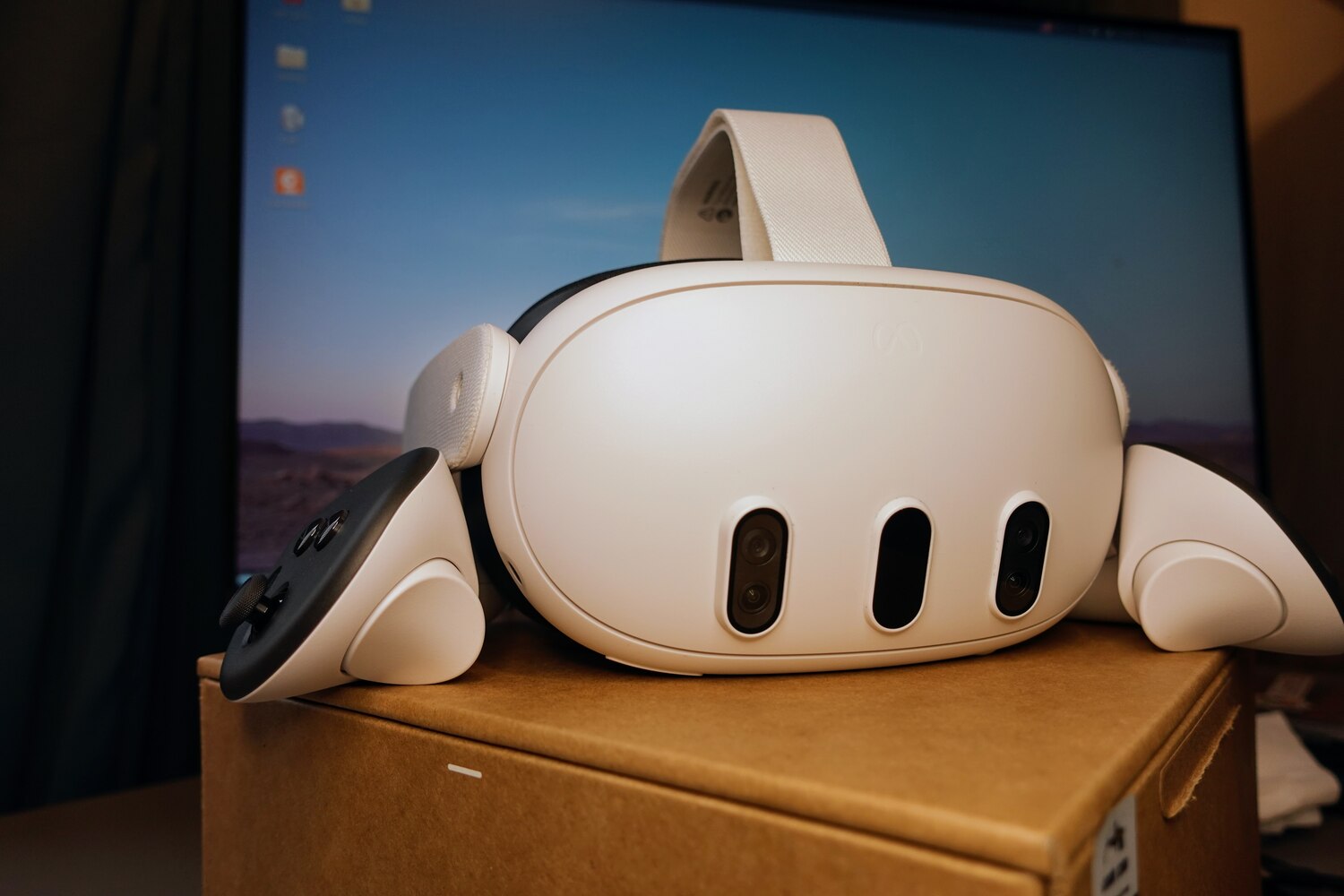
Photo: Roy.wonder.cohen via Wikimedia Commons, 25 October 2023 (archival). Resized and cropped under CC BY-SA 4.0. · Illustrative image.
Meta’s Reality Labs narrowed its September-quarter operating loss by $303 million year on year. Investors looking for evidence that Meta can sell enough headsets and glasses to cover the cost of developing them should look one line higher in the accounts. Sales actually fell by $27 million. The improvement came entirely from spending less.
Where the $303 million came from
The table compares the three months ended 30 September in each year. All figures are reported US dollars in millions. Meta’s quarterly filing
| Reality Labs | Q3 2025 | Q3 2026 | Change |
|---|---|---|---|
| Revenue | 470 | 443 | −27 |
| Costs and expenses | 4,902 | 4,572 | −330 |
| Operating loss | 4,432 | 4,129 | 303 narrower |
Employee compensation fell from $2,594 million to $1,970 million. That $624 million reduction was almost twice the decline in total costs. By subtraction, other costs and expenses rose $294 million. The distinction matters for anyone projecting another year of savings. Simply carrying the headline 7% reduction forward assumes that compensation can keep falling fast enough to absorb growth elsewhere.
What glasses sales can tell shareholders
Meta attributes the quarterly revenue decline to lower Quest sales, partly offset by higher AI glasses sales. Widen the window to the first nine months and the order reverses. Glasses more than offset weaker Quest sales, lifting segment revenue from $1,252 million to $1,276 million. The two periods tell a consistent story about which products are gaining ground, but a different story about how much growth they bought. Meta’s segment results
Meta reports operating profit for Reality Labs as a whole. A shareholder cannot use that figure to infer a margin on a pair of glasses or a Quest headset. The segment pays for longer-term work on devices, software and interfaces alongside products already on sale. A commercially successful pair of glasses could therefore coexist with years of segment losses. Equally, a smaller loss driven by compensation savings tells us little about demand for the next device.
The December-quarter test
Through September, Reality Labs had recorded an operating loss of $12.775 billion. Meta said it expected a full-year loss of approximately $18 billion to $19 billion. Subtracting the reported nine months leaves an implied December-quarter loss of about $5.2 billion to $6.2 billion, against $4.129 billion in the September quarter. That range is Compound’s calculation from management’s annual outlook. Meta has yet to report the quarter.
For valuation, the distinction is between a smaller recurring claim on the profits of Meta’s apps and a temporary lull in spending. The full-year outlook gives investors reason to be cautious about annualising the latest saving. In the next filing, look for two things together: whether glasses lift total segment sales even after the drag from Quest, and whether incremental revenue reduces the operating loss without another large cut to compensation. Seeing both would make a stronger case that commercial demand is starting to carry more of the development bill.
Follow the Meta stock profile and read Compound’s analysis of Meta’s advertising and AI spending for the economics of the business funding that investment.
Archival photograph by Roy.wonder.cohen. The photograph and its crops are available under CC BY-SA 4.0.