LEGO's Las Vegas F1 Race Was a Marketing Spectacle. Can the 2027 Sets Convert It Into Sales?
LEGO's 21 November celebrity race used 11 brick-built minicars, while the next Speed Champions F1 range targets March 2027. The real business test is retail conversion and licensing returns—not publicity alone.
 Wealth / The Compound journal
Photo: Mario.Surkovic / Wikimedia Commons, CC BY-SA 4.0 (https://creativecommons.org/licenses/by-sa/4.0/); photographed 3 April 2023; archival resized crop · Illustrative image.
The business value of LEGO’s celebrity Formula 1 race will not be measured by who crossed the line first. It will depend on whether a costly-looking promotional event attracts buyers to products that can sell repeatedly long after the Las Vegas Grand Prix weekend.
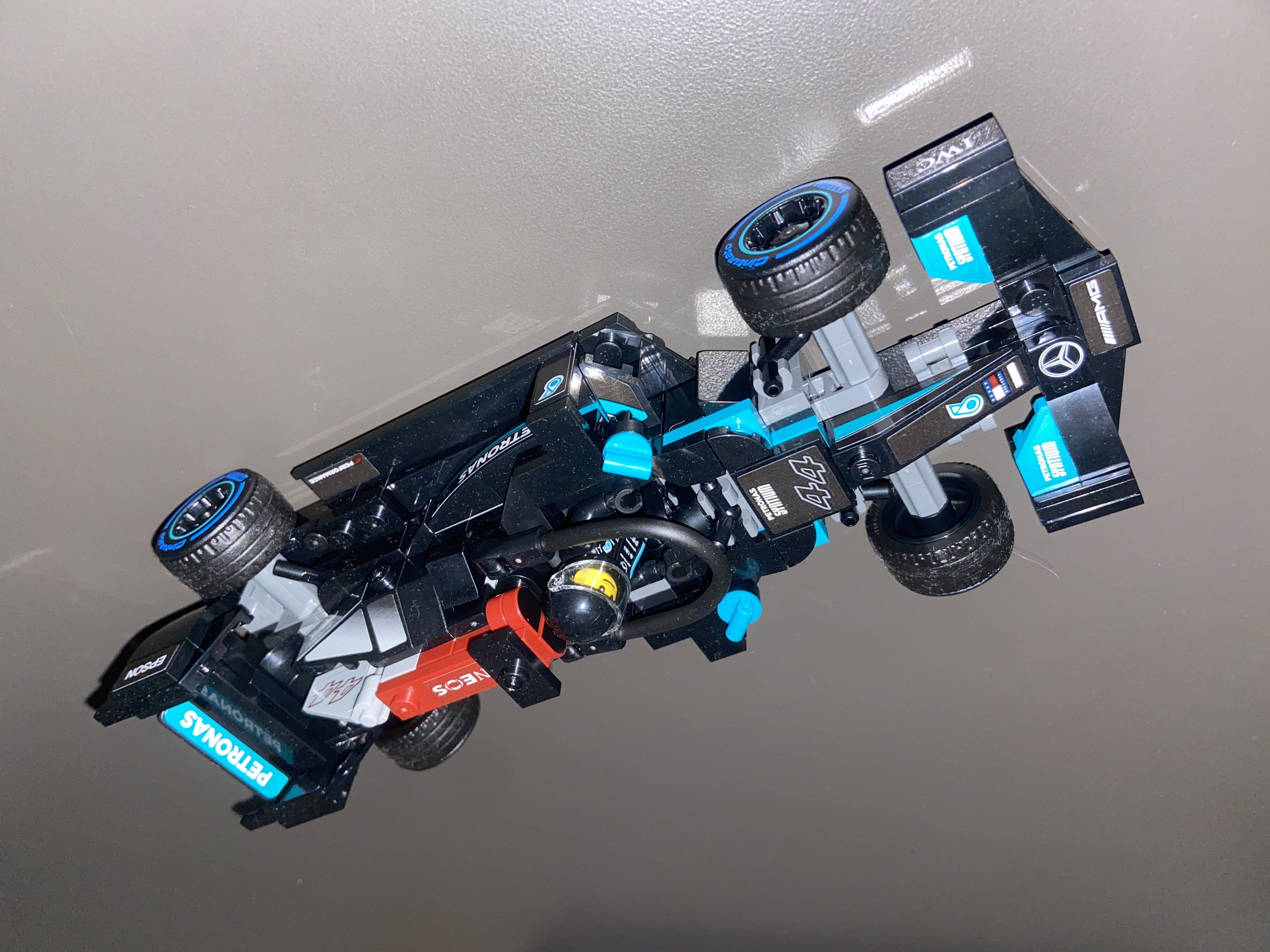
On 21 November 2026, the privately held LEGO Group reported that 11 celebrities drove 11 custom LEGO Formula 1 minicars ahead of the Las Vegas Grand Prix. The event had a race winner, DJ FISHER, but it was a branded entertainment activation, not a championship Formula 1 competition.
LEGO says 20 designers, engineers and builders developed the vehicles over 6,400 hours at its Kladno factory in the Czech Republic. That is an unusual amount of reported production effort for an advertisement. Crucially, the company has not reported the event’s production budget, attributable sales, F1 licensing payments or return on investment.
The race came only days after a linked commercial announcement: on 18 November, LEGO unveiled its next F1 Speed Champions portfolio, representing all 11 teams and 22 drivers as minifigures. The announced global sales date is 1 March 2027, with preorders open in selected markets; that is not the date all preorders or delivered sales are recognised.
The event and the product serve different economic purposes
The one-off race was designed to generate attention. A video watched by millions can create brand familiarity, but a view is not an order. A consumer might enjoy the spectacle without wanting a building set. Equally, a parent could discover LEGO through motorsport and purchase a product months later.
The 2027 range gives the marketing campaign something concrete to point toward: licensed sets associated with teams and drivers that fans recognise. That is more monetisable than the drivable promotional cars themselves, which are not advertised as a mass-market product in the 21 November announcement.
A useful way to judge the strategy is to separate three measures: reach (how many relevant people actually saw it), conversion (the percentage of those people who buy something incremental) and contribution (the money left after making, licensing, shipping and selling the product). Public statements establish a campaign and a product pipeline, but they do not supply all three measures.
Where Formula 1 licensing can add value
A licensed partnership gives a toy company recognition it otherwise might have to build from scratch. Familiar team colours, driver identities and race-day stories can make sets more attractive to collectors and adults as well as children.
The trade-off is dependence on another party’s intellectual property. Licensing can involve payments, approvals, design restrictions and contractual end dates. LEGO has not disclosed the financial terms of its F1 arrangement in these November announcements, so it would be wrong to impute a royalty rate or an exclusive term.
There is also an inventory challenge. Buyers may favour some teams and drivers far more than others. Offering all 11 teams gives the collection breadth, but retailers must decide how much stock each model merits. Winning at publicity and winning at shelf-level forecasting are separate skills.
A second advantage is repeatability. LEGO can use the F1 relationship across successive products, racing calendars and marketing events. The risk is that enthusiasm fades or a new season changes the designs customers prefer faster than physical inventory can be sold.
What could 6,400 development hours have cost?
The company’s 6,400-hour number covers development of the one-off minicars, not reported expenditure or the total promotional campaign. Labour rates and whether those hours displaced other projects are undisclosed.
A disciplined reader can test a hypothetical cost range without presenting it as a LEGO financial disclosure:
| Illustrative fully loaded hourly rate | 6,400 hours multiplied by rate |
|---|---|
| €40/hour | €256,000 |
| €70/hour | €448,000 |
| €100/hour | €640,000 |
These are hypothetical labour-value illustrations, not estimates of actual LEGO spend. The company did not provide pay rates, staff mix, fabrication inputs, vehicles, travel, venue costs, licensing fees, broadcasting rights or the campaign budget. Time worked is also not equivalent to cash spent: the people may have been salaried employees.
The gap between €256,000 and €640,000 demonstrates why the headcount and hours alone cannot prove extravagance or cost effectiveness. A campaign budget could be much larger once physical and media costs are counted, or its incremental payroll cash outlay could be smaller if some staff were already employed.
A sales sensitivity calculation, not a forecast
Suppose, solely for illustration, a campaign eventually causes 20,000 additional sets to be purchased, each producing €12 contribution after relevant variable product, fulfilment and distribution costs. The contribution would be €240,000, not necessarily sales revenue or accounting profit. At 50,000 extra sets with the same assumed contribution, the result would be €600,000.
Neither assumption is measured in LEGO’s announcements. Both ignore possible cannibalisation: a buyer might choose an F1 set instead of another LEGO set rather than spend more overall. They also do not account for fixed creative expenditure, licensing terms or changes in customer retention.
A realistic evaluation would track incremental orders against an appropriate baseline, repeat purchasing, gross margin by range, retailer replenishment and unsold products. Counting branded impressions alone is not enough.
Why this matters for LEGO as a private business
LEGO is privately held, and the race announcement offers no new public share price or audited quarterly result. Investors analysing private-company growth should resist assigning a valuation based on a promotional stunt.
This is a more tangible consumer-company story than a generic claim about a rising F1 audience. LEGO has a defined 2027 product portfolio and a live 2026 activation. Those decisions expose a business model built around licensed intellectual property, merchandising and retail execution.
The LEGO company research hub keeps this launch, its supporting evidence and later financial disclosures connected to a single company profile. Related coverage of Stripe’s distribution through a bank’s app illustrates a useful contrast: both businesses seek lower-friction customer acquisition, but neither partnership has disclosed a reliable campaign-specific profit figure.
The next figures worth checking
The useful follow-ups are not a second race recap. They are verified retail pricing by market, stock availability near 1 March 2027, management’s later product-demand commentary and any company-reported financial contribution specifically attributable to the partnership.
The central distinction is between an event that gets attention and a product that earns a margin. LEGO has shown the first and announced the second. The conversion between them is the part still unproven.
Compound Research, 23 November 2026. All cost and sales illustrations are labelled hypothetical. No royalty rate, campaign expenditure, unit sales or private-company valuation is asserted as fact.