Intel Earnings: Data-Centre Growth Meets a Weaker Outlook
Intel's data-centre revenue jumped 78%, but its Q4 guidance points lower. Why the server recovery and the wider turnaround need separate tests.
 Wealth / The Compound journal
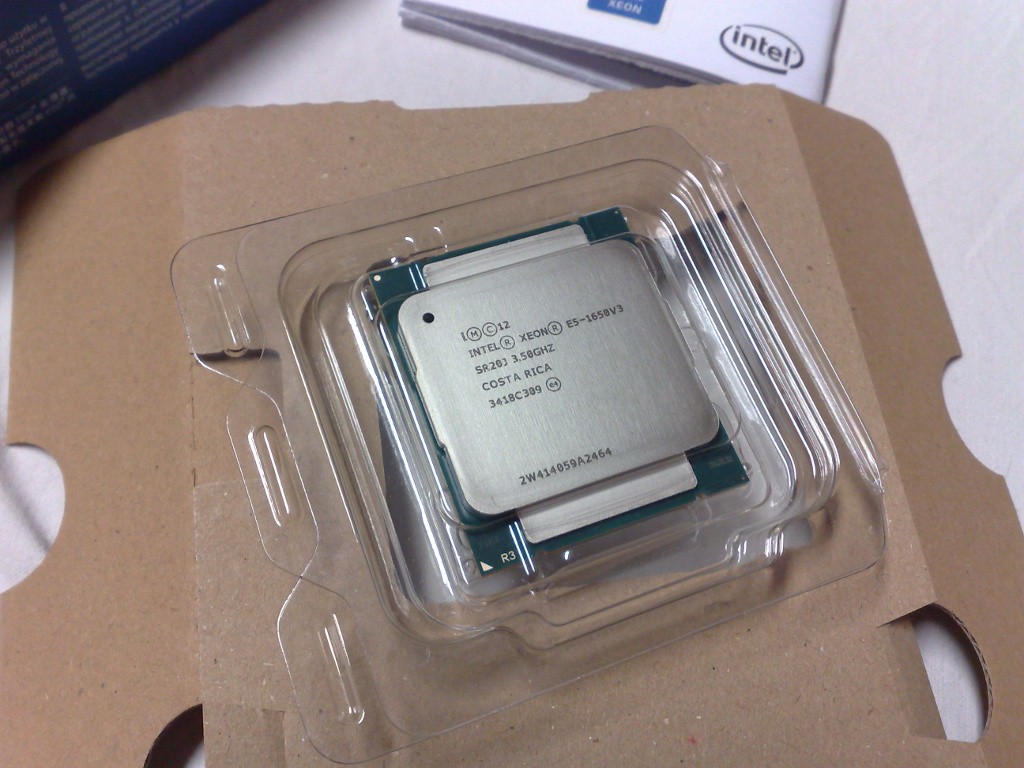
Photo: Dsimic / Wikimedia Commons (CC BY-SA 4.0; 2014-11-29) · Illustrative image.
Intel’s third quarter shows why a promising server business and a convincing turnaround are different investment propositions. Data-centre revenue surged, but the company’s next-quarter outlook points to weaker sales and margins.
The SEC earnings release, covering the quarter ended 26 September 2026, reports $16.513 billion of revenue, up 21% year on year. GAAP diluted EPS was $0.60, compared with $0.90; adjusted EPS was $0.52, against $0.23. Those measures move in opposite directions, so quoting one without its accounting basis would distort the result.
The server engine is strengthening
Data Center and AI revenue reached $7.3 billion, up 78%. Client Computing and Physical AI revenue fell 5% to $8.1 billion. Intel therefore has two sizeable businesses moving at very different speeds.
For an investor, that is more informative than the group growth rate. Strong demand in one market does not remove weakness in another. Nor does a sales increase by itself establish how much profit can be earned once capacity, product costs and investment requirements are considered.
The release puts GAAP operating margin at 15.3%, versus 5.0% a year earlier. That is meaningful operating progress. It still needs to be tested against the outlook rather than extrapolated indefinitely.
Why the next quarter changes the interpretation
Management forecasts Q4 revenue of $15–16 billion, a GAAP gross margin of 37.1% and adjusted EPS of $0.25. The revenue midpoint is approximately 6.1% below Q3, calculated from $15.5 billion and $16.513 billion. Adjusted EPS guidance is less than half the reported Q3 figure.
These are sequential comparisons with management guidance, not claims about a Wall Street earnings miss. They show why a good historical quarter can leave investors with a harder forward-looking question.
Intel also says the PC slowdown could persist through at least the first half of next year. That makes the balance between server growth and client weakness central to the outlook.
Foundry revenue is not all external customer revenue
Intel Foundry reported $6.7 billion of segment revenue, but the group also recorded $6.3 billion of intersegment eliminations. Adding the headline segment figures together would double-count internal business.
The investment test for foundry remains external demand, execution and eventual economics. Internal manufacturing activity can support Intel’s products, but it should not automatically be valued as if it were independent third-party sales. A larger segment number does not alone prove that the external foundry strategy has reached scale.
Keep the profit definitions straight
Consolidated net income was $3.520 billion; profit attributable to Intel was $3.320 billion, after non-controlling interests. The company earnings page retains the consolidated net-income basis used in its earlier quarterly data. EPS relates to Intel shareholders and includes the release’s stated diluted-share adjustments.
The bullish case is that server demand and better execution can sustain a recovery. The challenge is to convert that strength into durable group profit through the PC slowdown and manufacturing investment cycle. This release provides evidence of progress, not proof that the difficult part is over.
Browse Compound’s earnings hub for the other releases. Figures and guidance come from Intel’s SEC-furnished release; derived comparisons are Compound’s. General analysis, not a personal investment recommendation.
Cover: Dsimic, Wikimedia Commons, CC BY-SA 4.0. Photographed 2014-11-29; archival. Resized for display; display cropping may apply. This image and its resized version remain available under the same licence. An Intel Xeon E5-1650 v3 processor photographed in 2014; archival hardware, not a current-generation chip.