LIVE TO 100 PART 4 OF 4
Life for a 100-Year Life: Connection, Purpose and Ordinary Days
Who would you like to see, what would you like to do, and where would you feel you belong? Making room for relationships, interests and support through a changing life.
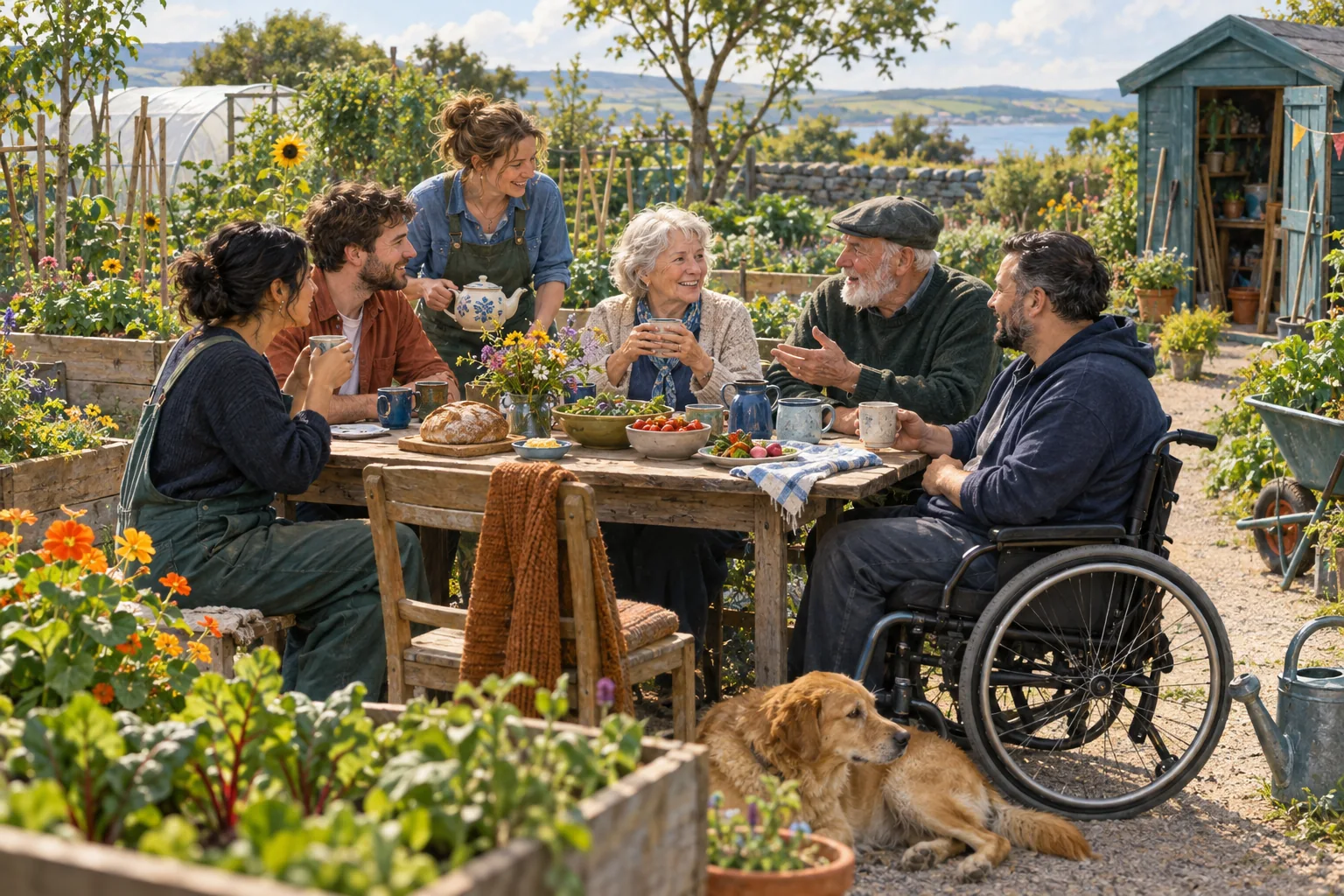
What would make an ordinary Tuesday worth looking forward to?
Perhaps there would be someone to meet, something to make, a place where you are expected or simply time to read without feeling hurried. A good day does not have to look impressive. Its value may be difficult to explain to anyone who does not know you.
The earlier parts of this series considered the longer-life question, money and choices, and health and capability. This final part asks what those things are for. It is about sustaining a life that feels like yours as relationships, work, responsibilities and health change.
Happiness here does not mean constant cheerfulness. It leaves space for interest, belonging, rest, affection and meaning, alongside frustration and sadness. No one should have to earn care or companionship by being positive.
Begin with the kind of day you value
Imagine a future day in enough detail to make it recognisable. Where would you wake up? Would you want company at breakfast or a quiet start? Is there something you would like to get out for? Who would you enjoy talking to? What would make the evening feel comfortable?
This is a reflection, not a psychological test. It can reveal the difference between a borrowed ambition and a personal preference. You might find that a celebrated retirement fantasy—constant travel, for example—matters less to you than a familiar neighbourhood and regular company. Another person may feel the reverse.
Now look at the conditions that day would need. A visit may depend on accessible transport. Enjoyable reading may depend on suitable print or an audiobook. Time with friends may depend on relief from caring duties. These details connect happiness to the financial and health questions in the other articles.
Some conditions are outside your immediate control. Name those honestly. A useful plan does not pretend that a better attitude can replace enough income, suitable housing, safety or access to care.
Connection is more than the number of people you know
It helps to distinguish three experiences. Social isolation concerns limited social contact or connections. Loneliness is the distress of feeling that the connection you have falls short of what you need. Solitude can be time alone that you choose and enjoy. They are not interchangeable. The WHO’s Commission on Social Connection sets out the distinction between isolation and loneliness and treats social connection as a public-health concern. WHO (1).
A crowded diary therefore cannot tell the whole story. You may meet plenty of people and still feel that nobody knows what your life is like. You may live alone and have relationships that feel close and dependable. Being married or having children is not a guarantee of either company or practical support.
Ask a more specific question: what kind of connection is missing? It could be somebody to confide in, companions for an activity, casual conversation or help when a day goes wrong. Different needs suggest different next steps. A hobby group may offer a pleasant shared activity without immediately becoming the place for a deeply personal conversation.
Compound’s guide to loneliness in Ireland explores that subject further. Here, the invitation is to notice the quality and fit of your connections without turning them into a score.
Give relationships a place in the week
Friendship can be easy to postpone when the diary is full, and harder to arrange when the familiar structure disappears. Leaving a job, moving, separating or becoming a carer can change when and how you see people. These transitions are reasons to reconsider arrangements, not evidence that anyone has failed at friendship.
A recurring plan can remove some of the work of starting again each time: a call on a particular evening, coffee after an appointment, watching a match together or a shared online activity. Choose something both people actually want and can manage. Reliability matters more than an elaborate occasion.
If you would like new connections, an activity with a shared focus can offer an easier first conversation. Ask what a first visit involves. You might want to arrive with somebody, speak to an organiser beforehand or attend for only part of a session. There is no obligation to enjoy every group you try.
Keep the practical questions visible. Can you hear in the room? Is it accessible? What does it cost? How would you get home? Does the setting feel welcoming to you? An invitation is more useful when the answer includes those details.
And connection does not require unlimited availability. A sustainable relationship allows for illness, different energy levels and boundaries. Being helpful is one way to participate; receiving help and simply being good company count too.
Keep curiosity without making it a performance
An interest can give an afternoon shape without becoming a second career. Music, gardening, local history, crafts, reading, games and learning something unfamiliar can be worthwhile even when you remain an enthusiastic beginner.
There is research behind taking interests seriously, but it needs careful interpretation. A 2023 study of 93,263 adults aged 65 or older across 16 countries found that having a hobby was associated with better reported wellbeing, including higher happiness and fewer depressive symptoms. It combined longitudinal studies; it did not randomly assign people to hobbies. Ireland was not one of the countries studied. Mak and colleagues (2).
That is encouraging evidence of a relationship, not proof that taking up a particular activity will treat depression or extend your life. Health, circumstances and participation can affect one another, and statistical adjustment cannot remove every uncertainty.
The personal question is simpler: is there something you would like to try, return to or adapt? Begin at a scale you can afford in time, energy and money. Borrow equipment before buying it if that is possible. Give yourself permission to stop an activity that does not fit.
Our article When did you last do something for fun? develops that invitation. Enjoyment does not need an impressive explanation, measurable improvement or an audience.
Find a door into community in Ireland
“Join something” can be unhelpfully vague. A better starting point is a real service, a named organiser or a place where you can ask what is available. The following are routes to explore, not promises that every area offers the same activities.
Your library. Public library membership is free in Ireland. Ask your local branch about reading groups, events and access arrangements rather than assuming a particular programme is running. Libraries Ireland (3). The national eLibrary (4) also provides routes to online reading, listening and learning, useful when getting out is difficult or you prefer to begin at home.
Volunteering. Volunteer Ireland provides information on opportunities and local volunteer centres, including ways to volunteer from home. Volunteer Ireland (5). Before committing, ask what the role involves, what support is offered and whether the hours are realistic. Wanting to contribute does not oblige you to take on more than you can sustain.
Social prescribing. The HSE describes services that connect people with local activities and support, with help from a social prescriber or link worker. It says you can refer yourself, or another person with their consent, by contacting a local service. HSE (6). It can be a starting conversation when you do not know where to begin; it does not replace needed healthcare.
There may also be sports clubs, cultural groups, community gardens, faith communities or disability-led organisations that suit you. Check the actual access and welcome rather than relying on a general label. Compound’s article on the Ploughing and community explores one familiar Irish gathering. A smaller, repeated encounter may be more useful for your own week.
Let purpose change shape
Paid work can organise much more than income: when you get up, who you see, what you are asked about and where your skills are recognised. When work ends or changes, it may help to separate those parts rather than trying to replace an entire job with one new activity.
| Something you may value | A question to explore |
|---|---|
| Company | Where could I have regular contact with people I enjoy? |
| Challenge | What would I like to learn or practise at a manageable pace? |
| Contribution | What could I offer, with clear limits on my time and energy? |
| Structure | Which small commitments would give the week a useful rhythm? |
| Rest | What would I like permission to stop doing? |
Purpose need not be a single mission. It can be a modest commitment to a person, a craft, a place or a principle. It can also be private: making your home welcoming, tending something or being present for someone whose life is difficult.
There is room for ambivalence. You may be relieved to leave a job and still miss it. You may enjoy helping and also need a break. Allowing those feelings makes a plan more honest than filling every open hour to prove that retirement is going well.
The same applies if illness changes a valued role. Ask which part of it still matters and whether another form could preserve something of that meaning. Watching, advising, listening or accepting care may be the appropriate form now. Your worth does not depend on staying productive.
Make room for loss, caring and difficult chapters
A longer life can include bereavement and other profound changes. A guide to happiness should acknowledge that without rushing to turn it into an opportunity. You may need company, privacy, practical help or professional support at different times.
The HSE emphasises that grief has no single correct form and does not necessarily unfold through clear stages. Feelings and physical symptoms can come and go. HSE (7). A difficult anniversary or an unexpectedly painful ordinary day does not mean you are doing it wrongly.
If you are supporting somebody, a specific offer may be easier to respond to than “let me know if you need anything”: a meal, a lift or a call at an agreed time. Ask rather than taking over. Keep the person’s preferences central, including the possibility that they want to talk about the person who has died.
Caring can contain love, satisfaction, exhaustion and frustration together. The carer’s own life still needs attention. Family Carers Ireland provides information, local contacts and support routes, including carer support groups. Family Carers Ireland (8). Asking about help is a practical step, not a statement about how much you care.
For older people needing connection or practical support, ALONE is another Irish route to explore. ALONE (9). Start with what is making the day difficult, rather than deciding in advance that you ought to manage it alone.
Know when a broader kind of help is needed
Friendship, community and enjoyable activities have a place in life, but they are not substitutes for assessment and treatment when those are needed. If distress, anxiety or loss of interest is persistent or affecting daily life, speak with a GP or an appropriate mental health professional. The HSE support directory (6) can help you find available routes.
For confidential emotional support, Samaritans can be reached on 116 123, day or night. If you or someone else is about to harm themselves or another person, the HSE advises calling 112 or 999, or going to the nearest emergency department. HSE urgent-help guidance (10).
Support does not need to wait until a situation is at its worst. Nor does using it cancel the value of the ordinary relationships and activities you already have. They can sit alongside each other.
Put something worthwhile into the coming week
Return to the ordinary day you imagined at the beginning. Choose a small part of it that belongs in the present. It could be contacting someone, asking a library about an activity, returning to a neglected interest or arranging help that would make another choice possible.
Then ask what would make that step easier. A smaller commitment? A lift? A quieter room? A reminder? Someone to come with you? You do not have to turn an intention into a complete new identity.
It may help to write three brief notes: someone I would like to connect with; something I would enjoy; something I need support with. There is no score and no requirement to make all three happen immediately. Treat them as prompts for a life you recognise, not a standard to judge yourself against.
Across this series, wealth is there to support choices, health is there to support participation, and happiness gives attention to what makes those choices worthwhile. They overlap in an ordinary visit, a suitable home, time to recover or a meal with someone you like.
A hundredth birthday remains uncertain. The coming week is close enough to make room for something that matters.
Related Compound guides
For the practical evidence on life satisfaction and the habits most worth testing, read How to be happier: what the evidence actually says.
For the social side of a long life, see How to make friends as an adult in Ireland and Loneliness in Ireland.
FOLLOW THE EVIDENCE
Sources, dates and definitions.
Source numbers match the links in the article. Access dates and the period each source covers are recorded below.
- From loneliness to social connection: report of the WHO Commission on Social Connection
World Health Organization. 30 June 2025.
Global evidence and definitions; not an estimate of loneliness in Ireland.
Accessed 16 September 2026.
- Hobby engagement and mental wellbeing among people aged 65 years and older in 16 countries
Mak HW and colleagues / Nature Medicine. 11 September 2023.
Five longitudinal studies; 93,263 adults aged 65+; observational associations; Ireland was not included; DOI 10.1038/s41591-023-02506-1.
Accessed 16 September 2026.
- Join your library
Libraries Ireland. Undated service information.
Free public library membership in Ireland; local activities and access arrangements vary.
Accessed 16 September 2026.
- eLibrary
Libraries Ireland. Undated service directory.
Online reading, listening and learning resources through Irish public libraries.
Accessed 16 September 2026.
- Volunteering and the volunteer centre network
Volunteer Ireland. Current service directory.
Ways to explore volunteering, including local centres and opportunities from home.
Accessed 16 September 2026.
- Organisations providing mental health supports and services
Health Service Executive. Current service directory.
Irish supports, including social prescribing and consent-based self-referral or referral.
Accessed 16 September 2026.
- Coping with grief after bereavement or loss
Health Service Executive. Online patient information.
Different experiences of grief, coping and routes to support.
Accessed 16 September 2026.
- Carer supports and local contacts
Family Carers Ireland. Current service directory.
Information, support managers, groups and other supports for family carers.
Accessed 16 September 2026.
- Support for older people
ALONE. Current service information.
Practical support and connection for older people in Ireland.
Accessed 16 September 2026.
- Get urgent help for a mental health crisis
Health Service Executive. Page displays last review 28 May 2025.
Irish urgent-help routes and current Samaritans contact details.
Accessed 16 September 2026.
A longer life is made of days that matter.