Two Irish couples earn €100,000. Why can their take-home pay differ by €9,556?
Two married Irish households each earn €100,000 gross, but their estimated 2027 take-home pay differs by €9,556. The reason is how income-tax bands, PAYE credits and USC work when one or both partners earn.
 News / Wealth
Illustration: Compound.ie
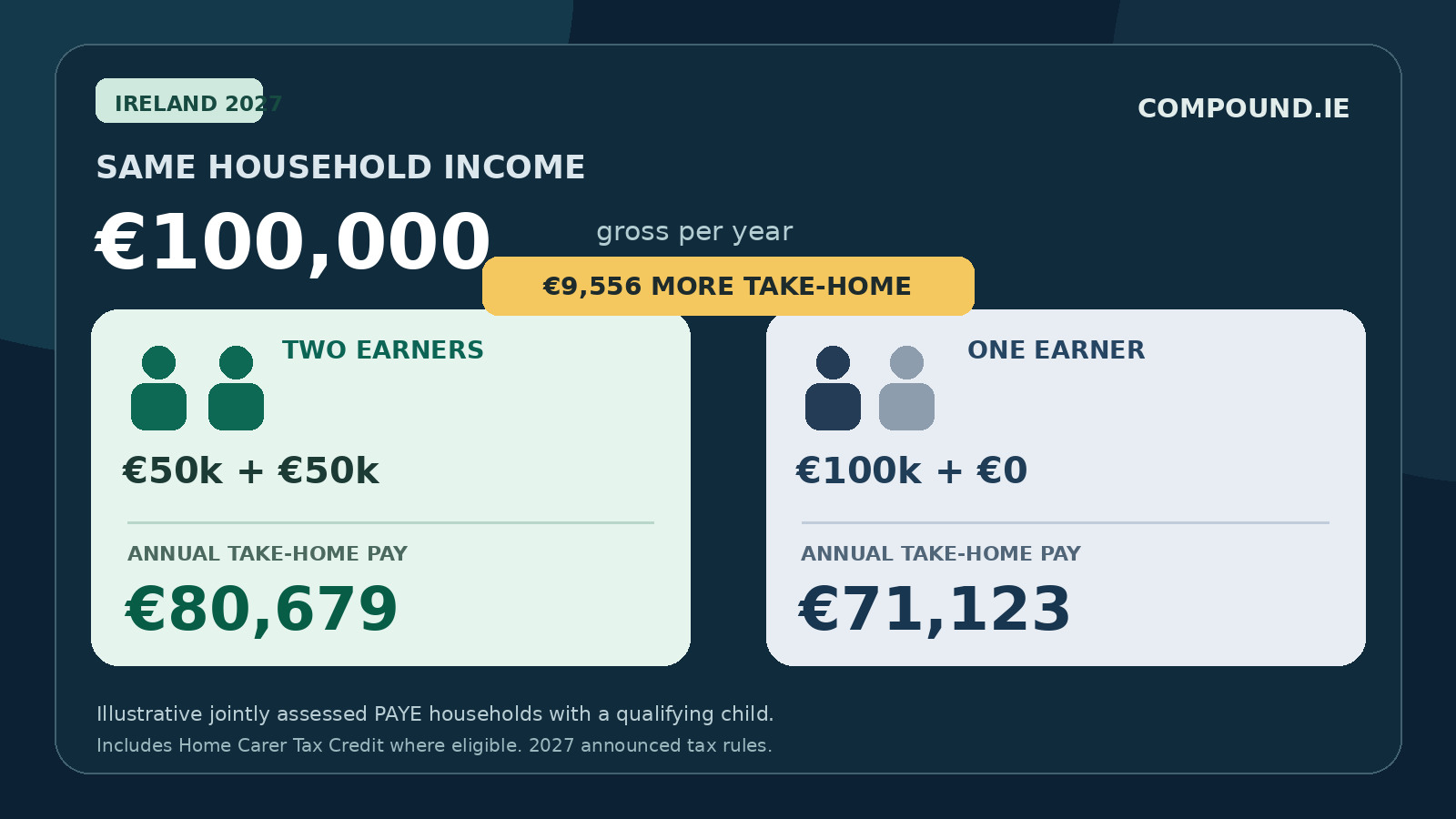
Two married households. The same €100,000 gross annual salary between them.
One household has a single €100,000 earner. The other has two people earning €50,000 each.
Based on the tax changes announced for 2027, the first could take home around €71,123; the second around €80,679.
That is a difference of €9,556 a year, or about €796 a month.
The difference is not a special penalty on marriage. It emerges from how Ireland’s joint-assessment income-tax bands, PAYE tax credits and individual USC liabilities interact. And it raises an interesting policy question: should two households with the same combined income face such different deductions?
Same €100,000 gross. Three different pay packets
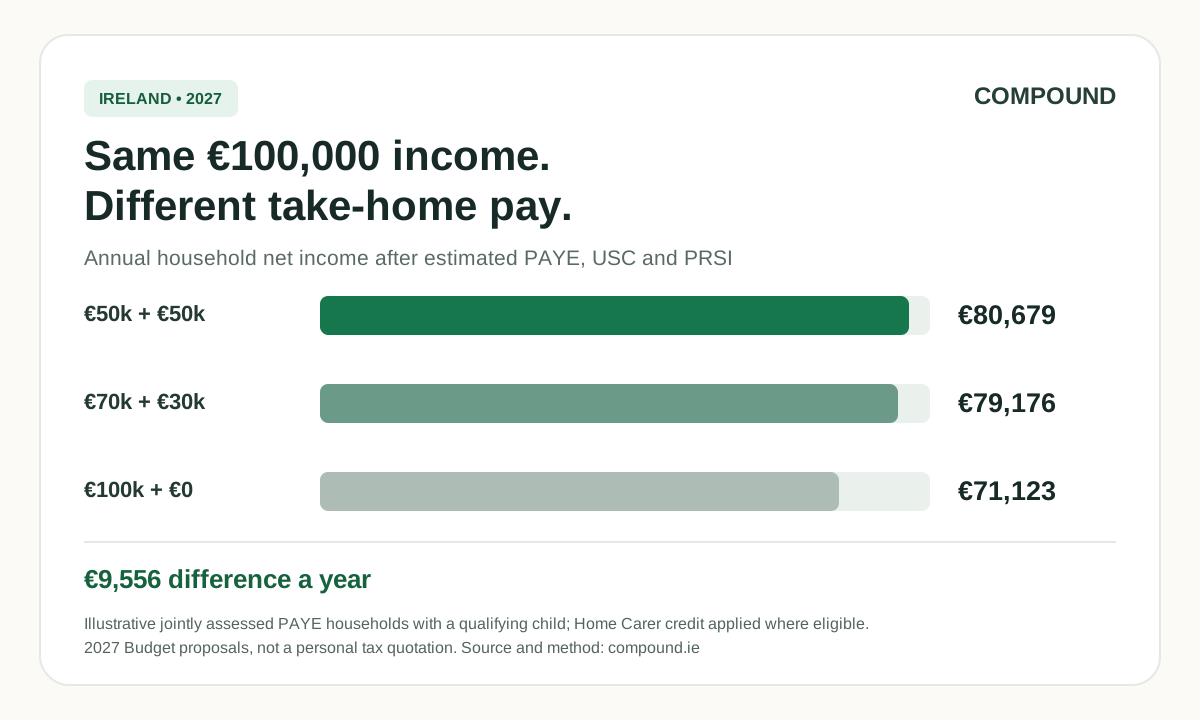
| Annual income split | Household gross | Income Tax | USC | Employee PRSI | Estimated take-home |
|---|---|---|---|---|---|
| €50,000 + €50,000 | €100,000 | €12,900 | €2,034 | €4,388 | €80,679 |
| €70,000 + €30,000 | €100,000 | €14,400 | €2,037 | €4,388 | €79,176 |
| €100,000 + €0 | €100,000 | €20,475 | €4,015 | €4,388 | €71,123 |
Important assumptions: All three couples are married or civil partners jointly assessed for income tax, have at least one qualifying dependent child, and receive ordinary Class A PAYE salaries. The one-income household is assumed to qualify for the €2,050 Home Carer Tax Credit. Calculations use the announced 2027 income-tax bands and credits, ordinary USC rates per employee, and an indicative 2027 employee PRSI blend of 4.35% for January–September and 4.50% for October–December. Annual incomes are level, and the figures exclude pension contributions, rent relief, mortgage relief, medical-card USC concessions, childcare costs and other personal deductions. Table values are rounded individually; results may differ by a euro when rounded.
These are forward-looking illustrations, not actual payslip quotations. The Budget 2027 measures were announced on 6 October 2026 and are still subject to the Finance Bill and enactment. See Revenue’s Budget 2027 status.
Why two earners can pay less income tax
The largest difference is Ireland’s 20% standard-rate income-tax band.
Under the announced 2027 rules:
- A married couple with one income has €55,500 taxed at 20%; the balance is generally taxed at 40%.
- A married couple with two incomes can increase that band by up to €37,500, but no more than the lower earner’s income. Their combined maximum is therefore €93,000.
For a €100,000 household with a single earner, €44,500 is above the standard-rate band. With two €50,000 earners, just €7,000 of combined pay is above the enlarged band.
That €37,500 difference in income charged at 20% rather than 40% reduces gross income tax by €7,500 before tax credits are considered.
The second earner also generates a separate €2,125 Employee (PAYE) Tax Credit. Unlike most joint-assessment credits, that employee credit cannot be transferred to a non-working spouse.
The one-income couple is not forgotten: where they qualify, the Home Carer Tax Credit rises to €2,050 in 2027. But Revenue does not allow a couple to claim both that credit and the two-income enhanced standard-rate band. The worked example gives the one-income couple the full Home Carer credit; without eligibility, their income-tax bill would be higher.
Sources: 2027 tax rates and bands, Revenue’s joint-assessment rules and Revenue on the Home Carer credit.
USC adds a second gap
USC is generally calculated on each person’s income, not on the couple’s €100,000 combined salary.
A single €100,000 earner therefore has more income exposed to the 8% USC band above €70,044.
By contrast, two €50,000 earners each remain below that threshold. In these examples, combined USC is approximately €4,015 for one earner versus €2,034 for two equal earners: a further difference of €1,981.
Employee PRSI, modelled here at the same blended percentage on all €100,000 of ordinary pay, is essentially identical across the examples. The illustration combines:
| Source of advantage for the €50k/€50k couple | Approximate annual value |
|---|---|
| Larger 20% income-tax band | €7,500 |
| Extra PAYE credit | €2,125 |
| Less: Home Carer credit available to qualifying one-income couple | -€2,050 |
| Lower combined USC | €1,981 |
| Total estimated take-home advantage | €9,556 |
Does this make Ireland unfair to one-income families?
There are arguments on both sides.
The case for the two-earner advantage: The additional standard-rate band and non-transferable PAYE credit recognise that two different people are earning wages. A second worker may face additional transport, childcare or other employment costs. A tax system that heavily taxes the second earner can discourage taking a job or increasing hours.
The case for a one-income family’s concern: A household may have one person earning a salary while the other does substantial unpaid caring work. Gross household income is still €100,000, and the household may have comparable housing, food and energy costs. The Home Carer credit partly acknowledges that, but it does not remove the full difference shown here.
Neither annual take-home figure measures a family’s overall welfare. A two-earner household might pay thousands more for childcare and commuting. A one-earner household may provide more unpaid care and lose potential career progression or pension contributions.
That is why €9,556 is a tax-and-pay comparison, not a claim that one arrangement is €9,556 better for every family.
For the practical decision about childcare and work, see Is returning to work after children financially worth it? and the Childcare Return-to-Work Calculator.
What if one spouse earns €70,000 and the other €30,000?
The intermediate example is revealing. With incomes of €70,000 and €30,000, the couple gets a 20% band of €85,500: the €55,500 base plus the lower earner’s €30,000.
Their estimated combined take-home pay is €79,176, only around €1,503 below the €50,000/€50,000 couple, but roughly €8,053 ahead of the one-income couple.
The two-income benefit is therefore not an all-or-nothing rule. It depends on how much the lower earner makes, and how both incomes fall across the USC bands. It is not a rule that the first €93,000 of any married couple’s income is taxed at 20%.
Can a married couple simply transfer the unused band?
Not the extra second-earner band. Revenue explicitly says the increase in the standard-rate band for two earners is not transferable from one spouse to the other. The Employee Tax Credit is also non-transferable.
Joint assessment can be valuable, and most eligible credits and reliefs can be allocated between spouses, but it does not make the tax treatment of €100,000 + €0 identical to €50,000 + €50,000.
For a wider explanation, see our guide to tax credits in Ireland.
Try your own household numbers
The examples above use a specific child-and-Home-Carer-credit scenario. Change the earnings, credit eligibility or pension deductions, and the answer changes.
Use Compound’s Budget 2027 Calculator to compare the announced rules with 2026, or the Income Tax Calculator and Take-Home Pay Calculator for a closer look at your own payslip. Check individual eligibility with Revenue.
The question worth asking
Ireland’s tax system deliberately distinguishes one worker earning €100,000 from two workers earning €50,000 each.
There are defensible reasons for rewarding the second earner. There are also defensible reasons to recognise unpaid care.
The real debate is not whether €100,000 is a good salary. It is what the tax system should recognise: equal household income, individual participation in paid employment, or the value of unpaid caring work.
If two families bring in the same €100,000 before tax, how different should their take-home pay be?
Methodology: calculated using announced 2027 income-tax bands (married base €55,500; second-earner addition up to €37,500), married personal credit €4,250, Employee credits €2,125 per eligible worker, and the full €2,050 Home Carer credit where eligible. USC per individual uses 0.5% up to €12,012, 2% up to €30,300, 3% up to €70,044, and 8% above. PRSI uses an indicative 4.3875% annual blended employee rate; actual payroll timing and individual circumstances vary. Figures rounded. Article reviewed 16 October 2026.
This article provides general information, not personalised tax advice. The 2027 figures are Budget announcements, subject to legislation.