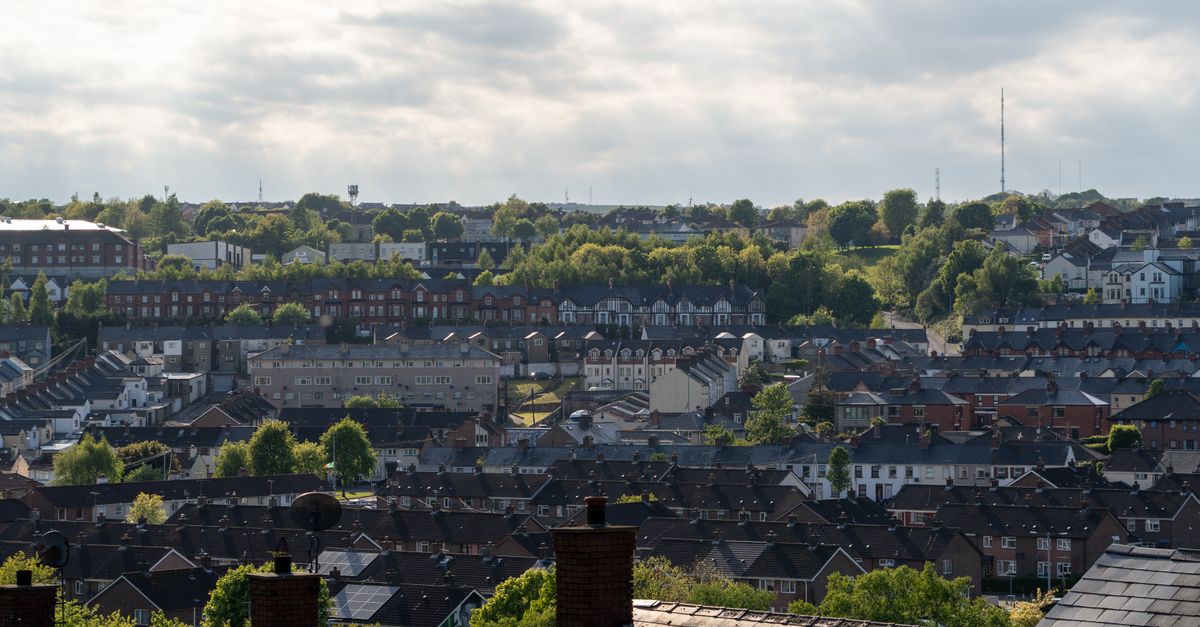
Irish house prices are estimated to be 17% overvalued — what does that actually mean for buyers?
ESRI research estimates Irish house prices are around 17% above levels implied by economic fundamentals. That does not mean prices must fall 17%. Here is what the finding means for buyers.
 News / Wealth
Photo: Donovan Kelly on Pexels · Illustrative image.
News analysis · 22 September 2026. The ESRI estimate is a model-based assessment of valuation, not a forecast that Irish house prices will fall by 17%.
Irish house prices are around 17% above the level suggested by economic fundamentals, according to research published this month by the Economic and Social Research Institute.
That is a striking number.
It is also an easy number to misread.
A finding that prices are 17% “overvalued” does not mean the ESRI expects Irish house prices to fall by 17%.
The estimate compares actual prices with levels suggested by factors including household incomes, interest rates and demographics. The ESRI itself stresses that the current market looks very different from the credit-driven property boom that preceded the financial crisis.
The more immediate issue is affordability.
House prices have risen faster than incomes, borrowing costs are higher than they were a few years ago, and housing supply remains constrained.
For someone trying to buy a home, the important question is therefore not simply whether prices are “overvalued”.
It is:
Can I comfortably afford this property if prices, interest rates or my own circumstances move against me?
What does “17% overvalued” actually mean?
The ESRI used several economic approaches to compare Irish residential property prices with underlying fundamentals.
Its composite estimate suggests house prices are currently around 17% above the level that would be consistent with factors such as incomes, interest rates and demographics. ESRI.
The underlying research describes this as a significant level of overvaluation, but one that is materially below the excesses seen before the financial crisis.
The ESRI estimates overvaluation peaked at more than 40% in 2006.
That comparison is important.
It means the researchers see a meaningful gap between house prices and fundamentals today, but not a repeat of the same conditions that existed at the height of the Celtic Tiger property boom.
Why 17% overvalued does not mean prices must fall 17%
“Fair value” models are not price targets.
Suppose an economic model suggests a €500,000 home is priced above the level justified by fundamentals.
There are several ways that gap could narrow.
House prices could fall.
But prices could also:
- remain broadly flat while household incomes rise;
- rise more slowly than incomes for several years;
- be supported by persistent housing shortages;
- respond to changes in mortgage rates;
- or move differently from the model because the underlying assumptions change.
In other words, valuation can normalise through prices, incomes, interest rates or time.
The 17% figure should therefore be read as a warning about the relationship between prices and economic fundamentals — not as a forecast for the next 12 months.
The latest house-price data are still rising
The most recent CSO Residential Property Price Index does not show a national fall in prices.
In the 12 months to July 2026, residential property prices increased by 5.5% nationally.
The increase was:
- 4.4% in Dublin;
- 6.4% outside Dublin.
The median price paid for a dwelling in the 12 months to July was €399,999. CSO.
Dublin’s median was €500,000, while Dún Laoghaire-Rathdown reached €684,411.
So there is an important distinction between two statements:
Prices can be estimated to be above fundamentals while still continuing to rise.
Both can be true at the same time.
What would a €400,000, €500,000 or €600,000 home require?
For a first-time buyer, the Central Bank’s standard mortgage measures allow borrowing of up to 4 times gross income, while the standard loan-to-value limit for a principal home is 90%.
Lenders still conduct their own affordability assessment and may lend less. A proportion of lending can also exceed the standard limits. Central Bank of Ireland.
Here is what the standard limits imply for three example purchase prices:
| Home price | 10% deposit | 90% mortgage | Gross income needed at 4× income | Monthly repayment at 4%* | Monthly repayment at 5%* |
|---|---|---|---|---|---|
| €400,000 | €40,000 | €360,000 | €90,000 | €1,719 | €1,933 |
| €500,000 | €50,000 | €450,000 | €112,500 | €2,148 | €2,416 |
| €600,000 | €60,000 | €540,000 | €135,000 | €2,578 | €2,899 |
*Illustrative 30-year repayment mortgage. These figures exclude insurance, fees and other ownership costs and are not a lender quote.
That table shows why affordability has become such a significant issue.
At the current national median price of roughly €400,000, a first-time buyer using a 10% deposit would need a mortgage of about €360,000.
Under the standard 4-times-income limit, that implies combined gross income of about €90,000 before a lender’s own affordability tests are considered.
You can model your own figures in Compound’s Mortgage Affordability Calculator and then stress-test the payment in the Mortgage Calculator.
Middle-income households appear to be under the greatest pressure
One of the more interesting findings in the ESRI research is that the burden does not appear evenly distributed.
The researchers found that the price-to-income relationship had moved furthest away from its historical norm for middle-income households.
That makes intuitive sense.
Higher-income households may have greater borrowing capacity and savings.
Lower-income households may already be largely priced out of home ownership in expensive areas.
Middle-income households can sit in the difficult space between the two: earning enough to pursue a purchase, but increasingly struggling to close the gap between what lenders will advance and what homes cost.
The ESRI describes the present episode primarily as an affordability problem.
How is this different from 2006?
This is the most important reason not to jump directly from “overvalued” to “crash”.
The ESRI says the current market differs materially from the pre-financial-crisis period.
Before the crash, excessive credit growth and loose lending standards were major features of the market.
Today, indicators of household indebtedness and broader credit conditions remain well below their pre-crisis peaks.
The Central Bank’s mortgage rules, introduced after the crash, also impose loan-to-income and loan-to-value limits designed to reduce the risk of unsustainable lending.
The current imbalance is therefore more closely associated with:
- house prices rising faster than incomes;
- higher mortgage rates;
- demographic demand;
- and insufficient housing supply.
That does not make house prices immune to falls.
It means the mechanism behind the present overvaluation is different.
Would a price fall automatically make homes affordable?
Not necessarily.
Consider a €500,000 property.
A 5% fall would reduce the price to €475,000.
That sounds helpful.
But if mortgage rates rose at the same time, some or all of the monthly-payment benefit could disappear.
Likewise, if prices stayed flat while wages increased over several years, affordability could improve without a nominal house-price fall.
This is why buyers should avoid focusing on the purchase price alone.
The monthly mortgage, deposit, buying costs and financial buffer all matter.
Use the House Deposit Calculator to isolate the deposit requirement and the House Buying Costs Calculator for stamp duty, legal costs and other upfront expenses.
Should a first-time buyer wait for prices to fall?
The ESRI research cannot answer that question for an individual buyer.
And neither can anyone reliably know where Irish house prices will be one or two years from now.
Waiting can work in your favour if prices fall or your income and deposit grow faster than the market.
It can work against you if prices continue rising, rents remain high or suitable properties become harder to find.
The decision is therefore better framed around personal resilience than a short-term house-price prediction.
A buyer should ask:
- Can I afford the repayment without using every euro of monthly surplus?
- What happens if the mortgage rate is one percentage point higher?
- Will I still have emergency savings after the deposit and buying costs?
- Is the property likely to suit me for long enough to absorb the transaction costs of buying and selling?
- How does the full cost compare with continuing to rent?
The Rent vs Buy Calculator is designed for that final question.
A 10% deposit is not the full cash requirement
Another common affordability mistake is to save exactly 10% of the purchase price and assume the job is done.
The deposit is only one part of the cash required.
A buyer may also need to fund:
- stamp duty;
- solicitor and conveyancing costs;
- survey or engineer fees;
- valuation fees;
- insurance;
- moving costs;
- furnishing or repairs;
- and an emergency reserve after completion.
Using every available euro for the deposit can leave a household technically able to complete the purchase but financially fragile immediately afterwards.
That matters more when prices are already stretched relative to incomes.
What should buyers take from the ESRI report?
The strongest conclusion is not that a property crash is imminent.
The research does not make that forecast.
The more defensible conclusion is that Irish house prices have moved materially away from the levels suggested by incomes, interest rates and demographics, with the affordability strain particularly visible among middle-income households.
At the same time:
- prices are still rising nationally;
- housing supply remains constrained;
- household debt conditions are healthier than before the last crash;
- and mortgage lending is subject to tighter macroprudential rules.
For a buyer, that argues for caution rather than market timing.
Do the calculation on the property in front of you.
Stress the mortgage rate.
Keep cash aside after completion.
And make sure the purchase still works if the housing market does something you did not expect.
“17% overvalued” is a useful warning about affordability. It is not a countdown to a 17% fall.
This article is general financial information, not a forecast of Irish property prices or personalised mortgage advice. Mortgage eligibility and affordability depend on lender criteria and individual circumstances.